
By David Vilchez, Founder & CEO, Medical Staff Talent
→ Sports Physiotherapist (Manual & Movement Therapy) — Private Family, Dubai
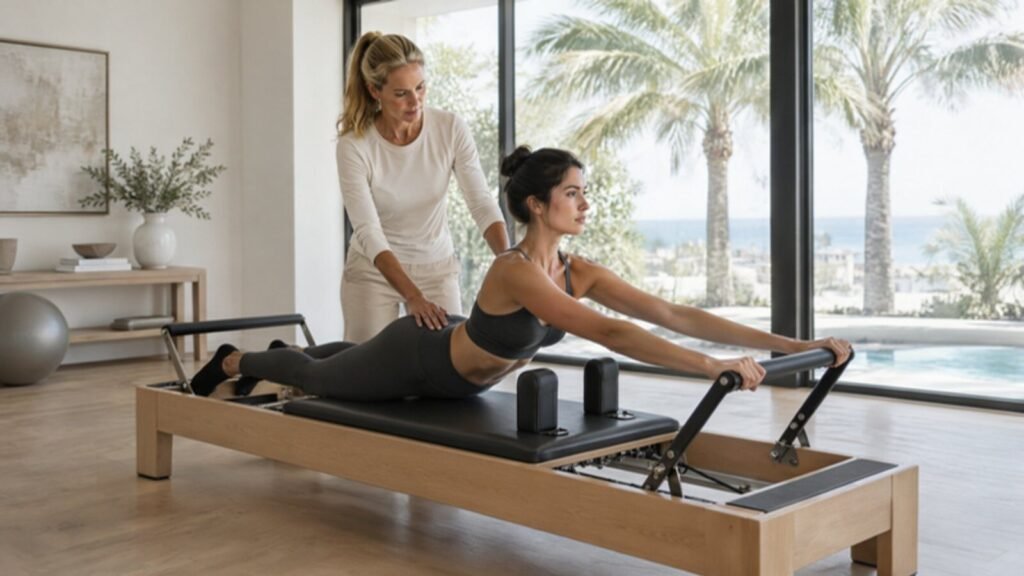
Walk through many private villas and family residences in Riyadh, Jeddah, Dubai, Abu Dhabi or Doha and you will often find a dedicated studio: a reformer by the window, a stack of mats, a few small props on a shelf. Pilates is popular with principals and family members alike. It feels controlled, it can be done quietly at home, and it suits people who want to move well rather than simply train hard. For many families, it is also a shared activity: different generations use the same studio at different times of day.
What a sports physiotherapist adds is clinical reasoning. A good instructor teaches the method; a Western-Trained physiotherapist uses it as one tool within a wider plan, chosen because of an assessment, adjusted because of an injury history and progressed because the body is ready. For a private family, that difference matters. This article explains how a live-in sports and manual therapy physiotherapist uses reformer and mat work in a private residence, how it fits alongside everything else in the family’s week, and what the role asks of the clinician.
Clinical Pilates versus a fitness class
A fitness class starts with the exercise. Clinical Pilates starts with the person. Before anyone steps onto a reformer, the physiotherapist looks at posture, movement quality, breathing, joint mobility, strength and, above all, the story behind them: the old shoulder that never quite settled, the lower back that tightens on long flights, the knee that complains after padel.
From there, exercises are selected for a reason and progressed deliberately:
- Assessment-led. Each exercise answers a question raised in the assessment, not a template.
- Clear progressions. Spring load, range, base of support and complexity are changed one at a time, so the clinician can see what the body tolerates.
- Linked to injury history. Pilates work is coordinated with soft tissue release, joint mobilisation and corrective exercise rather than sitting apart from them.
- Measured. Simple, repeatable observations show whether movement control, confidence and comfort are improving.
Pilates certifications, whether reformer, mat or a clinical Pilates course, are a genuine advantage. They are not a requirement. What a family needs first is a sports physiotherapist with sound clinical judgement; the Pilates skills sit on top of that foundation.
Where it fits in the family’s week
In a private household, Pilates rarely stands alone. A typical week for an active principal might include strength sessions in the home gym, a racket sport, swimming, and long days of meetings or travel. The physiotherapist’s task is to make the pieces fit together.
Reformer and mat work often sits naturally between heavier days: a session focused on breathing and deep trunk control the morning after a demanding strength workout, or a mobility-led session before an evening match. It complements a structured stretching programme, assisted stretching and active mobility work, and it gives a quiet, focused setting for breathing and core control, proprioception and balance.
Load management matters. The clinician keeps an eye on the whole week, not only on the hour in the studio, so that Pilates supports recovery and performance rather than becoming one more source of fatigue. When the family’s schedule changes, as it often does, the plan changes with it.
Reformer, mat and small equipment in a home studio
Many residences already have a reformer, sometimes a full studio. Others have a corner of the gym that could become one. A sports physiotherapist who understands the equipment can help the family’s office decide what is genuinely useful: a well-maintained reformer, good mats, a chair or barrel if space allows, and small props such as resistance bands, small balls, foam rollers and a ring.
Setting up the space is part of the work. Floor surface, lighting, temperature, ventilation, storage and privacy all affect how sessions feel. Equipment needs regular checks, especially springs and straps, and the clinician keeps it in good order alongside the rest of the treatment kit.
Then there is travel. Families move between homes in the Gulf, Europe and beyond, and a reformer does not fit in a suitcase. The answer is a mat-based version of the same programme, built in advance, with bands and small props that pack easily. Our article on the portable clinic and travelling physio equipment looks at how to keep a programme going wherever the family is staying.
Pilates for different family members
One of the pleasures of the role is that the same studio can serve very different people. The physiotherapist adapts the approach to each family member, always within the plan agreed with the family’s doctor where a medical question is involved. The examples below are general; they are not protocols.
A principal with back pain
Picture a principal whose lower back stiffens after long flights and long meetings. The physiotherapist assesses, works with manual therapy where appropriate, and uses Pilates to build movement confidence, trunk control and tolerance for sitting and travel. Any red flags or medical decisions go straight to the family’s doctor.
Post-natal women’s health
Many women in private families enjoy returning to exercise through Pilates after pregnancy. Timing and content are always agreed with her doctor, and the physiotherapist works within that agreement. Gentle, progressive work on breathing, posture and general strength can support a return to activity, with the pace set by how she feels and by her doctor’s guidance.
Older relatives and balance
For older family members, mat and reformer work can be adapted for balance, mobility and confidence in daily movement. Sessions are calm, unhurried and respectful, often shorter, and always aligned with any guidance from the family’s doctor.
Teenagers in sport
Teenagers who play tennis, football, ride or swim competitively can benefit from Pilates as part of a broader approach to movement quality, body awareness and injury prevention, coordinated with their coaches and agreed with their parents.
Working with the family’s Pilates instructor or trainer
Some families already have a Pilates instructor, a personal trainer or a strength coach. The physiotherapist is not there to replace anyone. The aim is a team that works well together, with clear roles: the clinician assesses, manages injuries and sets the boundaries of what is safe and appropriate; the instructor or trainer delivers sessions within that framework and brings their own expertise.
Good communication makes this work. Brief, discreet updates, agreed with the family’s office, keep everyone aligned without overloading the principal. Where questions are medical, they go to the family’s doctor. Our article on working alongside the family’s personal trainer, coach and doctor explores these relationships in more depth.
A hypothetical case
Picture a principal’s wife in Jeddah who wants to return to exercise after pregnancy. With her doctor’s agreement, the physiotherapist begins with gentle reformer sessions in the home studio: breathing, posture, gradual strength, at a pace she sets and her doctor approves. Over the following months, the sessions build steadily, and she grows more confident in her body.
In the summer, the family travels to London. Before departure, the physiotherapist prepares a mat-based version of the programme, with bands and a few small props, so that nothing is lost while they are away. The long-haul flight itself needs a plan, and our article on travel recovery after long-haul flights covers how a physiotherapist helps the family arrive feeling ready. Throughout, every decision about her recovery remains with her doctor.
Discretion in a home studio
A home studio is a private space. Sessions happen in the family’s residence, sometimes in the principal’s own rooms, and the physiotherapist sees family life at close quarters. Discretion is therefore part of the clinical skill set: no photographs, no social media, no conversation about the family outside the agreed channels, and careful handling of all health information.
It also means reading the room. Some family members prefer a quiet, focused session; others enjoy conversation. The clinician adapts, stays professional, and keeps clear boundaries. Our article on discretion with high-profile clients looks at what this means day to day.
Who we look for
We look for Western-Trained sports and manual therapy physiotherapists, trained in the UK, Europe, Australia, New Zealand, the United States or Canada. What counts is where you trained, not your nationality. Confident use of Pilates within clinical practice is welcome, alongside soft tissue release, assisted stretching, joint mobilisation, corrective exercise, movement analysis and injury prevention.
Roles are permanent, live-in and single-status: you relocate on your own and travel with the family between their homes and countries. Experience with elite athletes, professional teams or high-profile clients is a strong advantage.
The salary is from £60,000 a year gross, depending on experience, with free private accommodation, flights and travel paid, and medical insurance covered. Professional indemnity insurance is not included. The salary is agreed directly between the family and the clinician; each clinician should take advice from their own tax adviser on whether the income is taxable in their circumstances.
Medical Staff Talent introduces and verifies clinicians. The engagement is contracted directly between the family and the clinician, and all local arrangements (visa, licensed entity, coordination with local clinics) remain with the family’s own office and advisers.
See our current sports physiotherapist job. For further reading, explore training and recovery in Gulf heat.
Frequently asked questions
Do I need a Pilates certification?
It is an advantage, not a requirement. A reformer, mat or clinical Pilates qualification is welcome, but families look first for a sports and manual therapy physiotherapist with sound clinical judgement.
Will I only teach Pilates?
No. Pilates is one tool within sports and manual physiotherapy. The role also includes assessment, soft tissue release, joint mobilisation, assisted stretching, corrective exercise, injury prevention and support during travel.
Who can apply?
Physiotherapists with a degree from the UK, Europe, Australia, New Zealand, the United States or Canada, and current registration in the country where they trained. What counts is where you trained, not your nationality.
What is the salary?
From £60,000 a year gross, depending on experience, with free private accommodation, flights and travel paid, and medical insurance covered. Professional indemnity insurance is not included. The salary is agreed directly between the family and the clinician; each clinician should take advice from their own tax adviser on whether the income is taxable in their circumstances.
Send your CV in confidence
If this is the kind of work you want to do, send your CV in confidence. Every CV is read personally.
Send your CV in confidence
