
By David Vilchez, Founder & CEO, Medical Staff Talent
→ Sports Physiotherapist (Manual & Movement Therapy) — Private Family, Dubai
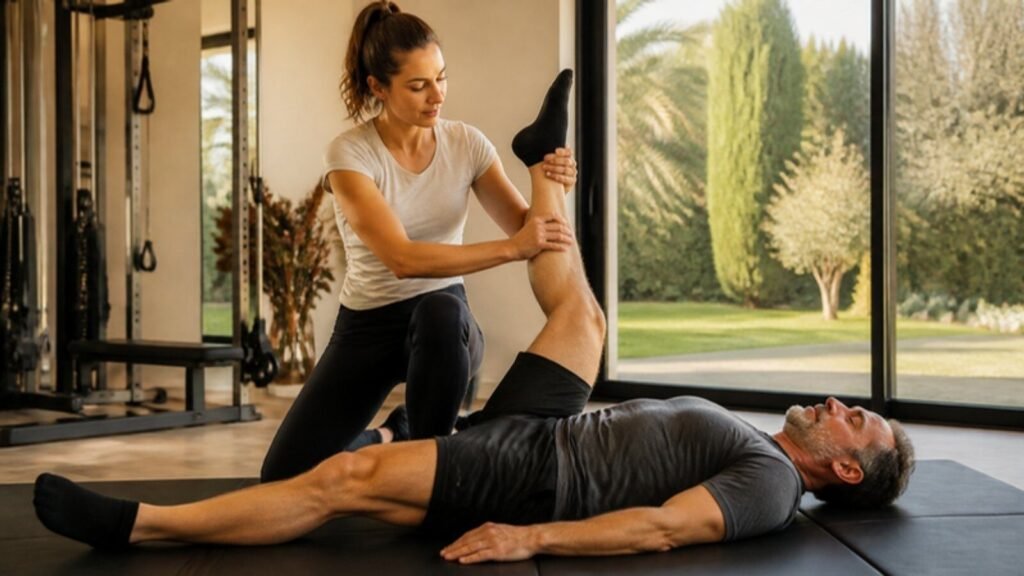
Balance and proprioception training is usually filed under sports rehabilitation: the ankle sprain, the reconstructed knee, the athlete learning to trust a limb again. In a private family role in Saudi Arabia, the UAE or Qatar, the same skills reach much further. On a single day, a sports physiotherapist may sharpen the footwork of a principal who plays padel, rebuild confidence in an older relative who has become wary of stairs, and help a teenager who is growing quickly to stay coordinated on the tennis court.
This article explains why balance and proprioception work sits at the centre of so many private family roles, how it is adapted across generations, and how to show this experience when you apply. It is written for physiotherapists trained in the UK or anywhere in Europe with a sports and manual therapy background. Where we describe a situation, it is a hypothetical example, not an account of a real person or placement.
Medical Staff Talent in one line: “Exclusively sourcing UK & European-trained Private & Concierge Physicians, Physiotherapists & Osteopaths, and Private & Maternity Nurses for Private Families across the GCC.”
Why balance matters so much in a private household
A private family is a small, mixed group of people who share one physiotherapist. Their needs differ widely, yet balance runs through almost all of them. For an active principal, good proprioception means quicker reactions on the court and fewer niggles after a weekend of sport. For a rider or a skier, it means control on uneven or moving ground. For an older family member, it can mean independence: walking in the garden, managing steps on a terrace or boarding a boat without a second thought.
Families rarely ask for “proprioceptive training” by name. They ask for someone who will keep a parent steady on their feet, help a principal move well into their sixties and support children who are training seriously. A physiotherapist who can see the common thread, and adapt one set of principles to very different people, is exactly what they are looking for.
For a full overview of the role itself, read our guide to sports physiotherapist jobs with private families in the Gulf.
From the athlete to the grandparent: one skill set, three adaptations
1. Performance and injury prevention for active adults
Here the work looks familiar to anyone from club or elite sport: single-leg control, reactive balance, landing mechanics, change of direction and perturbation drills, progressed from stable to unstable surfaces and from slow to sport-specific speeds. Padel, tennis, golf, riding, skiing and sailing each place their own demands on the ankle, knee, hip and trunk, and the programme follows the family’s sporting calendar.
Because time is short, drills tend to be brief and woven into a warm-up, a recovery session or hands-on work. Our article on sport-specific physiotherapy for padel, tennis, golf and riding describes how this fits around each sport.
2. Steadiness and confidence for older family members
With an older relative, the same principles serve a different goal: staying steady, confident and independent at home and while travelling. Typical elements include static and dynamic balance work, gait and turning practice, sit-to-stand and step training, ankle and hip strength, and reaction practice in everyday settings such as getting in and out of a car or moving between rooms with different floor surfaces.
Falls prevention for older people is a well-established field. In the UK, for example, NICE publishes guidance on falls assessment and prevention in older people, and the World Health Organization keeps a fact sheet on falls. A physiotherapist does not need to quote either to a family, but a sound grasp of current evidence shows in the way the programme is screened, dosed and explained.
Careful screening matters here. Dizziness, unexplained falls, new neurological signs or changes in medication go to the family’s doctor first. The physiotherapist works within their own scope of practice and within the plan agreed with the family’s medical advisers.
3. Coordination for children and teenagers in training
Young people who train seriously go through growth spurts that can briefly upset coordination. Short, playful proprioception and movement-control sessions can help them stay comfortable and well organised while they grow. This work is always agreed with the parents and fits within the plan of any coach the family already uses.
How the work compares across the household
| Family member | Main goal | Typical content | What makes it work |
|---|---|---|---|
| Active principal or spouse | Performance and injury prevention | Single-leg and reactive drills, landing and change of direction | Short sessions linked to the sporting calendar |
| Rider, skier or sailor | Control on uneven or moving ground | Trunk control, unstable-surface work, hip and ankle strategy | Drills that echo the real activity |
| Older relative | Steadiness, confidence and independence | Gait, turning, sit-to-stand, step practice, strength | Careful screening, patience and clear explanation |
| Child or teenager in training | Coordination during growth | Playful balance and movement-control games | Agreement with parents and coach |
Balance work on the move
Private families travel continuously, and their physiotherapist travels with them. A programme that depends on a fully equipped gym will not survive a month of residences, hotels, resorts and yachts. The physiotherapists who do well design routines that need very little: a folded towel or a foam pad, a doorway, a step, a resistance band and a clear floor.
Travel also changes what the body needs. After a long flight, stiffness in the ankles, hips and back can blunt balance for a day or two. On a yacht, the deck itself becomes a balance challenge, and older family members may need extra support to move safely around it. Arriving in a new house means new stairs, new floor surfaces and new lighting, all of which matter for someone who is less steady on their feet. Thinking ahead about these small changes is part of the job.
A hypothetical day built around balance
Picture a family spending the spring in Riyadh before travelling to Europe for the summer. Early in the morning, the physiotherapist takes an older relative through fifteen minutes of gait and turning practice in a quiet corridor of the residence, followed by sit-to-stand work and a short walk in the garden. Mid-morning, the principal has a brief assisted stretching session and a set of single-leg and reactive drills before a day of meetings. In the afternoon, a teenage member of the family does a playful coordination circuit agreed with the tennis coach. In the evening, before padel, the principal’s warm-up includes quick footwork and landing drills; afterwards, there is a short session of soft tissue work.
The following week, the family moves to a villa in the Mediterranean. The physiotherapist checks the stairs, the pool surround and the routes the older relative uses every day, and adapts the programme to the new setting. Nothing dramatic happens, and that is the point.
How families assess balance and proprioception experience
Families cannot watch you work before an introduction, so they rely on how clearly you describe it. The strongest applications usually:
- Name the work precisely. Reactive balance training, perturbation drills, landing mechanics, gait retraining and falls-prevention programmes say far more than “rehabilitation”.
- Show the range. Experience with both athletes and older adults is particularly valuable, because a household often includes both.
- Show the setting. Work with elite athletes, professional or national teams or high-profile private clients shows that you can deliver a high standard with discretion.
- Show the reasoning. A line on how you combine hands-on work, balance and movement control shows that results last beyond the session.
Our article on the hands-on skills private families ask for explains how manual therapy and movement control fit together, and our piece on elite-sport physiotherapists in private family roles explains how experience with athletes is weighed, and our guide for club and national-team physiotherapists moving to a private family sets out which team-sport skills transfer. If you are preparing to start, our guide to your first 90 days in a live-in physiotherapist role describes how an appointment usually begins.
What families look for
- A physiotherapy qualification obtained in the UK or Europe, with current registration in the country of training. What counts is where you trained, not your nationality.
- A strong sports and manual therapy background: soft tissue release, assisted stretching, active mobility and joint mobilisation, neuromuscular and movement control, corrective exercise, movement analysis and biomechanical assessment, injury prevention, breathing and core control, proprioception and balance.
- Experience with elite athletes, professional teams or high-profile clients is a strong advantage.
- Availability to start within about six weeks and complete flexibility.
- Readiness to live with the family and travel continuously with them across several countries. Every role is live-in and single-status: partners and children do not relocate with you.
What the role offers
- A permanent, live-in appointment with the family, with annual leave.
- From £60,000 a year gross, depending on experience.
- Free private accommodation in the residence.
- Flights and travel always paid for by the family.
- Medical insurance covered. Professional indemnity insurance is not included.
The salary is agreed directly between the family and the clinician; each clinician should take advice from their own tax adviser on whether the income is taxable in their circumstances.
How the introduction works
Medical Staff Talent introduces and verifies clinicians. The engagement is contracted directly between the family and the clinician, and all local arrangements (visa, licensed entity, coordination with local clinics) remain with the family’s own office and advisers.
You can read more about the profession on our physiotherapists page and see the current role on our sports physiotherapist vacancy.
Frequently asked questions
Do I need a specialist qualification in balance or falls prevention?
No. It helps to have relevant courses or experience, but what matters most is a strong sports and manual therapy background and the ability to adapt balance and proprioception work to very different people.
Will I work with older family members as well as athletes?
Often, yes. Many households include an older relative alongside active adults and children, so experience across age groups is a real advantage.
What equipment do I need for balance work while travelling?
Very little. Most programmes rely on simple tools such as a foam pad, a step and a resistance band, plus a clear floor. The family pays for flights and travel.
Can I apply if I trained in Europe but hold a different nationality?
Yes. What counts is where you trained, not your nationality. You need a physiotherapy qualification obtained in the UK or Europe and current registration in the country of training.
Can my partner or children come with me?
No. Every role is live-in and single-status, so partners and children do not relocate with you.
How do I apply?
Send your CV in English through our confidential online form. Please do not send it as an email attachment.
Apply in confidence
If you are a UK or European-trained physiotherapist with strong balance, proprioception and manual therapy skills, can start within about six weeks and are ready to relocate alone and travel with a family, we would like to hear from you. Send us your CV in confidence.
Read next: injury prevention for active private families: skiing, sailing, riding and padel.
Send your CV in confidence