By David Vilchez, Founder & CEO, Medical Staff Talent
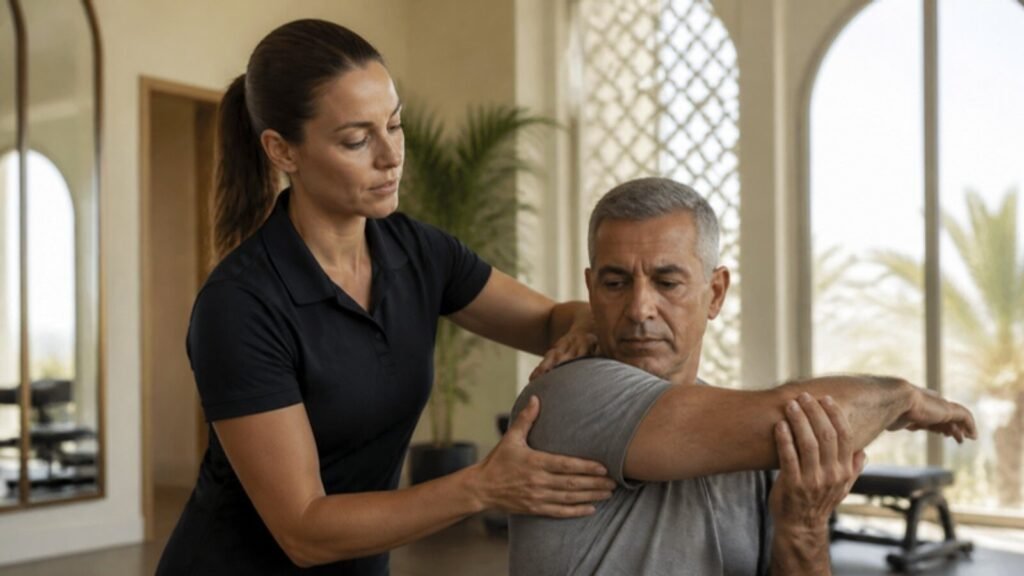
→ Sports Physiotherapist (Manual & Movement Therapy) — Private Family, Dubai
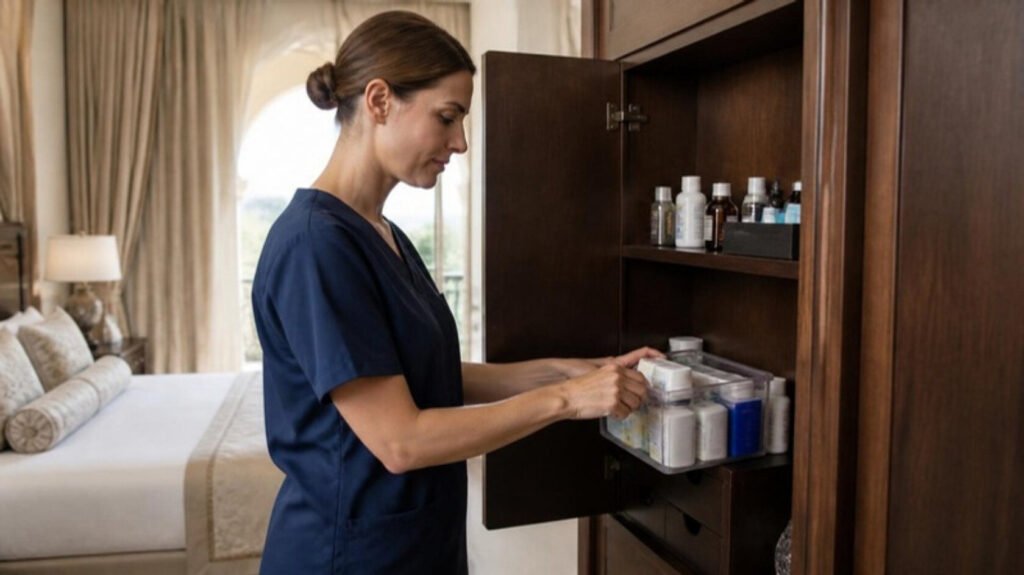
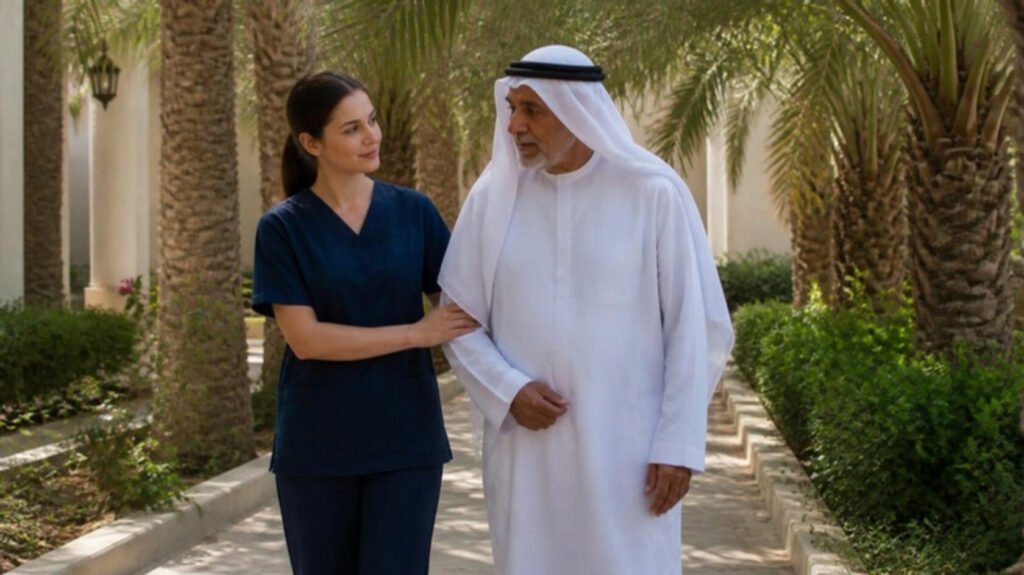
Most clinicians in Germany who write to us picture a Gulf hospital: a larger department, a new ward, a different healthcare system. Our appointments are something else entirely. They are permanent, live-in roles with one private family in Saudi Arabia, the UAE or Qatar. This article is for nurses, physiotherapists, osteopaths and doctors trained in Germany and working in a Krankenhaus within the statutory health insurance system (gesetzliche Krankenversicherung, GKV) or in private practice, who want to understand what really changes when the patient is a single household.
Medical Staff Talent in one line: Exclusively sourcing Western-Trained Private & Concierge Physicians, Physiotherapists & Osteopaths, and Private & Maternity Nurses for Private Families across the GCC.
For the wider picture across Europe, see our guide for European-trained clinicians.
Why a private family is a different decision from a Gulf hospital
A hospital move changes your employer and your city. A private family appointment changes the shape of your working life. There is no department, no rota coordinator, no Oberarzt down the corridor and no Stationsleitung to escalate to. There is one household, a small number of people whose health you know in depth, and a family office that organises everything around them. The clinical standard you trained to in Germany stays the same; the setting in which you apply it does not.
From a German ward or practice to one household: caseload, autonomy, documentation
Caseload. On a German ward you may care for many patients in a shift. In a household you care for one patient, or a handful of family members, every day. The work is deeper rather than wider: continuity of care, prevention, rehabilitation, routine monitoring and early recognition of change.
Clinical autonomy. You will often be the only clinician present. Judgement, precision and calm decision-making matter more than speed. You coordinate with the family’s own physicians and specialists when needed, and you must know exactly where your competence ends.
Documentation. German clinical documentation habits translate very well. In a household, records are kept with the same rigour, but stored and shared with strict discretion, often only with the family’s designated physician or office.
German healthcare vs private family practice in the Gulf
| Aspect | Krankenhaus or practice in Germany | Private family practice in the Gulf |
|---|---|---|
| Caseload | Many patients per shift or clinic list | One patient or a few family members |
| Team | Multidisciplinary department, hierarchy, handovers | You, a nursing partner where relevant, the family’s physicians and office |
| Autonomy | Defined by department protocols and seniority | High; you are often the only clinician in the room |
| Documentation | Hospital or practice systems, GKV billing requirements | Private clinical records, shared only on a need-to-know basis |
| Hours | Shifts and rotas set by the employer | Shaped by the family’s timetable; availability is part of the role |
| Where you live | Your own home | In the family’s residence, accommodation fully free |
| Travel | Rare, and outside work | Frequent, with the family, as part of the work |
| Confidentiality | Professional secrecy | Professional secrecy plus a strict non-disclosure agreement |
Travelling with the family
Families move between their residences and travel often: summers in Europe, trips on a private jet, time on a yacht. Your role travels with them. The family arranges and pays the visas for international travel. It is important to see travel clearly for what it is: work. You are on duty in a hotel suite in London or on board in the Mediterranean exactly as you are at home in Riyadh, Abu Dhabi or Doha.
Discretion and non-disclosure agreements
Every appointment involves a non-disclosure agreement. You will not discuss the family, their health, their homes or their movements with anyone, including on social media. German clinicians are used to strict professional secrecy; a private household asks for the same habit, applied to everything you see and hear, not only to clinical information.
What private families require from day one
Three conditions apply to every appointment:
- Start within about six weeks. Families usually need someone quickly. Check your notice period (Kündigungsfrist) in your contract or collective agreement, and, if you want to keep a right to return, whether your employer would grant unpaid leave.
- Total flexibility. Plans change at short notice: a trip moves, a guest arrives, a family member needs more care.
- Relocate alone and travel with the family at any time. Every role is live-in and single-status. Partners and children do not relocate with you.
For more detail, read what a live-in, single-status appointment means in practice.
Leaving the German system well: what to settle before you go
None of what follows is legal or tax advice. These are the points German-trained clinicians most often need to look at, with the official sources to check.
Unpaid leave and a right to return
If your employer applies the TVöD or the TV-L, § 28 provides for Sonderurlaub: employees may be granted special leave without pay (unter Verzicht auf die Fortzahlung des Entgelts) where there is an important reason. It is a discretionary provision, not an entitlement, and the employer weighs your interests against operational needs. Private and church employers have their own rules. Confirm with your HR department, your works council or your union before you resign or apply.
Your professional registration
Doctors. Your Approbation is the basis of practice in Germany. Membership of your Landesärztekammer depends on practising, or living, in that Land; the Ärztekammer Berlin, for example, explains that membership ends automatically when those conditions are no longer met and that you must report the end of practice or a change of residence within one month. Rules differ between the 17 chambers, and continuing medical education (Fortbildung) remains your responsibility. Confirm with your own Landesärztekammer.
Nurses. Under the Pflegeberufegesetz, using the title Pflegefachfrau or Pflegefachmann requires a permission (Erlaubnis), documented in your Berufsurkunde. Keep the original and certified copies with you. Where a nursing chamber exists, such as the Landespflegekammer Rheinland-Pfalz, confirm with the chamber how to report your move.
Physiotherapists. The title Physiotherapeutin or Physiotherapeut is protected under the Masseur- und Physiotherapeutengesetz and requires an Erlaubnis. Keep your certificate and transcripts in order.
Osteopaths. Osteopathy is not a separately regulated profession in Germany. A Bundestag research paper notes that, following a 2015 Düsseldorf court ruling, it is treated as Heilkunde, which in Germany requires either an Approbation or a Heilpraktiker permission under the Heilpraktikergesetz. Families look for clinicians whose German qualifications and permissions are clearly documented. Confirm your own status with your professional association or adviser.
Your tax residence in Germany
Unlimited income tax liability (§ 1 EStG) follows a residence (Wohnsitz, § 8 AO) or habitual abode (gewöhnlicher Aufenthalt, § 9 AO) in Germany. Keeping a flat in Germany that you could use can be enough to keep you resident, even if you live abroad. Deregister with your local registration office (Meldebehörde) within two weeks of moving out, under § 17 BMG.
Two rules deserve particular attention. First, § 1 Abs. 2 EStG keeps certain German nationals fully taxable abroad, but it concerns people paid from German public funds, not private family appointments. Second, and more relevant, § 2 AStG (extended limited tax liability) can apply for ten years after you leave if you were taxable in Germany as a German national for at least five of the last ten years, move to a low-tax country and keep substantial economic interests in Germany. Low taxation is defined in the law by comparison with the German burden, which makes this rule directly relevant to a move to the Gulf. Confirm with a German tax adviser (Steuerberater) before you move, and see our page on wealth preservation for GCC clinicians.
Your state pension
Under § 7 SGB VI, Germans whose habitual residence is abroad can pay voluntary contributions to the Deutsche Rentenversicherung. For 2026, the Deutsche Rentenversicherung gives a monthly range of 112.16 to 1,571.70 euros, and contributions for a year can be paid until 31 March of the following year. EU social security coordination covers the EU, Iceland, Liechtenstein, Norway and Switzerland, not the Gulf, and Germany’s list of bilateral social security agreements does not include the UAE, Saudi Arabia or Qatar. Confirm your own position with the Deutsche Rentenversicherung.
Your registration while you are away. You can keep your home registration active through years with one family if you plan it from the start. Read how many years, what counts as practice, and the pros and cons, and check your own situation with the Home Registration Checker.
Practising while you travel. What you may do clinically depends on the country you are in with the family. See what you can and can’t do, country by country, or check a destination with the Where Can I Practise? checker.
The three service lines
Private & Maternity Nurses. Nurses are always placed in pairs: two nurses alternating shifts of 8 or 12 hours, so care is continuous and each nurse has protected rest. Strict NDA. Experience in intensive care, paediatrics, neonatology, midwifery-adjacent maternity care or home care (ambulante Pflege) translates well. Read more about how private nursing in pairs works.
Physiotherapists & Osteopaths. Musculoskeletal, sports, neurological and post-operative rehabilitation experience, including manual therapy qualifications, is highly valued, as is the ability to run a daily programme for one person over months.
Private & Concierge Physicians. Facharzt training in internal medicine, general practice (Allgemeinmedizin), emergency medicine or anaesthesia translates well, together with the confidence to coordinate specialists across several countries.
Realistic salary bands
As market references, gross:
- Private & Concierge Physicians: £218,000 a year gross, with free accommodation and medical insurance covered (professional indemnity insurance is not included).
- Physiotherapists & Osteopaths: from £60,000 a year gross, depending on experience.
- Private & Maternity Nurses: from €5,000 a month.
The salary is agreed directly between the family and the clinician; each clinician should take advice from their own tax adviser on whether the income is taxable in their circumstances.
All roles are permanent, with annual leave. Accommodation in the residence is fully free. Medical insurance is covered; professional indemnity insurance is not included. Flights and travel are always paid for by the family. To compare your current position in euros with a Gulf package, use our home salary vs GCC gross package calculator, which includes Germany in its selector, and read our note on the Gulf cost of living for clinicians.
The honest trade-offs
- Availability. Being available around the clock and working a six-day week is normal in this work.
- Living where you work. Your home is the family’s residence. Privacy exists, but boundaries are different.
- Time off on the family’s timetable. Annual leave is taken when the household’s plans allow.
- Professional isolation. No colleagues to consult in the corridor and no Teambesprechung. You need to keep your own knowledge current.
- Distance from home. Family events in Germany will sometimes be missed.
Who it suits, and who it does not
It suits experienced, self-reliant clinicians who value depth over volume, are comfortable being the only professional in the room, and are free to relocate alone. It does not suit anyone who needs a fixed weekly schedule, wants to bring a partner or children, or depends on a large team for daily support.
Picture a physiotherapist trained in Germany, with ten years in orthopaedic and sports rehabilitation, a manual therapy qualification and no family commitments at home. She is used to precise documentation, enjoys long programmes with one patient and adapts easily to new places. A family needs daily rehabilitation for one member after surgery, at home and while travelling between their residences. This is a hypothetical profile, but it shows the kind of match families look for.
How the introduction works
Medical Staff Talent introduces and verifies clinicians. The engagement is contracted directly between the family and the clinician, and all local arrangements (visa, licensed entity, coordination with local clinics) remain with the family’s own office and advisers.
The process is simple. A family sends us a brief. We match it against clinicians we know, and speak with you in confidence. We verify your registration, references and clinical history, then introduce a small number of clinicians to the family. The family holds video interviews and makes the offer. We are not the employer and we are not a party to the contract. Your CV is never sent to a family without your agreement.
How to apply
Send your CV through the form on our website. Fluent English is required for every appointment. Prefer to read in German? See our pages in German for nurses and for physiotherapists.
Frequently asked questions
Can I keep my place in a German hospital while I work for a family?
Possibly. If your employer applies the TVöD or the TV-L, it may grant unpaid special leave (Sonderurlaub) under § 28 for an important reason, but it is discretionary, not a right. Confirm with your HR department or union.
Do I keep my Ärztekammer membership while I am abroad?
Membership of a Landesärztekammer depends on practising or living in that Land, so it may end when you move. You must report the change to your chamber. Confirm the rules with your own Landesärztekammer.
Can my partner or children come with me?
No. Every appointment is live-in and single-status, and you travel with the family at any time.
How much will I be paid?
As market references, gross: Private and Concierge Physicians £218,000 a year gross with free accommodation and medical insurance covered (professional indemnity insurance is not included); Physiotherapists and Osteopaths from £60,000 a year gross, depending on experience; Private and Maternity Nurses from €5,000 a month. The salary is agreed directly between the family and the clinician; each clinician should take advice from their own tax adviser on whether the income is taxable in their circumstances.
Will I travel with the family?
Yes. Families travel often, including summers in Europe, private jets and yachts. The family arranges and pays the visas for international travel, and travel is part of the work.
Is Medical Staff Talent my employer?
No. Medical Staff Talent introduces and verifies clinicians. The engagement is contracted directly between the family and the clinician, and all local arrangements (visa, licensed entity, coordination with local clinics) remain with the family’s own office and advisers.
Apply in confidence
If you are trained in Germany, experienced, discreet and free to relocate alone, we would like to hear from you. Send your CV through our secure CV form. On request, I can also send you personally our guide Private Household Appointments: A Guide for Western-Trained Clinicians.
Sources: § 1 EStG; § 8 AO; § 9 AO; § 2 AStG; § 17 BMG; § 7 SGB VI; Deutsche Rentenversicherung: freiwillige Beiträge; Deutsche Rentenversicherung: Sozialversicherungsabkommen; European Commission: EU social security coordination; Ärztekammer Berlin: Kammermitgliedschaft; Bundesärztekammer; § 1 Pflegeberufegesetz; § 1 Masseur- und Physiotherapeutengesetz; § 1 Heilpraktikergesetz; Deutscher Bundestag, Wissenschaftliche Dienste: Berufsbild des Osteopathen; TVöD and TV-L, § 28 Sonderurlaub.