By David Vilchez, Founder & CEO, Medical Staff Talent
→ Sports Physiotherapist (Manual & Movement Therapy) — Private Family, Dubai
More of the family briefs we see now mention a road bike, a running club or a first triathlon. A principal who took up cycling a few years ago is now riding long distances every weekend. A spouse is training for a marathon abroad. A teenager swims with a club and has started to race. Endurance sport has become part of family life for many households in the Gulf, and with it comes a clear need: someone who understands how these athletes load their bodies, and who can keep them training, recovering and travelling to events without breaking down.
This article is for anyone who has worked as a physiotherapist for cyclists, runners or triathletes, whether with clubs, national programmes or amateur athletes, and who is considering a live-in role with a private family in Saudi Arabia, the United Arab Emirates or Qatar. It explains what the work looks like, how it fits alongside a coach, and what the role asks of you.
Why endurance sport appears in family briefs
Endurance sport suits busy, driven people. It can be trained early in the morning, fitted around travel and measured precisely. Many principals enjoy setting a goal, a sportive, a marathon or a half-distance triathlon, and working towards it over months.
That kind of goal changes what a family wants from its physiotherapist. They are not only looking for someone to treat a sore back after a long flight. They want a clinician who understands training load, recognises early warning signs, works with the coach rather than against them, and helps an adult athlete keep going year after year. If you have spent time around cyclists, runners or triathletes, you already speak that language.
The common complaints
Endurance athletes tend to present with overuse problems rather than single traumatic injuries. You will recognise the pattern: pain that builds with distance, settles with rest and returns when training ramps up.
In cycling, families often ask about knee pain, hip and lower back discomfort on long rides, and neck or hand symptoms linked to position on the bike. In running, the usual questions concern the Achilles tendon, the sole of the foot, the knee and the hip. In swimming, the shoulder is the classic concern. Triathletes, of course, can bring all three.
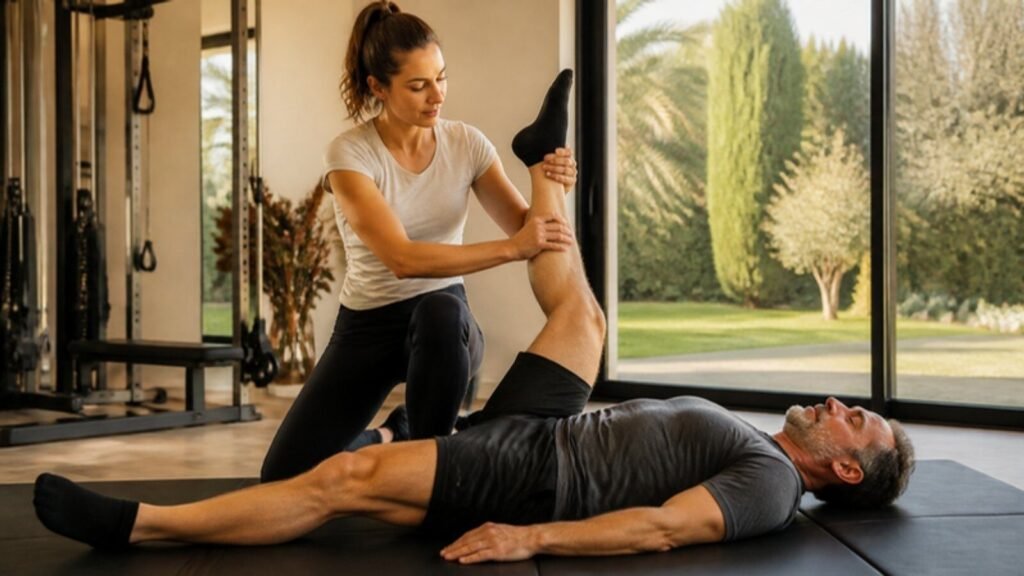
Your role is the one you already know: assess carefully, reason clinically, treat with your hands and with exercise, and adjust the plan as the athlete responds. When a symptom falls outside physiotherapy or does not behave as expected, you raise it discreetly with the family’s doctor. Families value a physiotherapist who knows where their scope ends as much as one who knows what to do within it.
Bike fit, running form and load
Working with the family’s bike fitter or coach
Many endurance-minded principals already have a coach, and some have a bike fitter they trust. You are not there to replace either of them. The coach writes the training plan; you bring the clinical side: assessment, treatment, movement analysis and the judgement to say when a niggle needs a change of plan.
Bike-fitting experience is useful, because position on the bike is often part of the story when a cyclist has knee, hip or back symptoms. Even if you do not fit bikes yourself, being able to observe a rider, discuss position sensibly with the fitter and connect what you see to what you find on the treatment table is a real advantage. The same applies to running form and to swim technique: you observe, you assess, and you share what you find with the coach. Our article on working alongside the family’s personal trainer, coach and doctor describes how these relationships work in practice.
Load and recovery across a season of events
Endurance athletes rarely get injured because of one session. More often the problem is the pattern: weeks of steady increases, a busy period of travel, poor sleep, then a race. A physiotherapist who follows one athlete closely can see that pattern building and raise it early.
In a household, you have time to do this properly. You see the principal most days, you know their travel schedule and you can talk openly with the coach about how training is landing. Strength and mobility work, recovery between hard sessions and sensible adjustments around travel are where you add most value. Our article on injury prevention with a private family covers the broader approach.
Training in the Gulf
Early mornings and the heat
For much of the year, outdoor endurance training in the Gulf happens very early in the morning or late in the evening, when temperatures are lower. Families who train seriously plan around this, and your working day will often follow the same rhythm: an early session before a ride, treatment later in the day, and recovery work in the evening.
Heat adds load to every session, so recovery, hydration and the athlete’s own response to training all matter more. Our article on training and recovery in the Gulf heat explains what this means for the physiotherapist.
Indoor trainers and pools in the residence
Many family residences have a well-equipped gym, an indoor bike trainer, a treadmill and a pool. This makes it easier to keep training going in the hottest months, and it gives you a controlled setting to observe a rider on the bike or a runner on the treadmill. It also means that indoor sessions can be long and repetitive, which brings its own overuse risks. You help balance the week so that convenience does not quietly become overload.
Travelling to events abroad
Endurance families travel to races: a sportive in the Alps, a marathon in a European capital, a triathlon on a Mediterranean island. When they do, you travel with them. Treatment may happen in a hotel suite the night before a race and in a rented villa the day after.
Race travel brings familiar challenges: long flights shortly before an event, a change of climate, a new bed and a different routine. You help the athlete arrive ready and recover well, and you keep an eye on how the rest of the family is coping with the trip. Our article on travel and recovery with a private family goes into more detail.
A hypothetical case
Picture a principal in Dubai preparing for a first half-distance triathlon abroad, about five months away. He has a coach who writes his training plan, and a bike fitter he visited once. He trains early most mornings, travels for business twice a month and has started to notice an ache at the front of his knee on longer rides.
The physiotherapist assesses him carefully, treats the knee and builds a short strength and mobility routine he can do in hotel rooms. After watching him ride on the indoor trainer, the physiotherapist shares observations about his position with the bike fitter, and agrees with the coach to ease the longest rides for a couple of weeks. When something does not respond as expected, the physiotherapist raises it with the family’s doctor.
Over the following months, the physiotherapist travels with the family to two countries, works six days a week and is available when needed. On race weekend, they treat the principal in a hotel suite, help him through the days after the event, and spend time with a teenage family member who has just joined a swimming club. It is the same clinical reasoning they used with club athletes, applied to one family over a long season.
The role in brief
- Role: permanent, live-in, single-status. You relocate alone, live in private accommodation provided by the family and travel with them.
- Rhythm: a six-day week, with availability around the clock when the family needs you.
- Package: from £60,000 a year gross, depending on experience, with accommodation, flights and medical insurance covered. Professional indemnity is not covered, so check your own cover before you go.
- Tax: the salary is agreed directly between the family and the clinician; each clinician should take advice from their own tax adviser on whether the income is taxable in their circumstances.
- Confidentiality: you sign the family’s NDA together with your contract with the family.
- Where: private families based in Saudi Arabia, the UAE and Qatar.
Who we look for
We introduce Western-Trained physiotherapists, trained in the UK, Europe, Australia, New Zealand, the United States or Canada, with a sports or manual therapy background. For endurance-minded families, these are the strengths that stand out:
- Experience with cyclists, runners, swimmers or triathletes, at club, national-team or committed amateur level.
- Strong manual therapy and exercise-based rehabilitation: soft tissue release, joint mobilisation, assisted stretching, corrective exercise and movement analysis.
- An understanding of training load and recovery, and the confidence to discuss it with a coach.
- Bike-fit awareness, gait or running analysis, or swim technique knowledge.
- Experience with elite athletes, professional teams or high-profile clients is a strong advantage.
- Comfort with travel, early starts and a life built around one household.
For an overview of what families ask for, see our page for physiotherapists.
How an introduction works
Medical Staff Talent introduces and verifies clinicians. The engagement is contracted directly between the family and the clinician, and all local arrangements (visa, licensed entity, coordination with local clinics) remain with the family’s own office and advisers.
Frequently asked questions
Do I need endurance-sport experience?
It is a strong advantage for families who cycle, run or race triathlon, because you will understand how these athletes train and where they tend to break down. Strong sports or manual therapy skills and sound clinical reasoning matter most.
Will I coach the training plan?
No. The coach writes the training plan. You bring the clinical side: assessment, treatment, movement analysis and the judgement to raise it when training load needs to change. You work alongside the coach, not in place of them.
Do families travel to races?
Yes. Endurance families often travel to events abroad, and you travel with them. Treatment may take place in a hotel suite before a race and in a rented residence afterwards.
Is bike-fitting experience useful?
Yes. Position on the bike is often part of the picture when a cyclist has knee, hip or back symptoms. Even without formal bike-fitting training, being able to observe a rider and discuss position with the family’s bike fitter is valuable.
What is the salary?
From £60,000 a year gross, depending on experience, with accommodation, flights and medical insurance covered. Professional indemnity is not covered. The salary is agreed directly between the family and the clinician; each clinician should take advice from their own tax adviser on whether the income is taxable in their circumstances.
Send your CV in confidence
If you are a Western-Trained sports physiotherapist with experience in cycling, running or triathlon, ready for a live-in role with a private family in Saudi Arabia, the UAE or Qatar, send your CV in confidence.
Send your CV in confidence