
By David Vilchez, Founder & CEO, Medical Staff Talent
→ Sports Physiotherapist (Manual & Movement Therapy) — Private Family, Dubai
Most clinicians in the Netherlands who write to us picture a Gulf hospital: a large department, a familiar rota, a new skyline. Our appointments are something else entirely. They are permanent, live-in roles with one private family in Saudi Arabia, the UAE or Qatar. This article is for nurses, physiotherapists, osteopaths and doctors trained in the Netherlands and working in the Dutch healthcare system or in private practice, who want a clear, honest picture before they decide.
Medical Staff Talent in one line: Exclusively sourcing Western-Trained Private & Concierge Physicians, Physiotherapists & Osteopaths, and Private & Maternity Nurses for Private Families across the GCC.
Why a private family is a different decision from a Gulf hospital
A hospital post abroad is still a hospital post: a department, a manager, colleagues on the next shift, a defined patient list. A private family appointment has none of that structure. You work for one household. There is no department to absorb a difficult day and no colleague down the corridor. Your patient may be one person, or a small number of family members, and the family’s private office is your point of contact for everything that is not clinical.
That changes the decision. The question is not “Do I want to work in the Gulf?” but “Do I want to be the clinician for one family, live in their residence and travel with them?” If the answer to the second question is yes, the rest tends to follow. If it is no, a Gulf hospital is the better path, and we will say so.
From a Dutch ward or practice to one household
Caseload. In a Dutch hospital, care organisation or practice you may see many patients in a shift. In a household, you look after very few people, in depth. Continuity of care replaces throughput.
Clinical autonomy. You will often be the only clinician present. You make decisions, escalate to the family’s physicians and specialists when needed, and own the plan. Precision and judgement matter more than speed.
Documentation. Records are still essential, but they are kept discreetly and to the standard you would apply at home. Clear, concise notes are what allow specialists, other clinicians and the family’s office to trust your work.
Dutch healthcare vs private family practice in the Gulf
| Aspect | Dutch healthcare (hospital, care organisation or practice) | Private family practice in the Gulf |
|---|---|---|
| Caseload | Many patients per shift or clinic | One family; one or a few patients, in depth |
| Team | Multidisciplinary team on site | Often the only clinician present; nurses work in pairs |
| Autonomy | Protocols, hierarchy, shared decisions | High clinical autonomy, with escalation to the family’s specialists |
| Documentation | Institutional systems | Discreet records to your professional standard |
| Hours | Scheduled rotas | Availability around the family’s needs; six-day week common |
| Where you live | Your own home | Live-in, in the family’s residence, accommodation fully free |
| Travel | Rare, for conferences | Constant, with the family, across several countries |
| Confidentiality | Professional duty of confidentiality | Professional duty plus a strict NDA |
Travel with the family
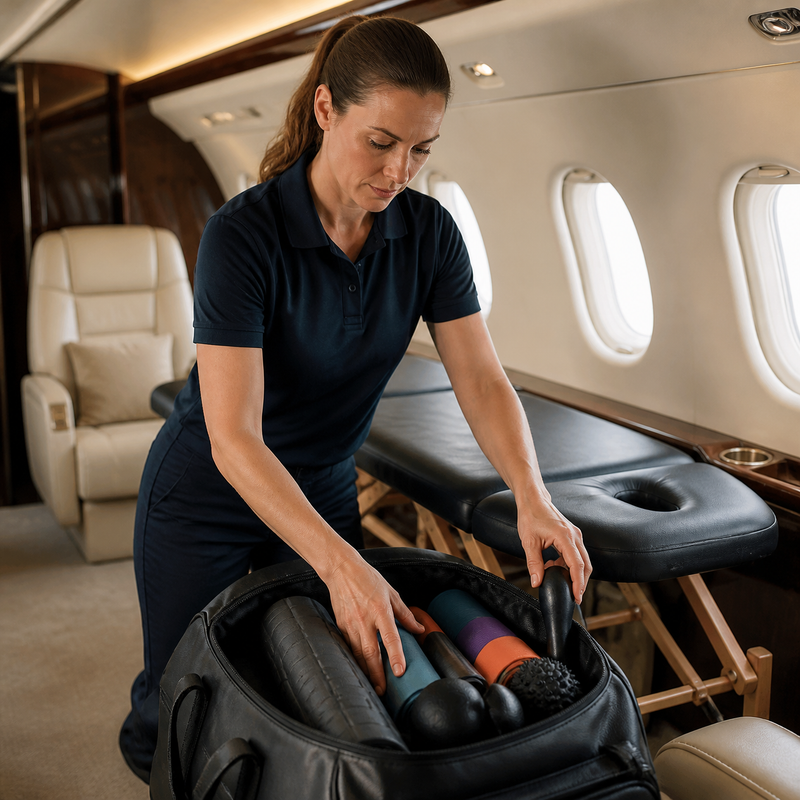
From the day you start, you travel with the family. Summers are often spent in Europe; there may be private jet flights between residences and weeks aboard a yacht. The family arranges and pays the visas for international travel. It is important to be clear: travel is work. You are there as their clinician, not as a guest, and your routine moves with them.
Discretion and NDAs
Every appointment comes with a strict non-disclosure agreement. You do not post about the family, their homes or their travel, and you do not discuss them with friends or former colleagues. Discretion is not a formality in this work; it is the reason families trust a clinician enough to bring them into their home.
What private families require from day one
Three conditions apply to every appointment:
- Start within about six weeks. Families usually need someone soon. Check your notice period in your employment contract and collective agreement (cao) now, so you know what is realistic.
- Total flexibility. Plans change with the family’s diary. Your days follow theirs.
- Relocate alone and travel with the family at any time. Every role is live-in and single-status. Partners and children do not relocate with you.
Leaving Dutch healthcare well: what to settle before you go
These points are general information, checked against official Dutch sources. Your own situation may differ, so confirm each one with the relevant body or your own adviser.
Your current post and any right to return
Whether you can take unpaid leave or keep a route back to your current employer depends on your employment contract and the collective agreement (cao) that applies to you. Ask your employer and HR department in writing what is possible before you resign, and confirm the terms with your employer or your own adviser.
Keeping your BIG registration
Doctors (arts), nurses (verpleegkundige) and physiotherapists (fysiotherapeut) are among the professions that must be registered in the BIG-register to use their protected title. According to the government’s guidance on BIG registration, you must re-register every five years and show enough hours of work experience or training; each profession has its own requirements. If you do not re-register in time, your registration is struck off and you may only use your title with the words “niet praktiserend” added. Osteopathy is not one of the professions listed in the BIG-register. Before you leave, check your re-registration date and how time spent abroad will be assessed, and confirm with the BIG-register directly.
Your tax position in the Netherlands
If you will be abroad for more than eight months, you must report your departure to your municipality, from five days before you leave, as set out on Rijksoverheid’s emigration page. The Belastingdienst emigration checklist advises keeping proof of deregistration, explains that you can file your return for the year of emigration online, and notes that if you keep Dutch income after leaving you may be treated as a non-resident taxpayer. Whether you remain tax resident depends on your circumstances; confirm with the Belastingdienst or your own tax adviser.
Your Zvw health insurance
Your Dutch basic health insurance under the Zvw ends when you move abroad, as the CAK explains. Tell your insurer your moving date; in the appointment itself, medical insurance is covered by the family. Confirm the details with your insurer, the CAK or your own adviser.
Your AOW state pension
When you go to live abroad you usually stop building up AOW, and Rijksoverheid states that your AOW is reduced by 2% for each year you are not insured. The Belastingdienst confirms that you can take out voluntary AOW and Anw insurance with the SVB. According to Netherlands Worldwide, you apply before you leave or within one year of leaving, you must have been insured for AOW for at least one year and be below AOW age, you can normally insure yourself for up to ten years, and the premium is a percentage of your income.
EU social security coordination does not cover the Gulf, and the UWV’s list of treaty countries does not include the UAE, Saudi Arabia or Qatar. Confirm your options with the SVB or your own adviser before you go.
Currency
The Netherlands uses the euro, so nurses’ salaries quoted in euros need no conversion; physician and physiotherapy bands are quoted in pounds sterling.
Your registration while you are away. You can keep your home registration active through years with one family if you plan it from the start. Read how many years, what counts as practice, and the pros and cons, and check your own situation with the Home Registration Checker.
Practising while you travel. What you may do clinically depends on the country you are in with the family. See what you can and can’t do, country by country, or check a destination with the Where Can I Practise? checker.
The three service lines
Private & Maternity Nurses. Nurses are always appointed in pairs: two nurses alternate shifts of 8 or 12 hours, so care is continuous and each nurse has proper rest, under a strict NDA. Experience in intensive care, neonatal and maternity care, oncology, and home or district nursing translates particularly well. Our article on private nursing in pairs explains how the shifts and handover work.
Physiotherapists & Osteopaths. Musculoskeletal, sports, neurological and post-operative rehabilitation experience is valued, especially from clinicians used to working independently with long treatment programmes.
Private & Concierge Physicians. Doctors with broad generalist experience, such as general practice, internal medicine, emergency medicine or anaesthesia, are well placed to act as the family’s first clinical point of contact and to coordinate specialists.
Realistic salary bands
These are market references, gross:
- Private & Concierge Physicians: £218,000 a year gross, with free accommodation and medical insurance covered (professional indemnity insurance is not included).
- Physiotherapists & Osteopaths: from £60,000 a year gross, depending on experience.
- Private & Maternity Nurses: from €5,000 a month.
The salary is agreed directly between the family and the clinician; each clinician should take advice from their own tax adviser on whether the income is taxable in their circumstances.
All roles are permanent, with annual leave. Accommodation in the residence is fully free. Medical insurance is covered; professional indemnity insurance is not included. Flights and travel are always paid for by the family. To compare your current position in the Netherlands with a Gulf package, use our home salary vs GCC gross package calculator, which includes the Netherlands in its selector, in euros. For the wider financial picture, see our articles on the Gulf cost of living for clinicians and wealth preservation for GCC clinicians.
The honest trade-offs
- Availability. Being available around the clock and working a six-day week are normal in this work.
- Living where you work. The residence is your home and your workplace. Privacy is real but different.
- Time off on the family’s timetable. Your annual leave is real, but it is planned around the family’s calendar.
- Professional isolation. There is no team room. You need to keep your own skills and CPD going.
- Distance from home. Birthdays, weddings and ordinary weekends in the Netherlands will often happen without you.
Our article on live-in, single-status appointments covers this in more detail.
Who it suits and who it does not
It suits clinicians who are settled in their practice, comfortable working alone, calm under scrutiny, discreet by instinct, and free to relocate alone and travel at short notice. It does not suit anyone who needs a fixed weekly routine, wants a partner or children with them, or values the energy of a large team above everything else.
Picture a physiotherapist from Utrecht with ten years in musculoskeletal and neurological rehabilitation, single, fluent in English, used to running long programmes on her own, and ready for a permanent change. She would be a natural fit for a family whose member needs daily rehabilitation and travels between residences. This is a hypothetical profile.
How the introduction works
Medical Staff Talent introduces and verifies clinicians. The engagement is contracted directly between the family and the clinician, and all local arrangements (visa, licensed entity, coordination with local clinics) remain with the family’s own office and advisers.
A family’s office sends us a brief. We match it against clinicians who have applied, speak with you in confidence, and verify your registration, references and clinical history. We then introduce a small number of clinicians, the family holds video interviews, and the family makes the offer. We are not the employer and not a party to the contract. Your CV is never sent to a family without your agreement.
How to apply
Send your CV through our website form. Fluent English is required for every appointment. Prefer to read in Dutch? See our page in Dutch for nurses or for physiotherapists. For a broader view, read our guide for European-trained clinicians.
Frequently asked questions
Do I keep my BIG registration while I work for a family?
You can stay registered, but you must re-register every five years and show enough hours of work experience or training. If you miss re-registration, your registration is struck off. Check with the BIG-register how your time abroad will be assessed.
Can my partner or children come with me?
No. Every appointment is live-in and single-status, and you travel with the family.
How much will I be paid?
As market references: physicians £218,000 a year gross, with free accommodation and medical insurance covered (professional indemnity insurance is not included); physiotherapists and osteopaths from £60,000 a year gross, depending on experience; nurses from €5,000 a month. The salary is agreed directly between the family and the clinician.
How much will I travel?
A great deal. From the day you start you travel with the family across several countries, often including summers in Europe. The family arranges and pays the visas for international travel, and travel is part of the work.
Is Medical Staff Talent my employer?
No. Medical Staff Talent introduces and verifies clinicians. The engagement is contracted directly between the family and the clinician, and all local arrangements remain with the family’s own office and advisers.
Are the roles permanent?
Yes. All roles are permanent, with annual leave.
Apply in confidence
If a permanent, live-in role with one private family in Saudi Arabia, the UAE or Qatar fits where you are in your career, send your CV through our website form. Every application is read personally and handled in strict confidence. On request, I can also send you our clinician guide, “Private Household Appointments: A Guide for Western-Trained Clinicians”.
Sources: BIG-register; Ondernemersplein (KVK and government); Rijksoverheid (AOW abroad); Rijksoverheid (emigrating); Netherlands Worldwide; Belastingdienst (emigration checklist); Belastingdienst (national insurance); UWV; CAK.