
By David Vilchez, Founder & CEO, Medical Staff Talent
→ Sports Physiotherapist (Manual & Movement Therapy) — Private Family, Dubai
Ask a sports physiotherapist what sits underneath almost every programme they write, and two things come up again and again: how the person breathes and how well they control their trunk. Neither is glamorous. Both decide whether a golf swing feels free, whether a long flight ends in a stiff lower back, and whether strength work transfers to real movement. In a private family in Saudi Arabia, the United Arab Emirates or Qatar, where one physiotherapist looks after the same people every day, breathing and core control stop being a warm-up and become the quiet foundation of the whole service.
This article explains what breathing and core control work looks like in private practice with one family, how a physiotherapist builds it into a demanding household routine, and what families look for in the clinician who leads it. For the wider picture of the role, see our guide to sports physiotherapist jobs with private families in the Gulf.
Why breathing and core control matter in a private household
In a clinic, a physiotherapist may teach diaphragmatic breathing or a deep abdominal activation in one appointment and hope it survives until the next. In a household, you are there the following morning, and the morning after that. You can see whether the pattern holds when the person is tired, rushed or back from a twelve-hour journey, and you can correct it in thirty seconds before it becomes a habit.
That daily contact is what makes this work so effective in a private setting. Breathing and trunk control are skills, and skills respond to short, frequent, well-coached practice far better than to occasional long sessions. They also suit every member of a family: the principal who sits in meetings all day, the teenager who plays tennis, the mother returning to exercise, the grandparent who wants to walk with more confidence. One clinician, with one consistent approach, can adapt the same principles to each of them.
There is a further benefit that families value highly: calm. A few minutes of slow, guided breathing at the end of a session is often the only moment in a principal’s day when nothing is asked of them. Physiotherapists who handle that moment well find that trust in the rest of their work grows quickly.
What a breathing and core control programme includes
There is no single method, and families notice when a clinician repeats one routine with everyone. A sound programme starts from assessment and draws on several elements:
- Breathing pattern assessment. Observing how the ribs, abdomen and shoulders move at rest, in different positions and under effort, and noting habits such as upper-chest breathing or breath-holding during lifts.
- Diaphragmatic and lateral rib breathing. Teaching a relaxed, full breath with gentle hands-on guidance at the lower ribs, first lying down, then sitting, standing and moving.
- Coordination of breath and trunk. Linking the exhale with gentle activation of the deep abdominal and pelvic floor muscles, so that the trunk is supported without rigid bracing.
- Thoracic mobility. Manual therapy and mobility drills for the ribcage and thoracic spine, because a stiff upper back limits both breathing and rotation.
- Progressive core control. Moving from low-load control exercises to anti-rotation, carrying, hinging and sport-specific patterns, always with the breath kept free.
- Down-regulation. Slow, paced breathing at the end of a session or before sleep, especially after travel or a demanding day.
Much of this relies on skilled hands as well as clear coaching. Our article on manual therapy jobs abroad and the hands-on skills private families ask for covers joint mobilisation, soft tissue work and movement control in more depth.
From the mat to real life: how the work progresses
The most common weakness in core programmes is that they never leave the floor. A principal who can hold a perfect position on a mat but braces and holds their breath when lifting a suitcase has not yet gained what matters. In a household you can close that gap, because you see the person in real situations.
Stage one: awareness
The first sessions are quiet and simple. The person learns to feel the lower ribs expand, to exhale fully and to find gentle trunk activation without tension in the neck or shoulders. Five to ten minutes is enough. The physiotherapist’s hands and voice do most of the teaching.
Stage two: control under light load
Once the pattern is reliable at rest, it is tested in sitting, kneeling and standing, and with slow limb movements. The aim is a trunk that stays steady while the person keeps breathing normally. This is also the stage where many physiotherapists introduce Pilates-based or similar control exercises, if that is part of their training. Our article on clinical Pilates in a private residence describes how reformer and mat work are used within a physiotherapy plan.
Stage three: strength and sport
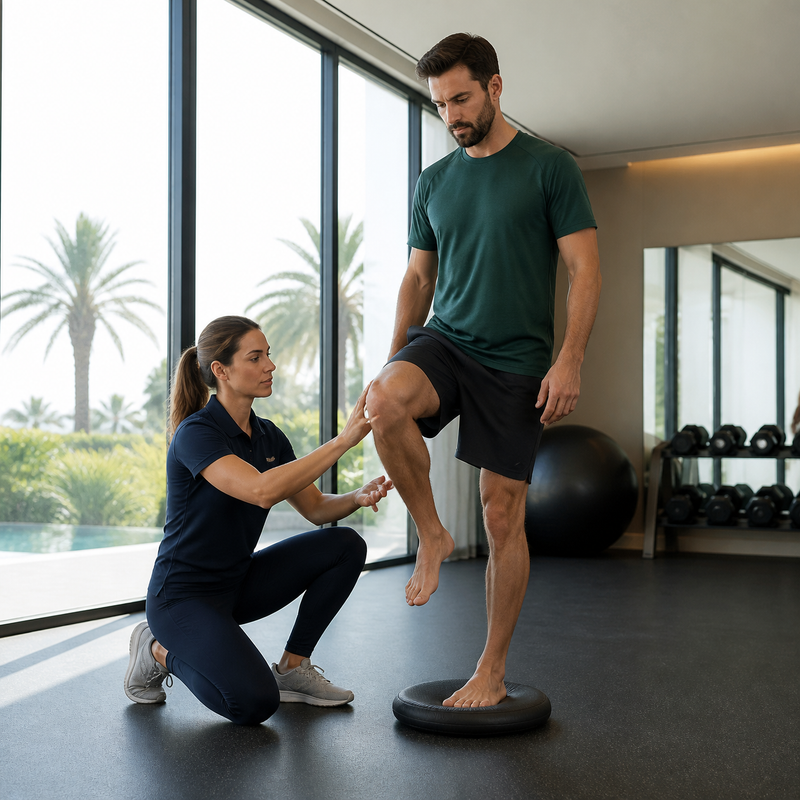
The pattern is then carried into strength training and into the family’s sports: rotation for golf, padel and tennis, an independent seat for riding, bracing and release for skiing or sailing. Our article on balance and proprioception training shows how the same progression applies to stability work, from elite athletes to older family members.
Stage four: everyday habits
Finally, the work becomes part of the day: two minutes of breathing after a flight, a short control routine before the first meeting, a cue the person remembers when they pick up a child. This is where a live-in physiotherapist has an advantage no clinic can match.
Adapting the programme to each family member
The table below is illustrative, not a prescription. It shows how one physiotherapist might adapt the same principles across a household; the content always depends on the individual assessment and on the family’s calendar.
| Family member | Typical aim | Emphasis | Usual format |
|---|---|---|---|
| Principal with a full diary | Less back and neck tension, better recovery after travel | Relaxed breathing, thoracic mobility, simple trunk control | Short morning routine and a calm close to the day |
| Active adult who plays golf, padel or tennis | Freer rotation and a more robust trunk | Rib and thoracic mobility, anti-rotation strength, breath during effort | Part of pre-sport preparation and strength sessions |
| Teenager in regular sport | Good movement habits while growing | Control and coordination, taught as games and challenges | Brief, varied sessions around school and training |
| Older family member | Confidence in walking, standing and getting up | Posture, gentle trunk strength, breathing with movement | Seated and standing exercises, unhurried pace |
| Family member returning to exercise after a break | A safe, gradual restart | Breath and deep trunk coordination before load | Gentle progression, reviewed regularly |
A typical case: the principal who holds their breath
Picture a principal in her forties who trains with a personal trainer three times a week, plays padel at weekends and has a lower back that tightens after every heavy session. On assessment, the physiotherapist finds good general strength but a habit of breath-holding and rigid bracing during almost every exercise, together with a stiff thoracic spine.
The clinician does not stop her training. Instead, they add ten minutes before each session: lateral rib breathing with hands-on guidance, thoracic mobility, and two or three control exercises in which she must keep breathing while the trunk works. They agree simple cues with the personal trainer so that the same pattern is reinforced in the gym. Over the following weeks, the load in her strength work is built back up with the new pattern in place, and a short breathing routine is added to her evenings when the family travels. This is a hypothetical example, but it reflects the kind of patient, coordinated work that private families value.
Keeping the programme going while the family travels
The family travels continuously, and the physiotherapist travels with them. Breathing and core control work is well suited to that life, because it needs almost no equipment: a mat, perhaps a light resistance band or a small ball, and a quiet corner of a residence, hotel suite or yacht deck.
- After flights. A few minutes of slow breathing and gentle trunk and hip movement help the body settle after long periods of sitting.
- On busy days. A two-minute routine the person knows by heart keeps continuity when a full session is impossible.
- In the heat. Sessions move indoors or to the cooler hours of the day, and intensity is adjusted sensibly.
- Before sport. Breath and trunk activation become part of the warm-up, wherever the family happens to be.
Mobility work travels in the same way. See assisted stretching and mobility programmes for busy principals for how short sessions fit around a full diary, and travel recovery after long-haul flights for how the physiotherapist plans around each journey.
Knowing the limits of the work
Good physiotherapists are clear about what breathing and core control work is for. It supports movement, comfort, performance and recovery. It is not a treatment for breathlessness, chest symptoms or any unexplained change in health. If something in the assessment or in a session suggests a medical cause, the physiotherapist says so plainly and discreetly, and the matter is taken up with the family’s own medical advisers. Families respect clinicians who know where their role ends.
The same applies to claims. Avoid promising that a breathing technique will transform sleep, stress or performance. Explain what you are doing and why, measure what can be measured, and let steady results speak for themselves.
What families look for in the physiotherapist
Families rarely ask for “a breathing specialist”. They ask for a sports physiotherapist with skilled hands and sound judgement, who can teach simply and adapt to an unpredictable life. In practice, that means:
- Confident assessment of movement and breathing patterns, and the manual therapy skills to free a stiff ribcage or thoracic spine.
- Good exercise prescription, from low-load control to strength and sport-specific work.
- Clear, calm coaching: short cues, no jargon, and patience with people who have little time.
- Additional training in Pilates-based rehabilitation or similar approaches, which is useful but not essential.
- Experience with elite athletes, professional teams or high-profile clients, which is a major advantage because it shows you can deliver under pressure and with discretion.
If you have worked in elite sport, our article on sports physiotherapists with elite athlete experience explains how that background translates to a private family.
Requirements and conditions of the role
The roles we are currently sourcing for sports and manual physiotherapists share the same core requirements and conditions:
- A physiotherapy degree from the UK, Europe, Australia, New Zealand, the United States or Canada, with current registration in the country of training. What counts is where you trained, not your nationality.
- Strong manual therapy, exercise prescription and movement control skills; experience with elite athletes, professional teams or high-profile clients is a major advantage.
- Availability to start within about six weeks and total flexibility.
- Willingness to live with the family and travel with them continuously across several countries. The role is live-in and single-status: you relocate alone, and partners or children do not relocate with you.
- Fluent English and complete discretion.
The package:
- Salary from £60,000 a year gross, depending on experience.
- Free private accommodation.
- Flights and travel paid by the family.
- Medical insurance covered. Professional indemnity insurance is not included.
- A permanent position with annual leave.
The salary is agreed directly between the family and the clinician; each clinician should take advice from their own tax adviser on whether the income is taxable in their circumstances.
Medical Staff Talent introduces and verifies clinicians. The engagement is contracted directly between the family and the clinician, and all local arrangements (visa, licensed entity, coordination with local clinics) remain with the family’s own office and advisers.
The current opening is our sports physiotherapist job with a private family. You can read about the first months in the role in your first 90 days in a live-in physiotherapist role, and see all our physiotherapy roles on the physiotherapists page.
Frequently asked questions
Is breathing and core control work a large part of the role?
It is a regular thread through the week rather than a separate service. It sits within a wider sports physiotherapy role that includes assessment, manual therapy, exercise prescription, mobility work and injury prevention.
Do I need a Pilates or breathing qualification?
No separate qualification is required. Families look for a qualified physiotherapist with strong manual therapy, exercise prescription and movement control skills. Additional training in Pilates-based rehabilitation or similar approaches can strengthen your CV.
How long are the sessions?
It depends on the person and the day. Many physiotherapists use short routines of five to ten minutes, repeated often, and build breathing and trunk control into longer strength, mobility or pre-sport sessions.
Who can apply?
Physiotherapists with a degree from the UK, Europe, Australia, New Zealand, the United States or Canada and current registration in the country of training. What counts is where you trained, not your nationality.
What is the salary?
From £60,000 a year gross, depending on experience, with free private accommodation, flights and travel paid and medical insurance covered. Professional indemnity insurance is not included.
Is the role permanent?
Yes. It is a permanent, live-in position with annual leave, and you travel continuously with the family across several countries.
Send your CV in confidence
If building breathing, core control and movement programmes for one family, and travelling with them, appeals to you, send your CV in confidence. Every CV is read personally.
Send your CV in confidence