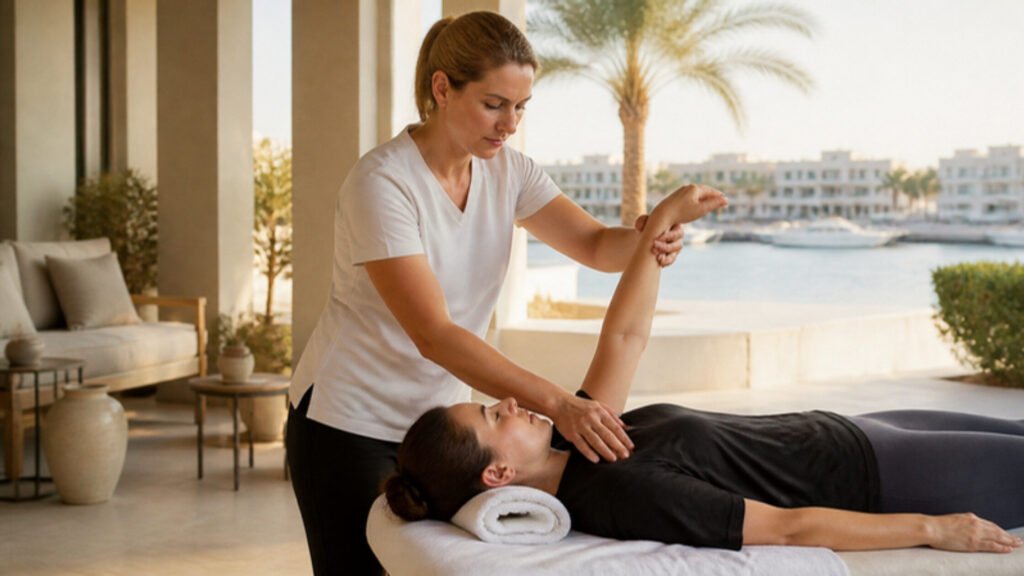
By David Vilchez, Founder & CEO, Medical Staff Talent
Many physiotherapists who look for manual therapy jobs abroad imagine a busy private clinic in a new city: a full diary, thirty-minute slots, a different patient every half hour. A role with a private family in Saudi Arabia, the UAE or Qatar works very differently. There is one household, the same people every day, and enough time to do hands-on work properly, follow its effect and adjust it the next morning.
This article sets out the hands-on skills private families ask for most often, how each one is used day to day in a residence or while travelling, and how to show them convincingly when you apply. It is written for physiotherapists trained in the UK or anywhere in Europe with a sports and manual therapy background. Where we describe a situation, it is a hypothetical example, not an account of a real person or placement.
Medical Staff Talent in one line: “Exclusively sourcing UK & European-trained Private & Concierge Physicians, Physiotherapists & Osteopaths, and Private & Maternity Nurses for Private Families across the GCC.”
Why private families value hands-on work
In many health systems, manual therapy has been squeezed by short appointments and large caseloads, and much of the session is spent on exercise prescription and advice. Those remain essential. But a private family is not asking a physiotherapist to discharge anyone. They want someone who keeps every member of the household moving comfortably: a principal who plays padel four evenings a week, a spouse who rides, an older relative whose mobility matters more each year, children who are growing and training.
For that, families tend to value what they can feel: tissue that moves more freely after a long-haul flight, a stiff back that loosens before a round of golf, a shoulder that feels steadier after a session. Hands-on work opens the door; movement control and exercise make the change last. The physiotherapists who do best in these roles combine the two naturally.
For a complete overview of the role itself, read our guide to sports physiotherapist jobs with private families in the Gulf.
The four hands-on skills families ask for most
1. Soft tissue release
Soft tissue work is often the first thing a family notices. Typical uses include forearm and calf work after racket sports, neck and upper back work after long days of meetings and screens, and hip and gluteal work for golfers and riders. In a household, the value lies in timing: a short session before a match or after a flight, rather than a long session once a week.
What families look for is good clinical reasoning behind the technique. A physiotherapist who can explain, in plain language, why a particular area is being treated and what the person should feel afterwards earns trust quickly.
2. Assisted stretching
Assisted stretching is one of the most requested elements of these roles, particularly for busy principals who would not stretch on their own. It is also one of the most underrated. Done well, it combines passive and active-assisted techniques, contract-relax approaches and breathing, adapted to the person’s age, sport and tolerance on the day.
A short, pleasant routine that someone actually looks forward to is often more valuable than a technically perfect programme that is skipped. Families notice the difference between a stretching session that feels rushed and one that feels calm, attentive and unhurried.
3. Joint mobilisation
Thoracic, hip, ankle and shoulder mobilisation come up again and again: thoracic rotation for golfers and tennis players, hip mobility for riders, ankle mobility for runners and padel players, and gentle mobilisation for older family members who want to stay independent. Graded mobilisation, chosen and dosed with care, sits at the heart of the profile.
Families expect careful screening. Any red flags, unexplained pain or suspected injury go to the family’s doctor first; the physiotherapist works within their own scope of practice and within the plan agreed with the family’s medical advisers.
4. Movement control
Hands-on work rarely holds on its own. Neuromuscular and movement control work, corrective exercise, breathing and core control, proprioception and balance training are what turn a good session into a lasting change. Short drills that fit into a hotel room, a residence gym or a yacht deck are particularly useful, because the household is rarely in one place for long.
Strength and conditioning plays a smaller part in these roles. The emphasis is on manual therapy, mobility and movement quality.
How the skills fit together day to day
| Skill | Typical moment in the day | Who it often helps | What makes it work in a household |
|---|---|---|---|
| Soft tissue release | Before or after sport, after flights | Racket players, golfers, frequent travellers | Short, well-timed sessions; clear explanation |
| Assisted stretching | Morning or late evening, after long meetings | Busy principals, riders, older relatives | A calm, unhurried routine people enjoy |
| Joint mobilisation | Before a round or match, during recovery | Golfers, tennis players, older family members | Careful screening and dosing |
| Movement control | Short drills between other commitments | Everyone, including children in training | Routines that need little space and no gym |
A hypothetical day built around hands-on work
Picture a family spending the winter months in Doha. In the morning, the physiotherapist runs a twenty-minute assisted stretching and breathing session for the principal before a day of meetings. Around midday, an older relative has gentle hip and ankle mobilisation followed by balance work in the residence gym. In the afternoon, a teenage member of the family has a short movement-control session within the training plan agreed with their coach. In the evening, the principal plays padel; the physiotherapist leads a warm-up beforehand and does forearm and calf soft tissue work afterwards.
The next week, the family flies to Europe. The same routines continue in a hotel suite with a portable couch, with a little extra attention to stiffness after the flight. Nothing about the day is dramatic, and that is the point: small problems are dealt with early and the whole household keeps moving. For another view of how this looks on the road, read our article on sport-specific physiotherapy for padel, tennis, golf and riding.
How families assess hands-on skills
Because a family cannot watch you treat before an introduction, they rely on how clearly you describe your work. In our experience, the strongest applications do three things:
- Name the techniques precisely. “Manual therapy” on its own says little. Soft tissue release, assisted stretching, graded joint mobilisation, neuromuscular control and proprioceptive training say much more.
- Show the setting. Work with elite athletes, professional or national teams, dance companies or high-profile private clients shows that you can deliver hands-on care to people who expect a high standard and value discretion.
- Show the reasoning. A line on how you combine hands-on work with movement control and exercise shows that your results last beyond the session.
Our article on what private families look for in a sports physiotherapist and how to show it in your CV goes into this in more detail, and our piece on elite-sport physiotherapists in private family roles explains how experience with athletes is weighed.
Clinic job abroad or private family: what changes
Both can be rewarding, but they suit different people. In a clinic abroad, you build a caseload, see many patients and leave work at the end of the day. With a private family, you live in the residence, see a small number of people every day, travel continuously with the household and become part of its routine. Continuity of care replaces volume; discretion and flexibility matter as much as technique.
If you are drawn to depth rather than throughput, and you enjoy seeing the effect of your hands-on work day after day, a private family role may suit you well. Our guide to your first 90 days in a live-in physiotherapist role describes how the start of an appointment usually unfolds.
What families look for
- A physiotherapy qualification obtained in the UK or Europe, with current registration in the country of training. What counts is where you trained, not your nationality.
- A strong sports and manual therapy background: soft tissue release, assisted stretching, active mobility and joint mobilisation, neuromuscular and movement control, corrective exercise, movement analysis and biomechanical assessment, injury prevention, breathing and core control, proprioception and balance.
- Experience with elite athletes, professional teams or high-profile clients is a strong advantage.
- Availability to start within about six weeks and complete flexibility.
- Readiness to live with the family and travel continuously with them across several countries. Every role is live-in and single-status: partners and children do not relocate with you.
What the role offers
- A permanent, live-in appointment with the family, with annual leave.
- From £60,000 a year gross, depending on experience.
- Free private accommodation in the residence.
- Flights and travel always paid for by the family.
- Medical insurance covered. Professional indemnity insurance is not included.
The salary is agreed directly between the family and the clinician; each clinician should take advice from their own tax adviser on whether the income is taxable in their circumstances.
How the introduction works
Medical Staff Talent introduces and verifies clinicians. The engagement is contracted directly between the family and the clinician, and all local arrangements (visa, licensed entity, coordination with local clinics) remain with the family’s own office and advisers.
You can read more about the profession on our physiotherapists page and see the current role on our sports physiotherapist vacancy.
Frequently asked questions
Do I need a postgraduate manual therapy qualification?
It helps, but it is not essential. What matters is a strong, well-described sports and manual therapy background and the ability to combine hands-on work with movement control and exercise.
Which manual therapy techniques do private families ask for most?
Soft tissue release, assisted stretching, joint mobilisation and movement-control work come up most often, along with breathing and core control, proprioception and balance.
Is strength and conditioning a large part of the role?
It plays a smaller part. The emphasis is on manual therapy, mobility and movement quality.
Can I apply if I trained in Europe but hold a different nationality?
Yes. What counts is where you trained, not your nationality. You need a physiotherapy qualification obtained in the UK or Europe and current registration in the country of training.
Can my partner or children come with me?
No. Every role is live-in and single-status, so partners and children do not relocate with you.
How do I apply?
Send your CV in English through our confidential online form. Please do not send it as an email attachment.
Apply in confidence
If you are a UK or European-trained physiotherapist with strong hands-on skills, can start within about six weeks and are ready to relocate alone and travel with a family, we would like to hear from you. Send us your CV in confidence.
Send your CV in confidence