
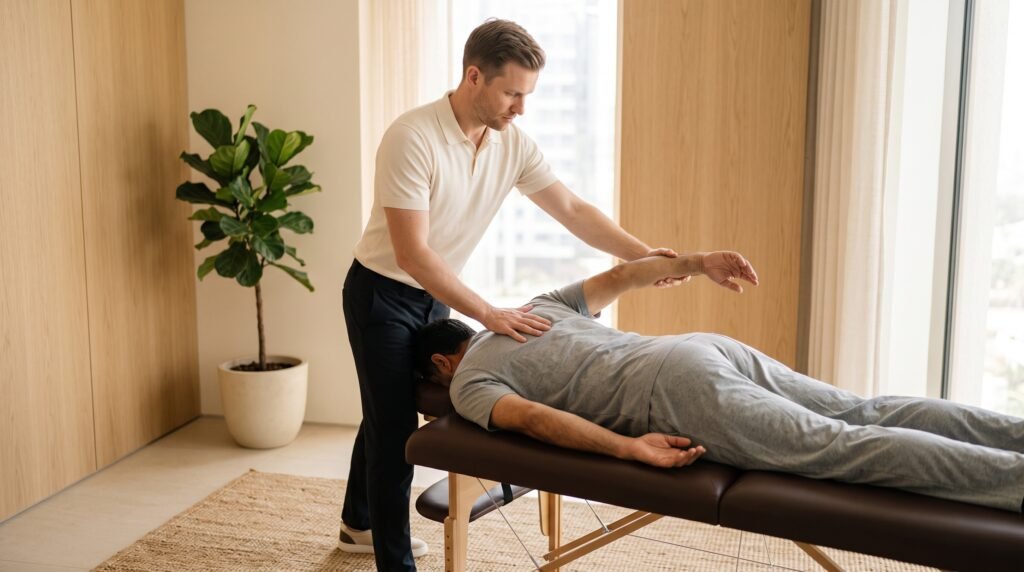
One-to-one physiotherapy appointments in Saudi Arabia, the UAE and Qatar for HCPC-registered physiotherapists, retained by private families. This page is for UK physiotherapists weighing a private household appointment in the Gulf: what happens to your HCPC registration, what the Gulf regulator will ask of it, and which mandates are open now.
Your HCPC registration does not stop at Heathrow
The HCPC states plainly that a physiotherapist who practises outside the UK can maintain their registration. For a household appointment, that matters more than it first appears. A Gulf regulator verifies your registration at source before it licenses you, the family’s advisers will want to see it current, and a Travelling or Rotational appointment often brings you back to UK practice between rotations. Letting it lapse closes doors you may want open in two years’ time.
Three practical points follow. Keep your correspondence address current with the HCPC, since renewal notices do not follow you abroad on their own. Keep your CPD record up to date and in a form you could submit, because the HCPC audits a sample of each profession at renewal and household work abroad is not an exemption. And renew on time within the two-year cycle; a lapse forces a readmission process that no Gulf licensing timetable accommodates well.
What the Gulf regulator will ask of it
Each jurisdiction licenses physiotherapists separately: the Dubai Health Authority (DHA) in Dubai, the Department of Health (DOH) in Abu Dhabi, the Saudi Commission for Health Specialties (SCFHS) in Saudi Arabia and the Department of Healthcare Professions (DHP) of the Ministry of Public Health in Qatar. All of them rely on DataFlow primary source verification of your degree, your experience and your registration.
From the HCPC side, the document you will be asked for is confirmation of your registration status, which you download from your HCPC online account. It shows your registration number, status and any practice restrictions. Order it when the regulator asks for it, not months ahead, so that it is current when it is read. Our guide UK Physiotherapists in the Gulf: What HCPC Registration Does Not Buy You covers the gaps that catch people out, and the GCC Licensing Classifier shows where a regulator is likely to place you.
A household appointment has one further condition: care inside a residence has to be delivered through a licensed entity, usually the family’s own. See Who May Lawfully Treat Inside a Private Residence. We map this route with you and guide you through it; we do not submit applications, process DataFlow or sponsor visas.
The HCPC registration you have maintained is the first thing a Gulf regulator verifies and the last thing a family’s adviser checks before an introduction.
What households ask physiotherapists to do
Musculoskeletal and post-surgical recovery, delivered one-to-one in a treatment suite within the residence rather than in twenty-minute slots. See how one household built it in Building a Private Physiotherapy Practice Inside a Family Residence.
Longevity, mobility and performance for principals who treat recovery time as a strategic cost. See Longevity and Elite Performance Physiotherapy.
Neurological, paediatric and women’s health rehabilitation, often alongside a maternity nurse after a birth. See Women’s Health & Post-Natal Physiotherapy.
Travel with the family by private jet and, in summer, on the Mediterranean when the family is aboard. See The Clinician in Transit.
How an appointment is structured
Appointments are Live-Out, Live-In, Rotational, Fixed-Term, Travelling, Locum or Sessional/Retainer; each mandate states its model, and the seven are compared in Live-In, Rota or Travelling? The contract is signed directly between you and the family or its licensed entity. We introduce and verify; we are not the employer, and the introduction fee is paid by the family, never by you.
Standing registers for physiotherapists
Many household mandates are never advertised. These standing registers are the briefs we place against throughout the year:
City by city, the Dubai, Abu Dhabi, Riyadh, Jeddah, Eastern Province and Doha pages list the named mandates open now, each with its own remuneration.
Questions HCPC-registered physiotherapists ask
Should I keep my HCPC registration while I work in the Gulf?
In most cases, yes. The HCPC allows you to maintain registration while practising outside the UK, the Gulf regulator verifies it at source, and it keeps a return to UK practice straightforward. Keep your contact details and CPD record current, and renew on time.
Which HCPC document will the Gulf regulator ask for?
Confirmation of your registration status, downloaded from your HCPC online account. It shows your registration number, status and any practice restrictions. Request it when the regulator asks, so that it is current.
Does Medical Staff Talent obtain my Gulf licence?
No. We map the licensing route with you and guide you through it. We do not submit applications, process DataFlow or sponsor visas; the family’s licensed entity and you complete those steps directly.
Who employs me, and who pays your fee?
The family, or its licensed entity, employs you under a contract you sign directly with them. We introduce and verify, and our fee is paid by the family.
Register confidentially
Send us your CV in confidence. Nothing is shared with a family without your agreement. See also our Physiotherapists & Osteopaths practice, the page for GOsC-registered osteopaths and all current mandates.