
Representative Mandate · Family Office, Dubai
The treatment suite was finished before the search began.
That was the easy part.
How a private physiotherapy practice inside a family residence is actually built — and why the room, the equipment and the licence are three separate decisions.
A composite illustration. We publish no client names, no dates, no locations beyond the city level, and no identifying clinical detail. What follows is built from the type of private physiotherapy mandates we are briefed on by family offices, to give chiefs of staff and private offices a realistic sense of process. It is not an account of any single named engagement.
The mandate
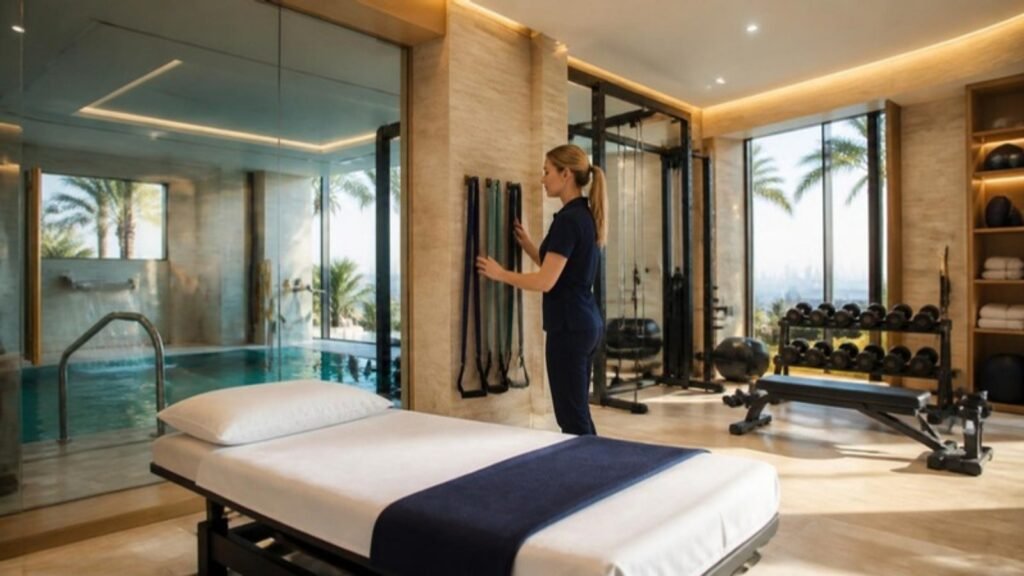
A family office in Dubai had fitted out a treatment suite inside the family’s principal residence: a treatment room, a rehabilitation gym and a hydrotherapy pool. The specification for the equipment had been written by the interior designer. The specification for the clinician had not been written at all.
The caseload, once we mapped it with the office, was broader than anyone had assumed. An elder principal’s mobility and falls prevention. A younger family member’s return to competitive sport after injury. Post-natal recovery for another. Occasional treatment for senior household staff, if the family wished to extend it. Three generations, four quite different clinical needs, one practitioner.
The office wanted a UK & European-trained physiotherapist able to design the service, lead the clinical work and treat the family one-to-one, with the expectation that a small team might follow.
The difficulty
A treatment room does not license a treatment. In Dubai, a physiotherapist treating inside a private home practises under a DHA professional licence activated through a licensed healthcare facility. The suite is where the care happens; it is not what makes the care lawful. The question of which licensed entity the physiotherapist would practise under had to be settled before the offer, not after arrival. We cover the options in who may lawfully treat inside a private residence.
Breadth is rare at senior level. Most senior physiotherapists have spent the last decade narrowing: elite sport, neurology, women’s health, musculoskeletal outpatients. This family needed someone confident across all of them, and honest about the edges of their competence — with a referral route ready for the cases that belonged to a specialist colleague.
The equipment had been chosen for the room, not for the patients. Some of it was right. Some of it would never be used. Some of what the caseload actually needed was missing.
Gender and chaperoning were not an afterthought. Several family members would be treated in a private setting, one-to-one, by a clinician they did not yet know. The family’s preferences on the clinician’s gender, and the chaperone arrangements for each patient, were stated at the outset and shaped the shortlist from the first day.
The process
Licensing alongside the search
We ran DHA licensing activation in parallel with the search rather than in sequence after it: the licensed entity agreed with the office early, credentials prepared as soon as a shortlist existed, and primary source verification through DataFlow started before final interview. The physiotherapist was able to begin treating the family within days of arrival, rather than waiting weeks on paperwork that could have been done while the search was still running.
Shortlisting for breadth, hands and judgement
- Demonstrated range — musculoskeletal and manual therapy as the base, with credible experience in at least two of falls prevention, sports rehabilitation and post-natal care
- Practical assessment — a case discussion built around a realistic, anonymised version of the family’s caseload, rather than a conventional competency interview
- Service design experience — evidence that the candidate had set up, not merely worked in, a clinical service
- Discretion and boundaries — referees asked specifically about the candidate’s conduct in private or high-profile settings
Letting the clinician specify the room
Before the offer, the shortlisted physiotherapist reviewed the suite and the equipment list with the office. Two items were returned, three were added, and the hydrotherapy protocol was rewritten around the elder principal’s needs rather than the pool’s specification. It cost the family less than the equipment it replaced.
What we insisted on in the terms
- Scope and referral written down — what the physiotherapist treats, what they refer, and to which orthopaedic, sports medicine and women’s health consultants
- Who the patients are — the family, household staff, guests — stated explicitly, because suite access tends to widen over time
- Availability defined — scheduled sessions, travel with the family, and what counts as out-of-hours
- Clinical records kept to professional standard, held under the licensed entity and not in a personal notebook
- A development path — the expectation of a small team stated at the outset, so that the first hire was recruited as a potential lead rather than a sole practitioner
The outcome
- The practice launched on the family’s committed date, with the physiotherapist licensed and treating within days of arrival
- Each family member had a written treatment plan within the first fortnight, and the referral routes were used as intended
- The physiotherapist went on to build a small supporting clinical team within the first year
- No aspect of the mandate, the family or the clinical picture entered public circulation at any point
What actually made the difference
Treating the licence, the room and the clinician as three separate decisions, taken in the right order — and letting the clinician, not the designer, have the final word on the room.
The second thing: recruiting for the practice the family would have in two years, not the one it had on the first day. A sole practitioner who is also a credible future lead is a different hire, and it is far easier to recruit for that at the outset than to discover the need at month eleven.
For Family Offices & Chiefs of Staff
Commissioning a Private Medical Appointment for a Household?
The Household Medical Commissioning Brief sets out how to appoint a private clinical team without exposing the principal: the seven deployment models, licence and indemnity inside a residence, why private nurses are placed in pairs, and a twelve-point commissioning checklist. It names no family and no residence.
Request the Commissioning Brief →
Need a short overview to forward instead? Download the capability statement (PDF).
Related reading
- Private physiotherapist for private families
- Women’s health and post-natal physiotherapy for private families
- The family medical entity: structuring in-house clinical governance
- Case study: a resident physician for a travelling family office
- Track record: representative GCC placements
- UK & European-trained physiotherapists in the Gulf
Composite and anonymised. No client, household, family or candidate detail is published, and none is disclosed at any stage of a mandate without explicit instruction.