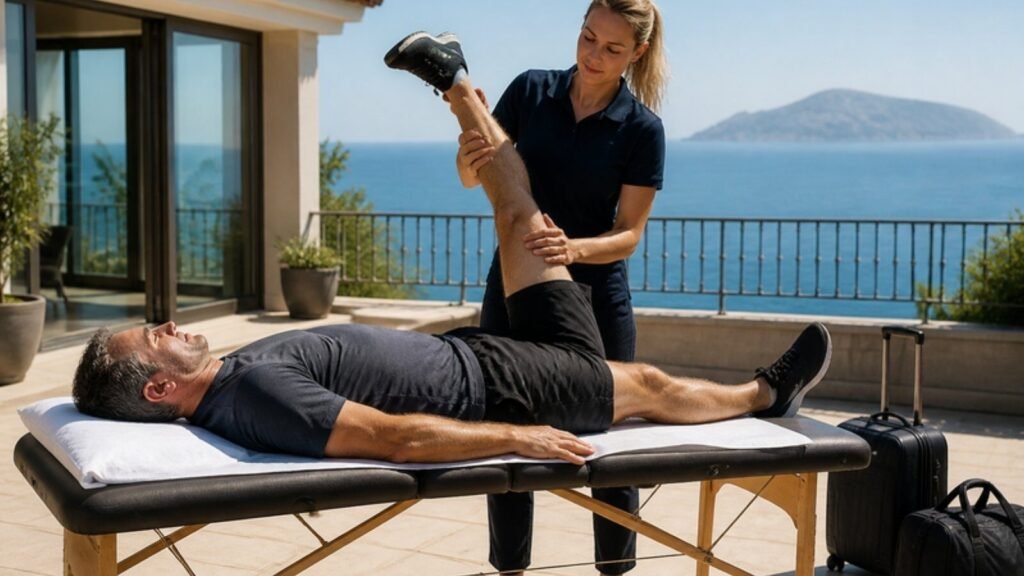

How doctors, nurses and physiotherapists can read malpractice cover in Dubai, Abu Dhabi, Riyadh and Doha as part of their real risk and career architecture
Malpractice Insurance in the Gulf is the quiet clause that decides how exposed you really are if something goes wrong. UK & European-trained clinicians often focus on visas and salary when they look at Gulf offers. Malpractice insurance is sometimes treated as a small detail, quietly assumed to be “taken care of”. It should never be assumed: professional indemnity insurance is not included in the appointments we introduce, so arrange your own cover and confirm it in writing. In Dubai, Abu Dhabi, Riyadh and Doha, that clause is not small. It decides how exposed you really are when something goes wrong in a private residence, villa or on a yacht, and whether your move is a calculated step or a quiet bet with your licence.
Why malpractice insurance matters more in the Gulf
In your home system, you may barely think about malpractice cover. In the Gulf private sector, it sits at the intersection of:
-
Contracting parties – arrangements differ from one engagement to the next, and cover is never automatic.
-
Real risk – high-acuity cases, household expectations and cross-border care raise the stakes.
When the policy is clear and robust, UK & European-trained doctors, nurses and physiotherapists can practise calmly. When it is vague or minimal, every deterioration, complaint or complication carries an extra layer of unease.
The core questions UK & European-trained clinicians must ask
Before signing any Gulf contract, you need precise answers in writing. Key questions include:
1. Who holds the policy?
-
Is there any existing cover that applies to you, or must you arrange a policy in your own name?
-
If a policy is offered, are you a named clinician, or only referred to under a generic policy?
-
Does the policy follow you across every setting in which you will work (residence, hotel, travel)?
2. What does it actually cover?
Look beyond the word “malpractice” and ask:
-
Scope of practice – does the policy explicitly cover your specialty, procedures and settings?
-
Settings – are home visits, hotel suites or yacht work included for private family patients?
-
Limits – what are per-claim and annual aggregate limits, in AED/SAR/QAR and GBP?
3. In which jurisdiction is it enforceable?
-
Where is the insurer based, and which law applies to claims?
-
Does cover apply only within UAE/KSA/Qatar, or more broadly?
-
How are cross-border issues handled if an incident spans multiple countries?
For roles that include concierge and travel elements, the questions from Medical Concierge in Dubai and Abu Dhabi: A Clear Guide for UK & European-Trained Clinicians also become relevant: how would any malpractice cover respond to care given in private villas, on yachts or during transfers into licensed facilities?
Typical risk patterns in Gulf malpractice cover
UK & European-trained clinicians in the Gulf often encounter a few recurring patterns:
Minimal cover for high-risk work
Some arrangements pair high-acuity or procedural work with low limits, or with policies designed for low-acuity settings. That misalignment is a warning sign: it leaves you carrying disproportionate risk.
Blurred Lines in Private Family Roles
In private family settings, you may hear phrases like “everything will be taken care of” or “we never have issues”. Without an explicit policy tied to your name and scope, confirmed in writing, “everything” can become unclear at the first complaint.
Assumptions about UK & European-trained standards
Some assume that because UK & European-trained clinicians bring strong practice habits, weaker insurance structures will do. The reality is the opposite: serious clinicians need serious cover to make calm decisions in complex situations.
How malpractice cover links to governance and culture
Malpractice insurance is not just a legal formality; how openly it is discussed says a great deal about governance. Clinicians who handle it well usually:
-
Raise insurance questions before signing, not after arrival.
-
Check that the cover they hold or arrange matches their actual scope of work.
-
Know in advance how an incident would be reviewed, and who would support them.
The same logic applies in private and concierge medicine. When cover, protocols and incident learning point in the same direction, clinicians practise calmly. When they rely on verbal reassurance alone, clinicians are left exposed.
What UK & European-trained clinicians should check before relocating
As part of your relocation and verification checklist, add a short malpractice section. Calm, practical steps:
-
Ask for policy summaries in writing, not just verbal assurances — or arrange your own policy before you travel.
-
Confirm that your procedures, settings and household tasks are inside scope.
-
Check whether run-off cover exists if a claim arises after you leave.
-
Clarify how malpractice insurance interacts with local complaint processes and internal investigations.
If answers remain vague, treat that as data, and take independent advice before you sign.
Why clarity on cover matters for both sides
Professional indemnity insurance does not come with the role (medical insurance is covered by the family). Settling the question in writing before you accept an appointment:
-
Protects your professional exposure and your registration at home.
-
Reduces anxiety around complex cases and household expectations.
-
Gives the family a clear, documented understanding of how you practise.
Clarity on cover, governance and working hours, agreed before arrival, is what allows a private appointment to settle calmly.
How Medical Staff Talent approaches malpractice cover
Medical Staff Talent introduces and verifies UK & European-trained Doctors, Nurses and Physiotherapists for private families across Saudi Arabia, the UAE and Qatar, and with the family across Europe and on international travel. Medical Staff Talent introduces and verifies clinicians. The engagement is contracted directly between the family and the clinician, and all local arrangements (visa, licensed entity, coordination with local clinics) remain with the family’s own office and advisers.
We do not arrange or provide malpractice cover, and no appointment should be assumed to include it. Before accepting any role, we encourage every clinician to confirm in writing:
-
Which insurer holds your own malpractice or indemnity policy.
-
That the policy covers your specialty, procedures and every setting in which you will work, including residence, hotel and travel.
-
How incident reporting, legal support and your insurer would interact in practice.
For clinicians considering a move, a helpful question is this: “If I had to brief a trusted legal or clinical advisor back home on this malpractice cover, would I feel confident or exposed?” Your answer to that question tells you more about the real risk of a Gulf role than any marketing line ever will.
Companion Guide
What Does This Role Actually Leave You With?
A precise benchmark of gross packages across Saudi Arabia, the UAE and Qatar, with guidance on structuring your position for long-term asset protection.
Download the Compensation & Tax Position Guide →