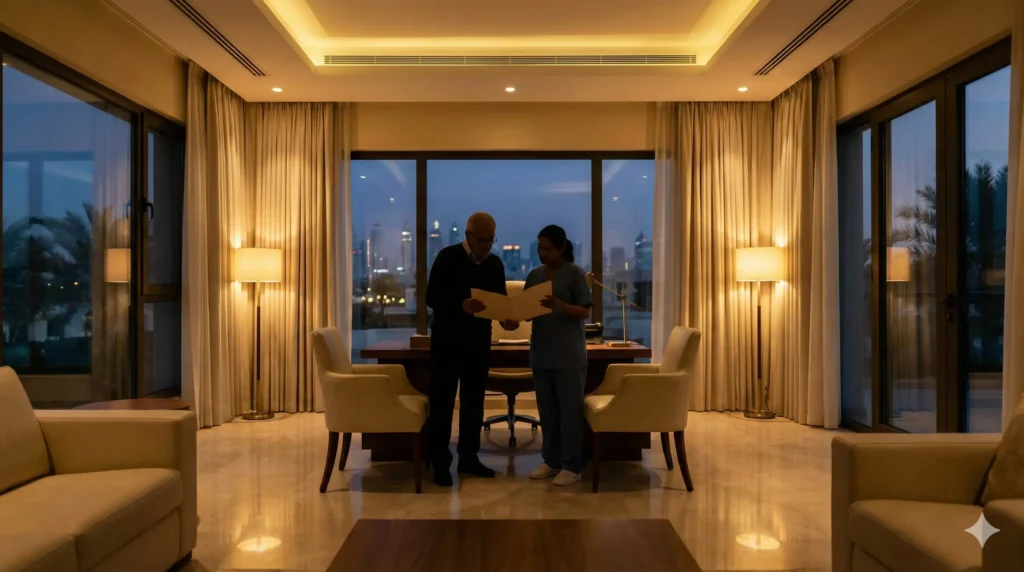

Transitioning from senior clinical roles in the UK and Europe to executive medical leadership inside the Gulf’s Royal Households and UHNW family offices
The Executive Pivot separates UK & European consultants who thrive in the Gulf from those who stall once clinical mastery alone is no longer enough. For the senior Consultant Surgeon in a London teaching hospital or the Attending Physician in a major European academic center, career progression often hits a predictable plateau. You have achieved clinical mastery, secured the UK CCT or an equivalent European Board Certification, and navigated the complex politics of your home institution. The future is comfortable, prestigious, and largely static. The Gulf Cooperation Council (GCC) region offers a starkly different trajectory. For Tier 1 UK & European-trained talent, moving to Dubai or Riyadh is not merely a change of geography; it is a fundamental pivot in professional identity, stepping out of purely clinical roles and into executive healthcare leadership on a global scale.
In mature Western systems like the NHS, success at the consultant level is often measured by clinical volume, research output, and the ability to navigate perpetually squeezed budgets. A senior consultant, no matter how talented, is often a highly skilled cog in a vast, established machine. The mandate inside a Royal Household or a family office’s private medical programme is fundamentally different. Here, you are not appointed to run a clinic; you are appointed to build a system around one family.
The region is transitioning rapidly from importing healthcare to creating indigenous, world-class infrastructure, driven by national visions like Saudi 2030. A UK & European-trained leader relocating today is expected to be an architect of clinical governance, a mentor to the household’s nurses and physiotherapists, and a strategist capable of aligning clinical excellence with the family’s priorities. The mindset must shift from “How many patients can I treat today?” to “How do I build a medical programme that keeps this family well for the next decade?”
Perhaps the most significant adjustment for inbound CCT-qualified talent is the sheer scale of autonomy combined with intense accountability. Western public systems are often defined by committees, slow consensus-building, and incremental change.
Inside a Royal Health Bureau in Riyadh or a family office in Dubai, decisions that would take years in Europe are often executed in months. This speed is exhilarating but demands a higher level of individual responsibility. There is no sprawling bureaucracy to hide behind. A Medical Director or Chief Royal Physician is given significant resources—a private clinical suite provisioned through an unconstrained procurement pipeline—and an unambiguous mandate to deliver world-class outcomes for the family. This environment favors the bold, decisive clinical leader over the cautious administrator.
For Royal Offices and family offices, the primary risk in appointing high-level UK & European talent is rarely clinical competence. It is cultural dissonance. The successful executive pivot requires a sophisticated level of Cultural Intelligence (CQ). Leading a small, multinational household medical team in the Gulf, while navigating relationships with the Royal Office, the family and regulators like the DHA or SCFHS, requires a diplomatic skillset that is rarely taught in Western medical schools. The most effective leaders are those who can wed the uncompromising clinical rigor of their UK & European training with a deep respect for local hierarchy, communication styles, and traditions. They understand that implementing sustainable change requires building consensus, not just issuing directives.
The decision to relocate at a senior career stage is significant. While the tax-free financial rewards are substantial, they are rarely the sole motivator for true Tier 1 talent. The primary driver is the opportunity for impact. The Gulf currently offers a professional canvas that does not exist elsewhere across the globe. It is the chance to leave a tangible mark—to be the founding Medical Director of a Royal Household’s clinical programme, or to define the standard of care for a family across three residences and a yacht. It is an opportunity to move from maintaining a legacy in the West to building a new one in the Gulf.
The transition from a senior clinical role in the West to an executive leadership position in the Gulf is not for everyone. It requires a shedding of old institutional comforts and an embrace of dynamic, high-stakes leadership. For the right CCT-qualified professional, however, it is the ultimate career accelerant.
Our brief on Private Medical Director appointments for Royal Households and family offices sets out what the role involves in practice. Contact David for a confidential discussion on your next appointment.
Companion Guide
Placement Inside a Royal Household Runs on Different Rules
Protocol, confidentiality and NDA standards, and the pathways that lead into Royal Households and UHNW private residences.
Download the Royal Household Companion Guide →