
If you searched “PQR for nurses”, you want three answers quickly: which title you will be licensed under, whether you have to sit the exam, and what can still slow the file down. The short version is below. The rest of this guide explains how the rules apply to a UK or European-registered nurse moving into a private post with a private family in Dubai or Abu Dhabi, where one misread clause can move a start date by a full season.
The answer in brief: under the third edition of the UAE’s Unified Healthcare Professional Qualification Requirements (PQR), a nurse with a bachelor’s degree in nursing is eligible for the Registered Nurse title with no minimum post-qualification experience. A nurse who holds a valid licence and good standing from one of the named countries, including the UK, Ireland and most of north-western Europe, may also be exempt from the licensure examination if the qualification is less than two years old or there is no gap in practice. The exemption covers the exam only. Primary Source Verification, the good standing certificate and activation of the licence by a licensed facility all still apply.
What the PQR Is, and Who Applies It
The PQR is the shared qualification rulebook of the UAE’s health regulators. Its preface says it is published jointly by the Ministry of Health and Prevention (MOHAP), the Department of Health – Abu Dhabi (DoH), the Dubai Health Authority (DHA) and the Sharjah Health Authority (SHA), and that the current third version replaces all earlier versions. The document is dated 2025, and the Department of Health’s PQR page still lists the third version as current.
In practice, a Dubai file and an Abu Dhabi file are judged against the same title definitions. Procedure differs from one authority to the next. What each title requires does not. Once you know where the PQR places you, most of the uncertainty about the licence is gone.
Our client market in the UAE is Dubai and Abu Dhabi, so this guide focuses on DHA and DoH. For how the UAE compares with Saudi Arabia and Qatar, see our GCC medical licensing comparison.
Nursing and Midwifery Titles Under PQR (3rd Edition)
Chapter Three of the PQR sets out the qualification and experience needed for each nursing and midwifery title. The table below restates sections 14 and 16; the primary sources are listed at the end of this guide.
| PQR title | Qualification required | Minimum experience |
|---|---|---|
| Registered Nurse | Bachelor’s degree in nursing (minimum three years full-time) | None required* |
| Assistant Nurse | Diploma of Nursing, at least 18 months’ course duration | None required* |
| Specialty Nurse (route A) | Registered Nurse qualification plus a clinical master’s degree or a postgraduate clinical nursing specialty qualification (at least one year) | One year post-qualification in the specialty |
| Specialty Nurse (route B) | Bachelor’s degree in a nursing specialty (at least three years) | Two years post-qualification in the related field |
| Nurse Practitioner | Registered Nurse requirements plus a clinical master’s or doctoral degree covering prescribing pharmacology, differential diagnosis and test interpretation, and advanced health assessment. Alternatively, Registered Nurse requirements plus a national certification or licence as a Nurse Practitioner | Two years post-qualification as a Nurse Practitioner |
| Registered Midwife | Bachelor’s in midwifery (at least three years), or a BSc in nursing plus a midwifery certificate (at least one year) | Two years as a midwife in a maternity hospital or related setting |
| Midwife Practitioner | Registered Midwife requirements plus a clinical master’s or doctorate in midwife practice with supervised advanced clinical practice | Two years as a midwife in a maternity hospital or related setting |
*The PQR marks both “no experience” titles with an asterisk that ties them to its Discontinuity of Practice (Gap of Practice) rules, covered below. “No experience required” does not mean “no questions asked”.
The 19 recognised specialty titles
Section 15 of the PQR lists the specialty titles a nurse can be licensed under. The ones that come up most often in private household work are Neonatal Nurse, Neonatology Critical Care Nurse, Pediatric Nurse, Pediatric Critical Care Nurse, Critical Care Nurse, Maternal Health Nurse, Palliative Care Nurse, Wound Care Nurse, Diabetic Health Nurse and Adult Health Care Nurse. The others include Anesthesia, Cardiovascular, Clinical Informatics, Community Health, Diabetic Foot, Emergency, Infection Prevention, Mental Health and Oncology Nurse. Aesthetic and dermatology nursing, a fast-growing private-sector specialty, is covered separately in Aesthetic and Dermatology Nursing in the Gulf.
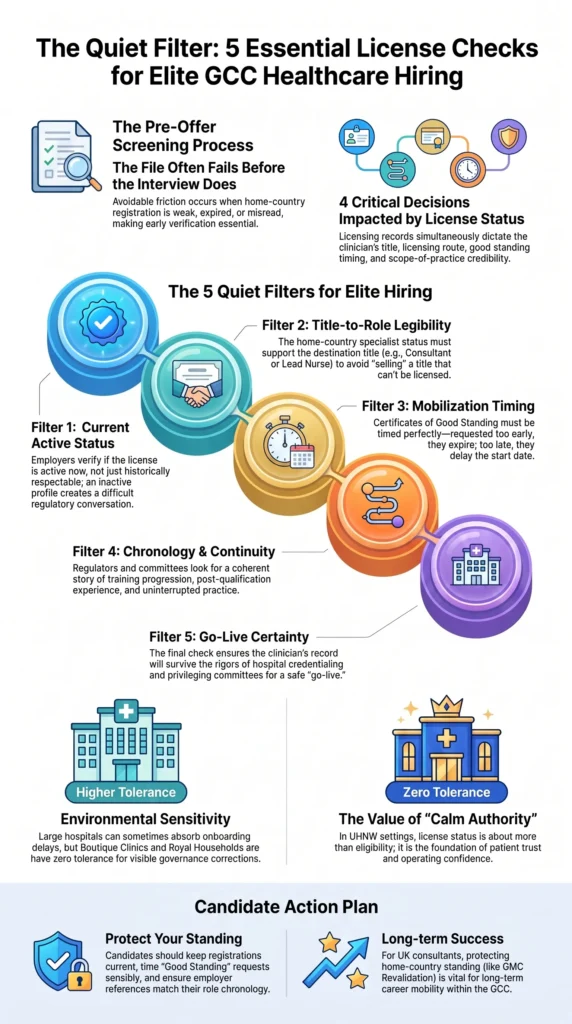
There is a second route. The PQR allows the authorities to grant specialization privileges on a Registered Nurse licence to a nurse with at least four years’ experience in one of those specialties. This matters for a senior NICU nurse from the NHS who has deep experience but no separate specialty qualification. Her file may be better presented as a Registered Nurse with a privilege request than as a Specialty Nurse application she cannot fully document. Households also screen home-country licence status before any offer is made; the five filters private families use explains how.
The Experience Exemption and the Exam Exemption Are Separate Rules
This is the part of the PQR that decides the timeline, and the part that is most often misquoted. Two separate clauses name the same list of countries.
1. The experience exemption (section 13.1.15)
Beyond the titles that need no experience anyway, nurses and midwives holding a valid licence or registration from a listed country are exempt from the required experience, provided that:
- the qualification was obtained within the last two years, or there is no gap in practice since the last day of employment;
- a valid Good Standing Certificate is submitted;
- Primary Source Verification is completed on the qualifications, experience and licence or registration documents; and
- English proficiency is evidenced where the degree was not taught in English or the licence comes from a non-English-speaking listed country.
For a UK-registered midwife, this is significant. Read literally, it can remove the two-year experience requirement for Registered Midwife, which is one of the titles a household describing a “maternity nurse” is often actually asking for.
2. The exam exemption (section 21.12)
Under Exam Equivalency Criteria 1, nurses and midwives with a valid licence and Good Standing Certificate issued by a listed country are exempt from the authority’s licensure examination, on the same condition: a qualification from the last two years, or no gap in practice.
| Listed European jurisdictions (sections 13.1.15 and 21.12) |
|---|
| United Kingdom · Ireland · France · Germany · Netherlands · Belgium · Luxembourg · Austria · Switzerland · Denmark · Sweden · Norway · Finland · Iceland |
The PQR list also names several non-European jurisdictions, which are outside the scope of this guide. Just as important is what the list leaves out. It does not name Spain, Portugal, Italy, Greece or any Central or Eastern European register. A nurse registered only in those countries should plan for the authority’s assessment and should not assume an exemption. We explain what that means for Central European files in our guide to Croatian, Polish and Czech nurses in the Gulf. The wider trend is covered in why Central European clinicians are the Gulf’s fastest-growing talent pool.
The English-language evidence thresholds
Where proof is required, the PQR accepts any one of the following:
| Test | Minimum stated in the PQR |
|---|---|
| IELTS | 5.0 |
| Occupational English Test (OET) | Grade C |
| TOEFL | 500 or equivalent |
| Cambridge Assessment English | 169 |
The limit on the exemption: the PQR says plainly that an exam exemption “is limited to exam requirements” and “does not apply to any other requirements for licensure such as credentialing, experience, PSV”. It is also lost altogether for a professional whose gap in practice exceeds two years. An exemption removes the exam. The rest of the file is still assessed in full.
Four Clauses That Catch Private-Duty Nurses
Nurses coming from NHS or European hospital posts usually meet the qualification standard easily. Files tend to stall on the clauses below, several of which bear directly on private household work.
1. The gap in practice
Private nurses often take a sabbatical between fixed-term appointments, or a season off after a demanding live-in post. The PQR does not treat that time as neutral. For nurses, the Gap of Practice table sets out:
| Gap in clinical practice | Nurses must complete |
|---|---|
| Three to under four years | 40 CME/CPD credits + 6 months’ training |
| Four to under five years | 60 CME/CPD credits + 8 months’ training |
| More than five years | Non-UAE nationals are, in general, unable to apply |
Training must take place in an approved practice setting. Applicants who complete gap requirements must then pass the licensure examination, even if they would otherwise qualify for an exemption. Keep in mind that the two-year threshold on the exam exemption comes well before the three-year threshold on retraining.
2. The good standing clock
The Good Standing Certificate must be no more than six months old when you apply, and it must cover the minimum experience required for the title. It is issued by the regulator in your country of last employment, which means the NMC for UK nurses and the NMBI for Irish nurses. Request it last, not first. Our guide to keeping your NMC or NMBI registration alive while you nurse in the Gulf explains why letting a home registration lapse is almost always a false economy.
3. Three attempts across all authorities
An applicant who does need the exam gets three attempts in total across the UAE authorities, with a possible final attempt at a different authority. Every attempt must be declared. Sitting the exam casually in Abu Dhabi “to see what it is like” before a Dubai appointment uses an attempt that counts in both.
4. Titles that cannot practise alone
The PQR states that Assistant Nurses and Assistant Midwives cannot work independently and must work under a Registered Nurse or Registered Midwife. For a household, this rules out one tempting economy: a sole-charge residential post cannot be filled at Assistant Nurse level. DHA’s supervision schedule adds a detail that matters for home maternity work. A Registered Midwife is normally supervised by an obstetrics and gynaecology specialist or consultant, and the schedule makes an exception for home care facilities.
From PQR Eligibility to an Active Licence: The Dubai Sequence
The PQR decides whether you are eligible. Dubai’s Manual for Licensing Healthcare Professionals (version 1.2, effective 8 May 2025) decides when you may start work. It sets out this sequence:
- Sheryan account and self-assessment.
- Meet the PQR: qualification, clinical experience, home-country licence and good standing.
- Obtain a positive PSV result. The manual allows PSV and the computer-based test to run at the same time.
- Pass the assessment where the PQR requires it.
- Registration certificate issued. It is valid for one year from issue.
- Licence activated by the employer through the facility’s own Sheryan account. The employer must hold a valid DHA facility licence that covers the professional’s specialty.
Three provisions in the manual matter most for private family appointments:
- A registration is not a licence. The manual lists “active professional registration without activating the professional license” among the conditions under which a professional is not entitled to practise.
- Malpractice cover is attached to the activation. The professional must hold medical malpractice insurance where the licence is activated. The licence can be activated for one, two or three years.
- Time away from practice counts against you. Not practising for six consecutive months during the licence’s validity, without an excuse DHA accepts, means a new licence must be obtained. For travelling or seasonal deployments that take a nurse out of the emirate for long periods, this belongs in the contract discussion from the start.
Where a nurse falls short of the experience a title requires, the manual allows a trainee title. It must be activated in a licensed facility with an approved clinical training service and under clinical supervision. That arrangement rarely fits a sole-charge residential post, which is why the PQR title needs to be settled before a brief is written.
Abu Dhabi uses the same PQR through the Department of Health’s own licensing channels. The sequence is broadly comparable, but procedural details and timings are specific to each authority. See our separate guides to DHA licensing in Dubai and DoH licensing in Abu Dhabi.
What This Means for the Household Commissioning the Nurse
For a family office, the published sequence explains why timing is set by the regulator rather than by the offer letter. As the DHA manual describes it, a registration is activated into a licence by an employer holding a valid DHA facility licence that covers the professional’s specialty. How that is arranged in any individual case is a matter for the family’s own office and advisers.
The PQR title also needs to match the brief. Three typical briefs show how the translation works:
| What the brief says | What the PQR title needs to be | Why it matters |
|---|---|---|
| “Maternity nurse for the first twelve weeks” | Registered Midwife, or Registered Nurse with Neonatal or Maternal Health specialisation | The PQR defines midwifery and neonatal nursing as separate titles; the licence must match the care the household actually describes |
| “Night nurse for a ventilated child, rota of two” | Pediatric Critical Care Nurse, or Registered Nurse with a specialization privilege | The PQR recognises Pediatric Critical Care Nurse as a distinct specialty title |
| “Live-in nurse for an elderly principal” | Registered Nurse; Palliative Care or Adult Health Care Nurse where relevant | A sole-charge post rules out Assistant Nurse |
The deployment model should be fixed at the same time as the title. A live-in · residential post, a rotational (rota) pair, a fixed-term contract around a birth, locum · short-term cover during a principal’s recovery, or a travelling · accompanying the family post each interact differently with the licence, although every one of them is live-in and single-status. The six-month inactivity rule and the facility activation requirement are two examples. We set out the options in the five deployment models private families use for their clinicians.
A Precision Protocol Before Anything Is Submitted
- Name the PQR title first, before specialty or salary. Registered Nurse, Specialty Nurse, Registered Midwife and Nurse Practitioner are different files.
- Check that your register is on the list. A UK, Irish or listed European registration opens both exemptions. Any other register means planning for the exam.
- Count your gap in practice to the day. A career break that has crossed two years has already cost you the exam exemption, whatever your register.
- Decide whether you are applying for a specialty title or a specialization privilege. Four or more years in a specialty without a specialty qualification points to the privilege route.
- Prepare the file for DataFlow. Reconcile dates, job titles and names across every document. Our DataFlow primary source verification guide covers the common discrepancies.
- Request the good standing certificate last, so that its six-month validity is as fresh as possible on submission.
- Confirm the activating facility in writing and that its licence covers your specialty, before you resign from your current post.
- Plan for renewal. The PQR sets a minimum of 20 CME/CPD credits a year for nurses. Our GCC CPD requirements guide covers how that works alongside NMC revalidation.
Where Medical Staff Talent Fits
Medical Staff Talent introduces and verifies clinicians. We do not submit, prepare or advise on the licensing file. The engagement is contracted directly between the family and the clinician, and all local arrangements (visa, licensed entity, coordination with local clinics) remain with the family’s own office and advisers. The submission is made by the clinician, and the licence is activated by the appointing licensed entity. The regulator-by-regulator detail is set out in our Gulf licensing guide, and our GCC Licensing Classifier gives a first reading of where a regulator is likely to place you.
- Private Nurses and Maternity Nurses: newborn care, critical care and rotational nursing for private families, under strict NDA. See Private & Maternity Nurses.
- Confidential routing: UK and European-registered nurses can submit a private profile through the Candidate Portal. Nothing is shared with a household or appointing entity without your instruction.
Frequently Asked Questions
Do UK nurses need to sit the DHA or DoH exam?
Not under Exam Equivalency Criteria 1, provided the nurse holds a valid UK licence and good standing, and the qualification is less than two years old or there has been no gap in practice. PSV, good standing and facility activation still apply.
How much experience does a Registered Nurse need under the PQR?
None is required for the Registered Nurse title with a bachelor’s degree in nursing, subject to the Gap of Practice rules.
Can a private family employ a licensed nurse directly, without a facility?
In Dubai, the DHA manual requires the licence to be activated by an employer holding a valid DHA health facility licence. A registration that has not been activated does not entitle the nurse to practise.
Regulatory Note and Primary Sources
This guide reflects the regulators’ published documents as of September 2026. Requirements are revised from time to time and are assessed case by case, so confirm your position with the relevant authority before making a binding career decision.
- UAE Health Regulatory Authorities (MOHAP, DoH, DHA, SHA), Unified Healthcare Professional Qualification Requirements, 3rd edition (2025): sections 1.3, 1.5–1.7, 2.2, 13–16 and 21.12. Published via doh.gov.ae/en/pqr
- Dubai Health Authority, Manual for Licensing Healthcare Professionals, version 1.2, effective 8 May 2025: sections 5.6, 5.11, 10, 11, 16 and Appendix 1. dha.gov.ae
Medical Staff Talent exclusively sources UK & European-trained Private & Concierge Physicians, Physiotherapists & Osteopaths and Private & Maternity Nurses for Private Families across Saudi Arabia, the UAE and Qatar — and on Mediterranean yachts when travelling with the family.
This guide summarises publicly available information from the regulators for general reference. It is not legal advice, and Medical Staff Talent does not advise on licensing, visas or local regulation.
Companion Guide
Know Where You Stand Before You Apply
Nine pages covering DHA, DOH, MOHAP, SCFHS and DHP — the five-stage sequence, realistic DataFlow timelines, and the seven delay points that cost clinicians months.
Download the Gulf Licensing Roadmap →