

QCHP is the Qatar Council for Healthcare Practitioners — the body within Qatar’s Ministry of Public Health that registers and licenses every clinician practising in the country. No doctor, nurse or allied health professional may work in Qatar, public sector or private, without a QCHP licence. Applications are administered through the Ministry’s Department of Healthcare Professions portal.
Obtaining one runs through four stages: document collation, DataFlow primary source verification, a Prometric examination where the specialty requires it, and QCHP evaluation. DataFlow alone typically takes four to six weeks and sits on the critical path — it is the stage that decides your timeline. What follows sets out each stage, the exemption criteria, and what actually causes delay.
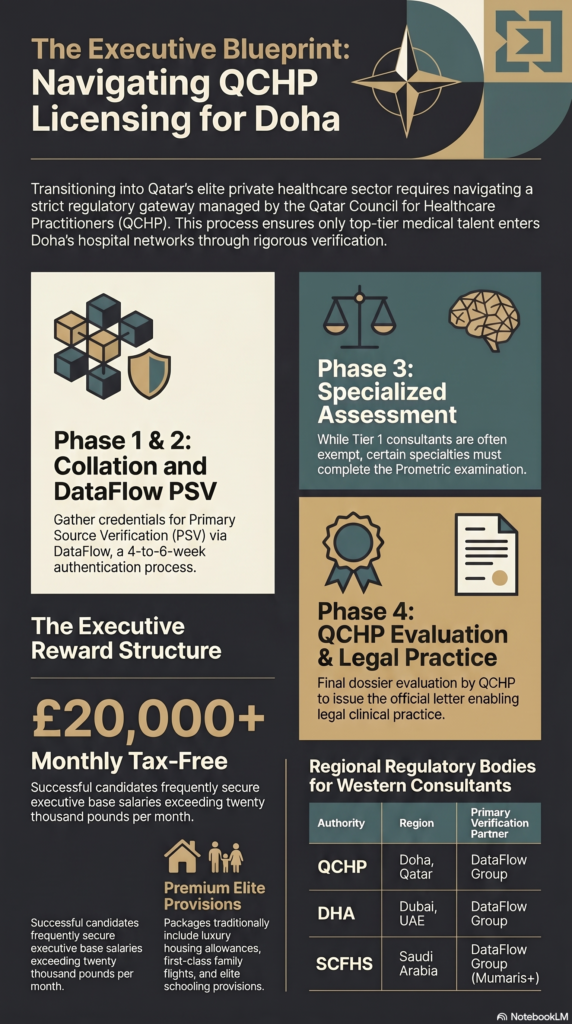
This QCHP Licensing Guide sets out, in full executive detail, exactly what Qatar’s regulator expects from UK & European-trained consultants before a single day of clinical work in Doha can begin. For UK & European-trained consultants, stepping into the elite private healthcare sector of Doha offers unprecedented clinical leadership opportunities and highly lucrative, tax-free compensation structures. However, transitioning into Qatar requires a meticulous understanding of the regulatory landscape. Securing your credentials through the Qatar Council for Healthcare Practitioners (QCHP) is the definitive first step toward formalizing your appointment in the region.
The Gulf Context: Why Doha Demands Precision
Doha is rapidly expanding its footprint in premium healthcare, mirroring the sophisticated administrative frameworks seen in other Gulf states. Much like the DHA licensing process in Dubai or the DOH framework in Abu Dhabi, Qatar’s Ministry of Public Health enforces strict regulatory gateways to ensure only top-tier medical talent enters its hospital networks. For UK & European-trained professionals, this means demonstrating absolute clarity in your clinical history and academic provenance.
The Reality of Primary Source Verification
Before applying for the QCHP license, candidates must undergo rigorous Primary Source Verification (PSV). This is conducted via the DataFlow Group, an independent partner that authenticates degrees, medical licenses, and certificates of good standing directly from the issuing bodies. Executive candidates must ensure their documentation is flawless to avoid delays that could impact their start dates and tax-free earnings.
A Strategic Breakdown of the QCHP Process
- Phase 1: Document Collation: Gather your medical degrees, board certifications (e.g., CCT, CCST or an equivalent European fellowship), valid home country medical license, and comprehensive logbooks.
- Phase 2: DataFlow PSV: Submit documents for verification. This process typically takes 4 to 6 weeks but can be expedited for premium applicants.
- Phase 3: Prometric Examination (If Applicable): Whether the written examination applies to you turns on QCHP’s published qualification requirements and your own registration and practice history rather than on your country of training, and specific specialties may still require an assessment.
- Phase 4: QCHP Evaluation: Following successful verification, the QCHP evaluates your dossier against their credentialing guidelines to issue your evaluation letter, enabling you to practice legally. Your prospective employer will often coordinate the final visa processing via Qatar’s e-Government portal.
The Executive Compensation Reality
UK & European-trained consultants successfully navigating this pathway frequently secure executive compensation packages exceeding £20,000 monthly, devoid of income tax deductions. Beyond the base salary, these packages traditionally include premium housing allowances, first-class family flights, and elite schooling provisions. Navigating this administrative threshold is a minor hurdle compared to the financial and professional rewards awaiting in Doha.
Secure Your Transition with Medical Staff Talent
At Medical Staff Talent, we exclusively partner with UK & European-trained specialists navigating the complexities of the Gulf market. Whether you are comparing the QCHP with SCFHS licensing in Saudi Arabia or evaluating your strategic options across the region, our team ensures a seamless administrative transition. Learn more about our executive methodology, or connect directly with our talent specialists to begin your journey to Doha.
This QCHP Licensing Guide is intended as a living reference for any UK & European-trained consultant weighing a move to Doha, and the practical detail above should be read alongside current QCHP circulars, since processing timelines and documentary requirements are periodically revised by the regulator. Institutions across Qatar are increasingly competing for the same narrow pool of CCT-qualified consultants and specialist board holders, which means candidates who arrive with a complete DataFlow dossier and a clear understanding of the Prometric exemption criteria are consistently the fastest to convert an offer into a start date. David Vilchez and the Medical Staff Talent executive search team work directly with QCHP-sponsoring Royal Households and UHNW employers across Doha, and can advise confidentially on how a specific specialty, board certification, or seniority level is likely to be assessed before an offer is formally extended. See how QCHP compares to the other five GCC pathways in our complete GCC medical licensing comparison.
Companion Guide
Know Where You Stand Before You Apply
Nine pages covering DHA, DOH, MOHAP, SCFHS and DHP — the five-stage sequence, realistic DataFlow timelines, and the seven delay points that cost clinicians months.
Download the Gulf Licensing Roadmap →