By David Vilchez, Founder & CEO, Medical Staff Talent
When a private family in Saudi Arabia, the UAE or Qatar asks us for a physiotherapist, the brief often looks orthopaedic at first glance: a knee replacement, a stubborn back, a principal who plays padel. Read a little further and a second need appears. A new mother in the household who wants to recover properly after birth. A daughter preparing for her first pregnancy. An older relative whose continence and core strength have started to limit her life. In these households, women’s health physiotherapy is not a niche add-on; it is part of the care the family expects to have under its own roof.
This article is written for UK & European-trained physiotherapists with training or experience in women’s, pelvic and postnatal health who are curious about what that work looks like inside a private residence. It covers the clinical scope, how the day is organised, what families require, the salary band, and how an introduction happens.
Medical Staff Talent in one line: Exclusively sourcing UK & European-trained Private & Concierge Physicians, Physiotherapists & Osteopaths, and Private & Maternity Nurses for Private Families across the GCC.
Why women’s health matters so much in a private family household
Gulf households are frequently multigenerational. Mothers, daughters, sisters-in-law and grandmothers may live in the same compound or travel together for months at a time. Pregnancies and births are central family events, and the weeks around them are organised with great care: a maternity nurse for the newborn, a physician on call, and increasingly a physiotherapist who looks after the mother.
Privacy shapes everything. Many women in these households prefer to discuss pelvic floor symptoms, postnatal recovery or pain during intimacy only in their own home, with a clinician they have come to trust, and without the exposure of a public clinic waiting room. A physiotherapist who lives with the family and travels with them can offer exactly that: continuity of care, discretion and the time to do things properly.
The clinical scope: what a women’s health physiotherapist does for a family
The scope is broad, and the strongest candidates are comfortable across most of it while knowing precisely where their training stops.
Antenatal care
Assessment and management of pregnancy-related pelvic girdle pain and low back pain, posture and movement advice, safe exercise prescription across the trimesters, pelvic floor preparation and, where appropriate, birth preparation education in coordination with the family’s obstetrician and midwife.
Postnatal recovery
Structured recovery after vaginal birth or caesarean section: scar care and mobility, assessment of diastasis recti, graded abdominal and pelvic floor rehabilitation, return to exercise and return to sport. Families value a clear plan with milestones and a clinician who explains progress in plain language.
Pelvic health across the lifespan
Stress and urge incontinence, prolapse symptoms, pelvic pain and bowel dysfunction, from the early postnatal period through perimenopause and later life. Internal examination and treatment, where indicated, are carried out only within your training, registration and the patient’s informed consent.
Menopause, bone health and longevity
Strength and impact-loading programmes for bone health, balance and falls prevention, and long-term mobility work for older women in the household. This often overlaps with the longevity work many families ask for across the whole household.
Physiotherapists from these backgrounds tend to fit well: specialist women’s health or pelvic health roles in a national health service, postnatal or maternity outpatient services, private pelvic health practice, and musculoskeletal physiotherapists with recognised postgraduate courses in pelvic and obstetric physiotherapy. Osteopaths with specific antenatal and postnatal experience are also considered.
What the day looks like inside a residence
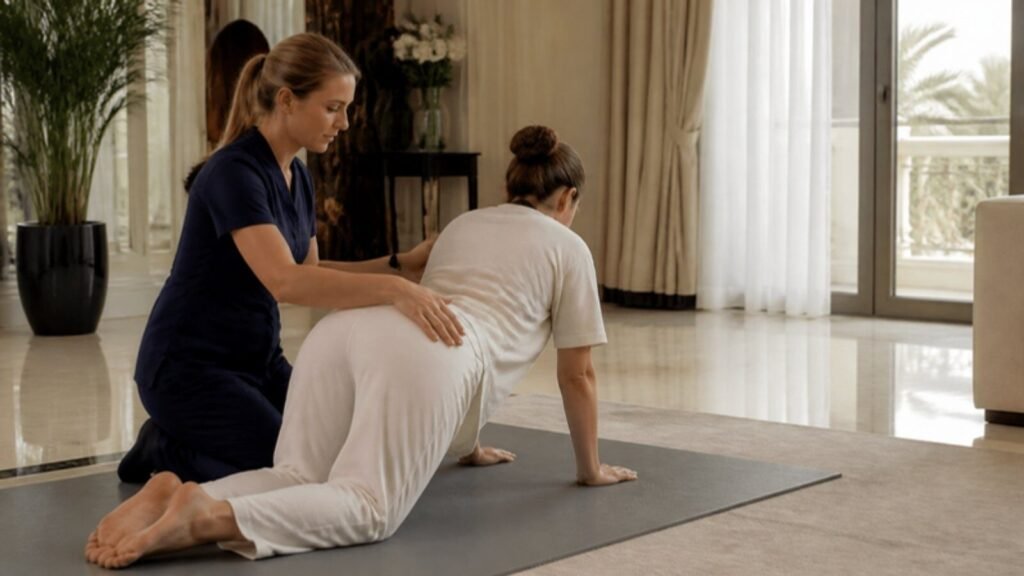
Picture a physiotherapist joining a family in Riyadh six weeks after the birth of their third child. Her mornings start with a session for the mother in a quiet treatment room on the private floor of the residence: breathing and core work, pelvic floor training, gentle strength. Late morning is for the grandmother’s balance programme. In the afternoon she reviews the week’s plan with the family’s physician and the two maternity nurses caring for the baby. Three weeks later the family leaves for the summer in Europe, and the programme continues in a rented villa, then on a yacht, with the essentials packed in a single case. This is a hypothetical example, but it reflects the rhythm of the work.
The common threads are these:
- One-to-one time. No waiting list, no twenty-minute slots. Sessions follow the family’s day, often early morning and late afternoon.
- Coordination. You work alongside the family’s physician, its private and maternity nurses, and sometimes a personal trainer or nutritionist. Agree early who leads on what.
- Records. Clear notes for every session, written so that a visiting specialist abroad could pick them up and understand the plan.
- Travel. Summers in Europe, other residences, private aircraft and yachts. The family arranges and pays the visas for international travel.
- Discretion. A strict NDA covers the family, the residence and your movements. Women’s health work is, by nature, among the most sensitive care in the household.
Women’s health physiotherapy at home versus in a clinic
| Outpatient women’s health clinic | Private family residence in the Gulf | |
|---|---|---|
| Caseload | A list of patients each day | One or a few women in one household |
| Session length | Fixed slots | As long as the plan requires |
| Follow-up | Weeks between appointments | Daily or several times a week, for months |
| Setting | Clinic room | Private treatment room, gym or pool in the residence |
| Team | Multidisciplinary clinic team | Family physician, maternity nurses, household team |
| Travel | None | Part of the role, wherever the family goes |
| Confidentiality | Standard clinical confidentiality | Strict NDA covering family, residence and movements |
What families require from every clinician
Whatever the specialty, families apply the same conditions, and we apply them to every candidate:
- Start within about six weeks of an offer. Needs around a birth do not wait for a three-month notice period.
- Total flexibility on hours and destinations. The family’s diary sets the pattern.
- Relocate alone and travel with the family anywhere, at any time. Every role is live-in and single-status, so a partner or children do not relocate with you.
- A physiotherapy or osteopathy qualification obtained in the UK or Europe, with valid registration in the country where you trained. What counts is where you trained, not your nationality.
Fluent English for daily clinical work is expected. Arabic is an advantage in some households but not a requirement.
Remuneration
As a market reference, physiotherapists and osteopaths in private family appointments earn £60,000–£120,000 a year gross. Where you sit depends on years of practice, the depth of your women’s and pelvic health training, and the complexity of the brief. Specialist postgraduate training in pelvic health typically strengthens your position within the band.
These are permanent roles with annual leave; the contract is renewed yearly, and accommodation in or right next to the residence is provided free of charge. The salary is agreed directly between the family and the clinician; each clinician should take advice from their own tax adviser on whether the income is taxable in their circumstances.
Who this work suits
It suits experienced physiotherapists who enjoy long therapeutic relationships, who are confident working as the only clinician of their discipline in the house, and who find meaning in helping one woman recover fully rather than many women partially. It suits people who travel well and keep their own professional development going without a department around them.
It does not suit clinicians who need a fixed rota, who draw their energy from a large clinical team, or whose personal commitments make relocating alone impractical. None of that is a criticism; it is simply a sign that a clinic role is the better fit.
How the introduction works
Medical Staff Talent introduces and verifies clinicians. The engagement is contracted directly between the family and the clinician, and all local arrangements (visa, licensed entity, coordination with local clinics) remain with the family’s own office and advisers.
In practice, you send your CV through our confidential form. We read it personally, speak with you, verify your qualification, registration and references at source, and introduce you to a family only when a brief matches your experience, and only with your agreement. We never name a family publicly and never share your profile without your consent. If women’s or pelvic health is your field, say so clearly in your CV: list your postgraduate courses, the conditions you treat and the settings you have worked in.
You can read more about the role on our Physiotherapists and Osteopaths pages, about the maternity nurses you will often work alongside on our Private & Maternity Nurses page, about the conditions in what live-in and single-status really involve, and about how families structure a permanent private physiotherapist appointment. For the household’s own perspective on this need, see women’s health and post-natal physiotherapy for private families.
Frequently asked questions
Do I need a specialist title in women’s health to apply?
No. Families look for demonstrable experience and recognised postgraduate training in women’s, pelvic or obstetric physiotherapy. A specialist title helps, but a strong MSK physiotherapist with solid pelvic health training and postnatal experience is also considered.
Is the work only with new mothers?
No. Postnatal recovery is common, but families also ask for antenatal care, pelvic health support across the lifespan, menopause and bone health programmes, and general musculoskeletal and longevity work for the household.
How much does a women’s health physiotherapist earn with a private family?
As a market reference, £60,000–£120,000 a year gross, depending on experience, training and the brief. The salary is agreed directly between the family and the clinician.
Can my partner or children relocate with me?
No. Every role is live-in and single-status: the clinician relocates alone and lives in, or right next to, the family’s residence.
Do I need previous Gulf experience?
No. Families value the quality of your UK or European training and clinical experience. They do require that you can start within about six weeks and travel with them.
Is Medical Staff Talent my employer?
No. Medical Staff Talent introduces and verifies clinicians. The engagement is contracted directly between the family and the clinician, and all local arrangements remain with the family’s own office and advisers.
Apply in confidence
If you are a UK or European-trained physiotherapist or osteopath with experience in women’s, pelvic or postnatal health, can start within six weeks, and are ready to relocate alone and travel with a family, we would like to hear from you. Send us your CV in confidence.