
By David Vilchez — Founder & CEO, Medical Staff Talent. David advises Royal Households and UHNW Families across the GCC on the exclusive placement of UK & European-trained medical talent, with a focus on licensing strategy and deployment risk.
Home-country licence status in GCC hiring is often the quiet difference between a premium offer and a delayed start. This guide sets out the five checks well-advised Royal Households and family offices run to protect title accuracy, good standing, credentialing integrity, and mobilisation confidence for UK & European-trained doctors, physiotherapists, and nurses.
In elite Gulf recruitment, the file usually fails before the interview does.
A doctor, nurse, or physiotherapist may look strong on paper, interview well, and still create avoidable friction later if the home-country registration story is weak, expired, incomplete, or misread. That is why home-country licence status in GCC hiring should be verified before the offer is emotionally positioned.
In Dubai, Abu Dhabi, Riyadh, and Doha, Royal Households and family offices do not simply buy experience. They buy a clinician whose title, standing, and governance profile can move calmly from shortlist to live practice. Home-country status is not a background administrative detail — it is an early hiring filter.
Why Home-Country Licence Status in GCC Hiring Matters Before the Offer
The best-advised households do not wait for the paperwork to be “sorted” after the preferred candidate says yes.
They check the home-country record first because it affects four expensive decisions at once: title, licensing route, good standing timing, and scope-of-practice credibility. A premium £ package feels far less stable once a household discovers that the clinician’s home registration does not read as clearly as the CV suggested.
This matters most in Royal Households, Sovereign Estates, and UHNW medical environments — settings with very little tolerance for visible correction. A delayed downgrade, a narrower title, or a late documentation problem does not only slow activation. It weakens trust.
This is why GMC Specialist Register GCC: Hiring Guide and Good Standing Certificates GCC: Quiet Licensing Edge belong upstream of offer design, not downstream of it.
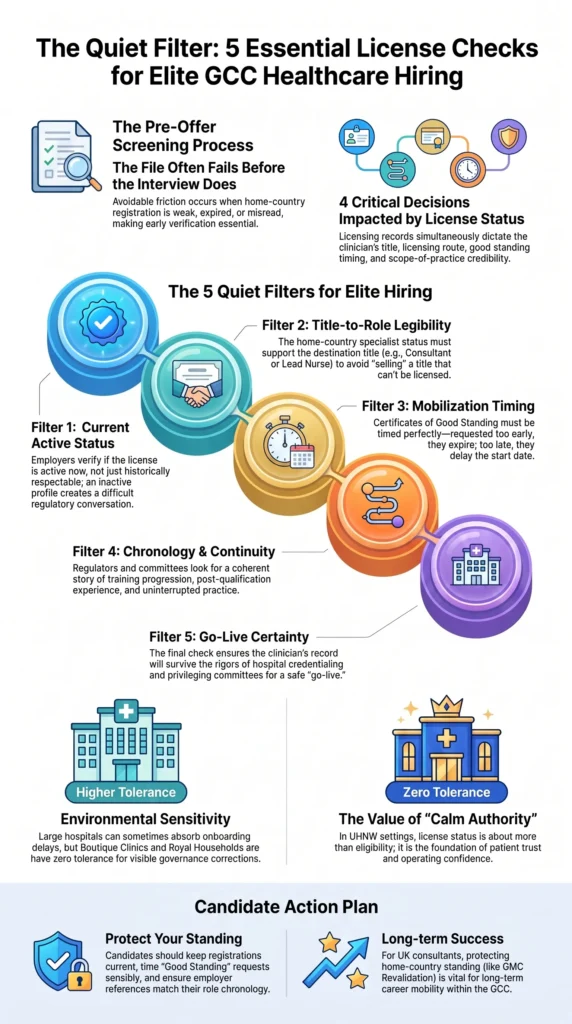
The Five Quiet Filters Serious Royal Households Use
| # | Filter | What It Protects |
|---|---|---|
| 1 | Is the licence active now, not just historically respectable? | Regulatory credibility |
| 2 | Does specialist status support the marketed title? | Title-to-role legibility |
| 3 | Is good standing current enough to travel when needed? | Mobilisation timing |
| 4 | Does chronology and continuity of practice read cleanly? | Family office confidence |
| 5 | Will the story survive credentialing and privileging? | Go-live certainty |
1. Is the home-country licence active now, not just historically respectable?
A strong past career is not the same as a clean current file.
Serious households want to know whether the clinician is actively registered, whether renewal obligations have been maintained, and whether any interruption needs explanation. In elite hiring, a profile that was excellent two years ago but is presently inactive creates a different regulatory conversation from the one many family offices expect.
For doctors, the GMC Specialist Register is one useful reference point when consultant-level positioning matters. For nurses, households can search the register directly. For physiotherapists, they can check the register, while Irish-trained physiotherapists may also need a clean CORU registration.
This is not bureaucracy for its own sake. It is about avoiding a premium conversation built on an outdated assumption.
2. Does specialist or professional status support the marketed title?
A common Gulf hiring mistake is to sell the destination title before testing the origin status.
A household may describe the role as consultant-level, lead nurse, or senior physiotherapy hire, but the home-country record still needs to support that narrative. The most credible households ask whether the title being sold is genuinely legible from the clinician’s training route, registration history, and current professional standing.
Dubai, Abu Dhabi, Riyadh, and Doha are not one title market. The same clinician can be attractive in all four locations, but the file may need to be positioned differently depending on the regulator and facility type. This is why GCC Licensing Strategy for Tier-1 Consultants should be read before role language becomes too ambitious.
3. Is good standing current enough to travel when the time comes?
Households often understand good standing in theory and mishandle it in timing.
A certificate requested too early can become commercially awkward later. One requested too late can delay the file just when the household wants certainty. In premium hiring, that timing problem becomes more visible because the clinician has usually been sold on discretion, speed, and clarity.
Good standing is not separate from home-country licence status. It is one of the clearest expressions of it.
A current, readable, regulator-friendly standing narrative signals that the clinician can move from admiration to activation without unnecessary noise — which is precisely why Good Standing Certificates GCC: Quiet Licensing Edge is such an important companion piece inside this cluster.
4. Do chronology and continuity of practice read cleanly?
An active licence alone is not enough.
The home-country story still needs coherent chronology: training progression, post-qualification experience, title evolution, employer dates, and continuity of practice. Premium candidates often have complex careers across fellowships, private work, academic posts, and leadership responsibilities. The stronger the profile, the more carefully the chronology must be presented.
Well-advised households gain an advantage by screening earlier and more quietly. A smart family office does not ask only, “Is this person impressive?” It asks, “Will this story still hold together when the regulator, the medical director, and the family office read it in sequence?”
For Abu Dhabi especially, that logic sits naturally beside DOH PQR Abu Dhabi: Tier-1 Consultant Guide, where home registration integrity and title truth matter before the role is promised.
5. Will the same story survive credentialing and privileging?
The final filter is the most commercially important.
A clinician may look licensable in principle and still create friction once the household has to define real scope, sign-off, and safe go-live conditions. Home-country licence status matters here because it influences how confidently the household can translate reputation into privilege-ready practice.
Weak hiring models treat sourcing, licensing, and credentialing as three separate conversations. Stronger households connect them from the beginning — which is precisely why Credentialing and Privileging GCC: Elite Hiring Guide should sit next to licensing strategy, not after it.
Why This Matters Differently in Private Hospitals, Clinics, and Royal Settings
A large private hospital can sometimes absorb a degree of title or onboarding friction. A boutique private clinic usually has much less room for that. A royal household or UHNW family setting has even less.
In those environments, the household is not only hiring for technical care. It is hiring for calm authority, discretion, governance maturity, and predictable operating confidence.
That changes the value of home-country licence status in GCC hiring. It becomes less about formal eligibility alone and more about whether the clinician’s record supports trust without constant explanation.
For Medical Staff Talent, this is where recruitment becomes commercially intelligent rather than transactional. We exclusively recruit UK & European-trained Doctors, Physiotherapists, and Nurses for Royal Households and UHNW/UHNWI Families across Saudi Arabia, the UAE, and Qatar — with the licensing reality built into the search from day one.
What Candidates Should Understand as Well
This issue does not sit with the household alone.
For candidates, the message is simple: do not rely on prestige language when a cleaner documentary story is available. Keep registration current. Time good standing sensibly. Make sure employer references, scope language, and role chronology tell one coherent story.
For UK-trained consultants, it is also sensible to think beyond the move itself. GMC Revalidation in the GCC: 2026 Playbook is relevant because long-term Gulf success often depends on how well the clinician protects home-country standing while adapting to a new governance environment.
Where Medical Staff Talent Fits
At Medical Staff Talent, we do not treat elite recruitment as a CV exercise followed by paperwork.
We use the home-country record as an early signal of deployability. That protects shortlist quality, title credibility, start-date realism, and long-term retention. It also helps Royal Households and family offices avoid the most expensive mistake in Gulf hiring: falling in love with the profile before stress-testing the file.
That is why our Full-Cycle Recruiting Service is designed around one operating sequence rather than disconnected steps. In premium Gulf healthcare, search quality and licensing realism should never be separated.
Closing Position
A premium offer should not be the first moment the household looks seriously at the clinician’s home-country record.
By then, the emotional and commercial cost of downgrade, delay, or correction is already too high. In elite Gulf healthcare, home-country licence status in GCC hiring is not a background administrative detail. It is the quiet filter that protects title truth, family office confidence, the principal’s trust, and the credibility of the eventual £ package.
For serious Royal Households and family offices, that check belongs at the beginning.
For a discreet discussion about title logic, regulator fit, and clean deployment across Dubai, Abu Dhabi, Riyadh, and Doha, Contact Us.
Companion Guide
Know Where You Stand Before You Apply
Nine pages covering DHA, DOH, MOHAP, SCFHS and DHP — the five-stage sequence, realistic DataFlow timelines, and the seven delay points that cost clinicians months.
Download the Gulf Licensing Roadmap →