
By David Vilchez, Founder & CEO, Medical Staff Talent
→ Sports Physiotherapist (Manual & Movement Therapy) — Private Family, Dubai
When a sports physiotherapist joins a private family in Riyadh, Dubai, Abu Dhabi or Doha, one of the first practical questions is where the work will actually happen. In a club there is a medical room; in a clinic there are cubicles and a gym. In a private residence there is usually a room that has been set aside for you, and it is often a blank canvas. How you shape it says a great deal about your standards, and it shapes the quality of every session that follows.
This guide is written for UK & European-trained physiotherapists with a sports and manual therapy profile who are considering a permanent, live-in role with one private family. It covers the space, the equipment, hygiene and records, and the travel kit that lets the treatment room follow the family wherever they go. The short video below explains what families value in a sports physiotherapist; the rest of the article is about turning that profile into a room that works. For the wider picture of the role itself, see our guide to sports physiotherapist roles with private families in the Gulf.
Why the treatment room matters more in a residence
In a private family role you treat a small number of people, often one principal and a few family members, with continuity that a clinic cannot offer. There is no waiting list and no fifteen-minute slot. That freedom raises expectations. The family’s office will judge your work not only by outcomes but by how calm, organised and discreet the setting feels. A tidy, well-equipped room signals clinical seriousness; a cluttered one undermines it, however good your hands are.
The room is also where trust is built. Principals who are used to the best hotels and private clinics notice details: clean linen, good light, a temperature that suits soft tissue work, privacy from the rest of the household. Getting these right early makes every later conversation about your programme easier.
Choosing and shaping the space
You will rarely choose the room from scratch. More often the household manager shows you a guest suite, a corner of the home gym or a spa area and asks what you need. A few principles help you make the most of what is offered.
Privacy and access
The ideal room is close to where the principal spends the day but away from the busiest corridors used by staff. A door that closes, window coverings and a quiet route in and out matter more than size. If the room is shared with a gym or pool area, agree times when it is reserved for treatment.
Light, temperature and floor
Natural light is pleasant but glare is not; soft, adjustable lighting is best for assessment and hands-on work. Gulf residences are air-conditioned to cool settings, which can make longer soft tissue sessions uncomfortable, so ask for local control of the temperature or keep warm towels and blankets to hand. A non-slip, easy-to-clean floor and enough clear space around the table for movement analysis are essential.
Room for movement, not just a table
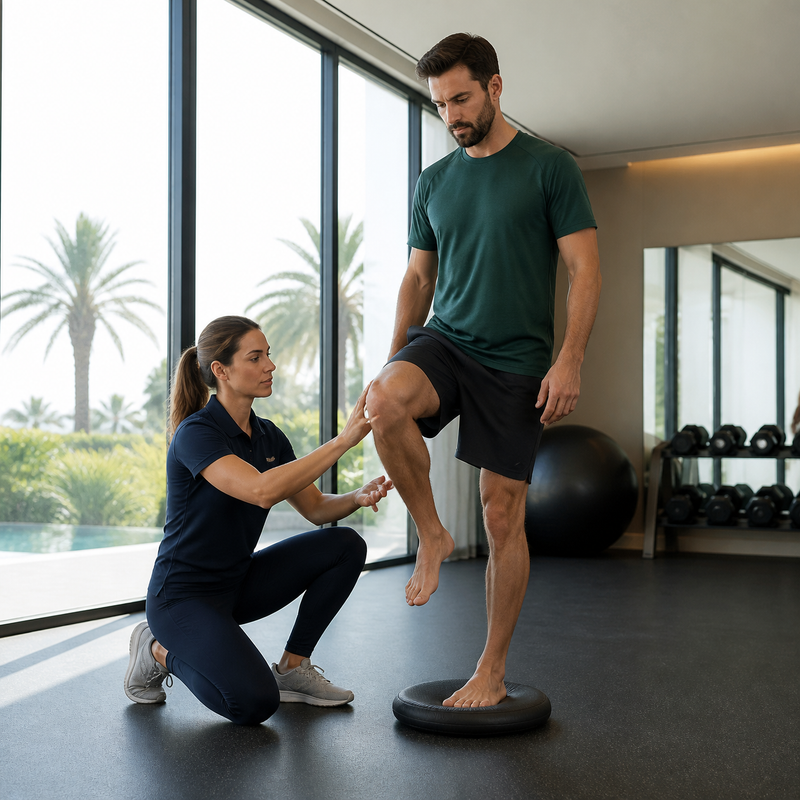
Sports and manual therapy in a private setting is rarely just passive treatment. You will want space for corrective exercise, mobility work, balance and proprioception drills, and breathing and core work. Aim for a clear area of floor where the principal can lunge, rotate and move freely, ideally with a mirror for feedback.
The core equipment list
Most families are happy to equip the room well once they understand what each item is for. Present a short, justified list rather than a catalogue. A typical starting point for a sports and manual therapy physiotherapist looks like this:
- A height-adjustable treatment table with a face hole, plus a portable table for travel.
- Mats, a set of foam rollers and massage balls for self-release and mobility work.
- Resistance bands, a small range of dumbbells or kettlebells, and a stability ball for corrective exercise.
- Balance tools such as a wobble board and balance pads for proprioception training.
- A goniometer, a tape measure and a simple dynamometer for objective measures you can track over months.
- Taping supplies, hot and cold packs, and good-quality linen and towels.
- A secure, lockable cabinet for supplies and a separate place for clean and used linen.
Electrotherapy devices, shockwave or other specialist equipment can be discussed later if the clinical picture calls for them. Start with what you will use every day and add as the programme develops; that approach also shows the family’s office that you spend their budget thoughtfully.
Hygiene, safety and professional standards
A residence is not a clinic, but your standards should be exactly the same. Agree a cleaning routine for the table and equipment, a supply of fresh linen for every session, and hand hygiene facilities in or near the room. Keep a small first-aid kit and know where the household’s own emergency arrangements are. If the principal has specific medical needs, coordinate with the family’s physician or medical team so that your work fits into one clinical picture.
Professional indemnity insurance is not covered by the family, so arrange your own cover before you start and keep it current. Our article on physiotherapist roles with private families explains the full package: from £60,000 a year gross depending on experience, with accommodation, health insurance and flights covered.
Records and confidentiality
Continuity of care depends on good notes. Keep clear, dated records of assessments, treatments, objective measures and programme changes, stored securely and never on shared household devices. Discretion is part of the role: you will usually sign a non-disclosure agreement, and nothing about the family, the residence or the principal’s health should leave the room in conversation, on social media or in photographs. A simple rule helps: if a detail would identify the family, it does not belong outside your clinical record.
A treatment room that travels
Private families move with the seasons. A typical year might include the main residence, a summer house in Europe, time on the family yacht and frequent short trips. Your treatment room has to travel with you. Most physiotherapists build a compact travel kit that fits into one or two cases:
- A lightweight portable table or a high-quality mat if a table is impractical.
- Bands, a travel roller, balls and taping supplies.
- A small set of measuring tools to keep your objective tracking consistent.
- Linen, sanitiser and a compact first-aid kit.
- Your clinical notes in a secure, encrypted format.
On a yacht or in a hotel suite, adapt rather than compromise: a session on deck at sunrise or in a cleared corner of a suite can be just as effective when the plan is clear. Flights and travel are paid by the family, and you travel with them as part of the household.
A hypothetical first fortnight
Picture a physiotherapist arriving at a residence in Abu Dhabi. In the first days they meet the household manager, walk through the options for a treatment room and agree on a guest suite near the home gym. They present a one-page equipment list, which is approved within the week, and meanwhile they work from the travel kit. By the end of the second week the room is set up, the principal has had a full assessment, and a programme of soft tissue work, assisted stretching and corrective exercise is in place, with measures recorded for review at four weeks. This is a typical case, not a real placement, but it reflects how quickly a well-prepared clinician can establish a working space.
How we work
Medical Staff Talent introduces and verifies clinicians. The engagement is contracted directly between the family and the clinician, and all local arrangements (visa, licensed entity, coordination with local clinics) remain with the family’s own office and advisers. Every role is permanent, live-in and single-status, travelling with the family.
If you are a UK & European-trained sports or manual therapy physiotherapist, read more on our physiotherapists page or, if you are an osteopath, on our osteopaths page.
Frequently asked questions
Does the family pay for the treatment room equipment?
In most cases the family’s office equips the room once it understands what each item is for. Present a short, justified list and add specialist equipment only when the clinical picture calls for it.
How large does the room need to be?
Privacy, light and a clear floor area for movement matter more than size. A guest suite or a reserved part of a home gym usually works well.
What happens when the family travels?
You travel with them and work from a compact travel kit: a portable table or mat, bands, rollers, taping supplies and your secure notes. Flights and travel are paid by the family.
What is the package for a physiotherapist?
From £60,000 a year gross depending on experience, with accommodation, health insurance and flights covered. Professional indemnity insurance is not covered. The salary is agreed directly between the family and the clinician; each clinician should take advice from their own tax adviser on whether the income is taxable in their circumstances.
How do I apply?
Send your CV through our confidential form. We review every application personally.

