
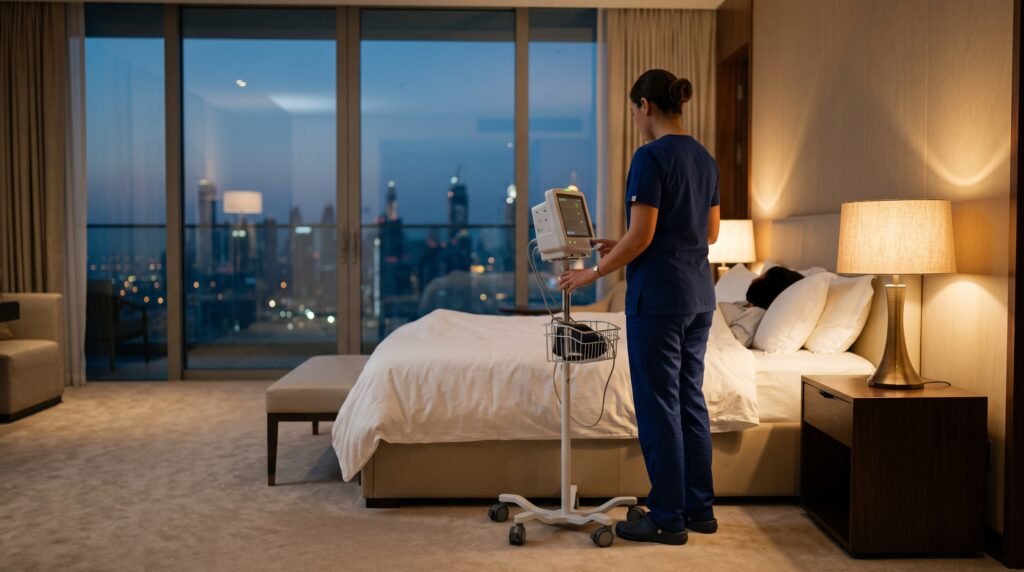
Most of the private duty nursing enquiries that reach my desk describe the job as “one patient instead of a ward.” That’s true as far as it goes, but it undersells what the senior end of this market actually asks of a nurse. A single-patient placement inside a private residence is not simply a hospital job with the volume turned down — it is case management, and at the senior level it includes coordinating care across borders, specialists and time zones with no charge nurse to hand a hard decision to.
Two mandates on my desk this month illustrate the point precisely: a Senior VIP Private Nurse role for a family in Abu Dhabi, and a Private Duty Nurse appointment for critical and post-operative care for a private family in Doha. Neither is a junior post, and neither is advertised or filled the way a general private duty vacancy would be.
A senior private duty nurse is not a more experienced version of a junior one. The scope of the decisions is different, not just the number of years behind them.
What separates a senior appointment from a standard private duty role
A standard private duty placement asks a nurse to deliver excellent one-to-one clinical care within a clearly bounded scope. A senior appointment adds three things on top: oversight of preventive and monitoring routines that run for years rather than a single recovery period, direct responsibility for escalation decisions with no second clinical opinion in the building, and — increasingly — a coordinating role across the visiting specialists, international hospitals and travelling care teams a Gulf private family relies on.
International medical coordination: what the job actually involves day to day
This is the part candidates most often underestimate. A senior private duty nurse working for a family that travels between the Gulf, Europe and the United States for specialist opinions is frequently the person who keeps the clinical record coherent across all of it — briefing the incoming specialist, translating a discharge summary from a hospital in another jurisdiction into a workable home care plan, and knowing which findings genuinely change the daily routine and which are noise. It is closer to a private case manager’s remit than a ward nurse’s, built on top of full clinical competence rather than instead of it.
The credentials and experience bar
Both mandates we are currently working specify a minimum of five to six years’ post-qualification experience in high-acuity, private duty, or VIP family health management — not simply five years of general nursing. Employers at this level are explicit that they want a nurse who has already made independent escalation calls, not one about to make their first. Fluent English, current unrestricted registration, and total NDA-level discretion are baseline, not differentiators. So are availability to start within six weeks of offer, complete flexibility around the family’s calendar, and the ability to relocate alone and travel with the family worldwide, often at short notice.
What the packages look like right now
| Mandate | Location | Package |
|---|---|---|
| Senior VIP Private Nurse, elite family residence | Abu Dhabi | £70,000 – £85,000 tax-free |
| Private Duty Nurse, critical & post-operative care | Doha | £80,000 tax-free |
| Private duty / private family nursing, general market band | GCC-wide | £48,000 – £85,000+ tax-free |
Packages at the senior end sit above the general private duty band because the coordination responsibility is priced directly, in the same way it is for the physicians who direct these households’ broader care programmes.
Frequently asked questions
What experience is required for a senior private duty nurse role in the Gulf?
Employers at this level typically ask for five to six years’ post-qualification experience in high-acuity, private duty, intensive care, or VIP family health management, with a demonstrated record of independent clinical decision-making rather than general ward experience alone.
How is a senior private duty role different from a standard one-to-one nursing job?
The clinical scope can look similar on paper. The practical difference is coordination — a senior nurse is frequently the person managing continuity across visiting specialists, international hospitals and travelling care teams, not just delivering care to a single patient in one location.
Who handles licensing for private duty nursing roles in Abu Dhabi and Doha?
All local arrangements (visa, licensing and coordination with local clinics) remain with the family’s own office and advisers.
Start a confidential conversation
I place nurses into exactly this kind of senior, coordination-heavy private duty role across the Gulf on a confidential basis. If this sounds like the direction your career is heading, send us your CV and I will talk you through the current mandates in confidence.
Further reading: Nurses practice | Private Duty Nurse for a Private Family | Private Duty Nursing vs. Hospital Nursing in the Gulf | All current mandates.
Companion Guide
Placement Inside a Private Family Runs on Different Rules
Protocol, confidentiality and NDA standards, and the pathways that lead into private family residences.
Download the Private Family Companion Guide →Commissioning on behalf of a household? Family offices and chiefs of staff can request The Household Medical Commissioning Brief. Advisers introducing a principal: Referral & Introduction Partners.