
Private, maternity and critical care nursing appointments in Saudi Arabia, the UAE and Qatar for NMC-registered nurses and midwives, retained by private families. This page sets out what happens to your NMC registration when you work for a family in the Gulf, what the Gulf regulator will ask of it, and which briefs are open now.
Keeping your NMC registration while you work abroad
Most household nurses keep their NMC registration, and the NMC’s own revalidation guidance makes that workable. Revalidation still falls every three years, but the NMC confirms that hours worked overseas as a nurse or midwife count towards the practice hours requirement. If you work wholly overseas, your confirmer can be your line manager where you work, or another regulated healthcare professional where you practise.
In a household, that usually means planning your confirmation conversation with the family’s physician or medical director well before your renewal date, and keeping your reflective accounts and CPD evidence as you go rather than reconstructing them at the end. A nurse on a Rotational pattern, back in the UK every few weeks, has more options still.
What the Gulf regulator will ask of it
Nurses are licensed by the DHA in Dubai, the DOH in Abu Dhabi, the SCFHS in Saudi Arabia and the DHP of the Ministry of Public Health in Qatar, each after DataFlow primary source verification. The UAE regulators apply the Professional Qualification Requirements, which decide your title; our guide PQR for Nurses in the UAE explains how.
From the NMC you will need a Certificate of Current Professional Status (CCPS), also called a letter of good standing. The NMC asks you to request it after you have applied to the regulator in the country where you will practise; it is sent to you and to that regulator, and it is valid for three months from issue. Request it last, not first, or it may expire before the file is read.
Care inside a residence is delivered through a licensed entity, usually the family’s own; see Who May Lawfully Treat Inside a Private Residence. We map this route with you and guide you through it; we do not submit applications, process DataFlow or sponsor visas.
Household nurses are placed in pairs, never alone. Continuity of care is designed into the appointment, not left to one person’s stamina.
What households ask of NMC-registered nurses and midwives
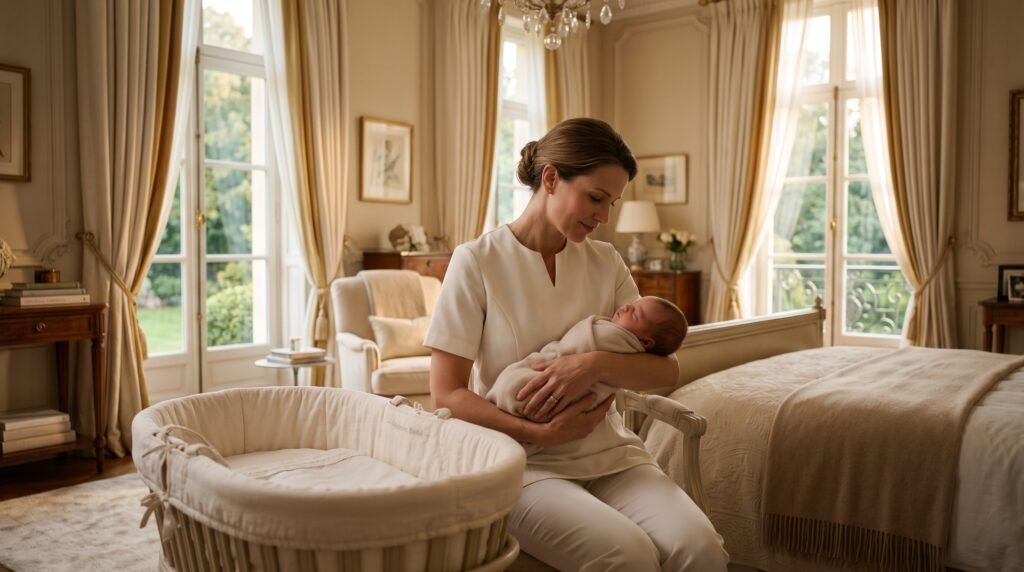
Maternity and newborn care. Registered midwives and nurses with newborn experience, supporting the mother and infant in the residence through the first weeks and often beyond. See Maternity Nurse and Newborn Care Specialist for a Private Family.
Critical care and rotational nursing. ICU, PICU, renal and geriatric nursing on residence rotas, with strict NDAs and a partner nurse on the opposite rotation. See Private Duty Nursing for a Private Family.
Travel with the family by private jet and, when the family is aboard, on the Mediterranean. See The Clinician in Transit.
How an appointment is structured
Appointments are Live-Out, Live-In, Rotational, Fixed-Term, Travelling, Locum or Sessional/Retainer, and each mandate states its model; see Live-In, Rota or Travelling? The contract is signed directly between you and the family or its licensed entity. We introduce and verify; we are not the employer, and the introduction fee is paid by the family, never by you.
Standing registers for nurses
- Dubai
- Abu Dhabi
- Riyadh
- Jeddah
- Eastern Province
- Doha, Qatar
- Locum cover for Private Families (2–12 weeks)
The Dubai, Abu Dhabi, Riyadh, Jeddah, Eastern Province and Doha pages list the named mandates open now, each with its own remuneration.
Questions NMC-registered nurses ask
Do hours worked for a family in the Gulf count towards NMC revalidation?
Yes. The NMC confirms that hours worked overseas as a nurse or midwife count towards the practice hours requirement. If you work wholly overseas, your confirmer can be your line manager where you work or another regulated healthcare professional where you practise.
When should I request my NMC CCPS?
After you have applied to the Gulf regulator, and close to when it will be read. The certificate is sent to you and to the regulator and is valid for three months from issue.
Will I work alone?
No. Household nurses are placed in pairs, and the wider team typically includes a physician and a physiotherapist.
Who employs me, and who pays your fee?
The family, or its licensed entity, under a contract you sign directly with them. We introduce and verify, and our fee is paid by the family. We map the licensing route with you but do not submit applications, process DataFlow or sponsor visas.
Register confidentially
Send us your CV in confidence. Nothing is shared with a family without your agreement. See also our Private & Maternity Nurses practice and all current mandates.