
By David Vilchez, Founder & CEO, Medical Staff Talent
Most clinicians in Spain who write to us picture a Gulf hospital: a larger department and a familiar shift pattern in a different climate. Our appointments are something else entirely. They are permanent, live-in roles with one private family in Saudi Arabia, the UAE or Qatar, where you are the clinician the household relies on, wherever the household happens to be.
This article is for nurses, physiotherapists, osteopaths and doctors trained in Spain and working in the Sistema Nacional de Salud (SNS) or in private practice, who want a clear, unvarnished picture of what changes, and of what to settle in Spain before they go.
Medical Staff Talent in one line: Exclusively sourcing UK & European-trained Private & Concierge Physicians, Physiotherapists & Osteopaths, and Private & Maternity Nurses for Private Families across the GCC.
Why a private family is a different decision from a Gulf hospital
A hospital in Riyadh, Dubai or Doha is still an institution: a department, a line manager, a roster, colleagues on the next shift. A private family is one household. There is no department to absorb a difficult day and no colleague down the corridor. You answer to the family and, usually, to the family’s office, and your patients are a small number of people you come to know very well.
That changes the decision. The question is whether you want your working life and your daily life to sit inside the same household.
From an SNS ward or clinic to one household
Caseload. In the SNS you may see dozens of patients in a shift or a clinic list. In a private household your caseload is one family, sometimes one person. The work is deeper rather than wider: continuity of care, prevention, rehabilitation that is followed through day by day, and the confidence of knowing a patient’s history in full.
Clinical autonomy. You will often be the only clinician in the residence. That brings genuine clinical autonomy, and with it the responsibility to recognise early when a specialist, a clinic or a hospital is needed, and to coordinate with the family’s own office and advisers when it is.
Documentation. There is no hospital record system to lean on. Precise, private notes that you keep yourself, and a disciplined handover when another clinician is involved, become part of the role.
SNS vs private family practice in the Gulf
| Aspect | SNS (public system in Spain) | Private family practice in the Gulf |
|---|---|---|
| Caseload | Many patients per shift or clinic | One family, often one principal patient |
| Team | Multidisciplinary department | Usually you alone, or two nurses working alternating shifts |
| Autonomy | Protocols, hierarchy, service lines | High; you decide when to involve outside specialists |
| Documentation | Institutional clinical record | Your own precise, confidential notes |
| Hours | Rostered shifts and on-call guardias | Available when the family needs you; a six-day week is normal |
| Where you live | Your own home | In the family’s residence, accommodation fully free |
| Travel | None as part of the job | Travel with the family is part of the work |
| Confidentiality | Professional secrecy | Professional secrecy plus a strict NDA |
Travel with the family
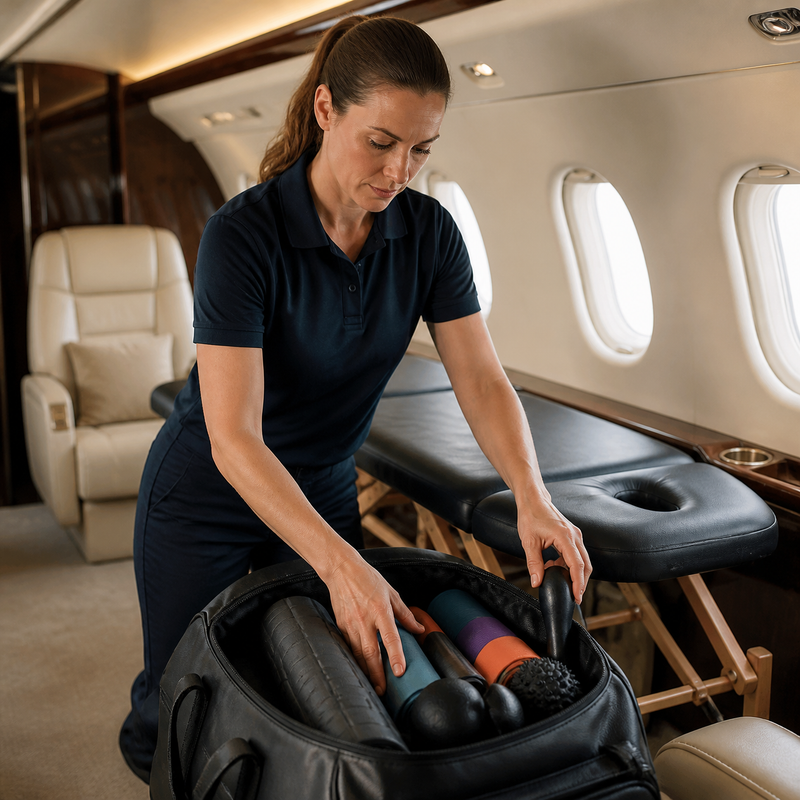
From the day you start, you travel with the family. A household based in Riyadh, Abu Dhabi or Doha may spend the summer in Europe, move between residences, fly by private jet or spend weeks on a yacht. The family arranges and pays the visas for international travel. Travel is not a holiday: it is the work, in a different setting, to the same standard of care.
Discretion and NDAs
Every appointment comes with a non-disclosure agreement, and families take it seriously. No photographs of the residence, the aircraft or the family; no social media references to where you are or whom you work for; no conversations about the household with friends or former colleagues. For more on what living in the residence involves, see what a live-in, single-status appointment means.
What private families require from day one
Three conditions apply to every appointment we introduce:
- Start within about six weeks. Families usually need someone quickly. Check your notice period, or the time your servicio de salud takes to resolve a request for leave, before you apply.
- Total flexibility. Schedules follow the family, not a roster.
- Relocate alone and travel with the family at any time. Every role is live-in and single-status.
Leaving the SNS well: what to settle before you go
The points below summarise official sources. They are not legal or tax advice, and rules change.
Keeping a route back to the SNS: excedencia voluntaria
Most SNS clinicians are personal estatutario, employed under the Estatuto Marco (Ley 55/2003), either as permanent staff (fijo) or on an interim appointment (interino). For permanent staff, the usual way to work abroad and keep a route back is excedencia voluntaria por interés particular (article 67). It requires five years of effective service in the public administrations immediately before the request, it is granted subject to the needs of the service, and the minimum period is two years. It is unpaid and does not count towards career grade or trienios.
Importantly, excedencia voluntaria does not reserve your post. Return is through the voluntary mobility procedures of any health service, or provisionally in your own health service when a vacancy exists (article 69). Your regional health service may have its own rules on timings and other situations. Confirm with your servicio de salud and, if relevant, your union or your own adviser. Source: Ley 55/2003, BOE.
Your colegio registration
In Spain, membership of the relevant colegio is a requirement to practise a profession where a state law requires it (Ley 2/1974, article 3.2), and that applies to medicine, nursing and physiotherapy. The national bodies are the Consejo General de Colegios Oficiales de Médicos, the Consejo General de Enfermería and the Consejo General de Colegios de Fisioterapeutas de España; your registration itself sits with your provincial or regional colegio. Osteopathy is not among the titled health professions listed in Ley 44/2003, so if you practise osteopathy and are also a physiotherapist, the registration that matters in Spain is your colegio de fisioterapeutas. Whether to keep your registration active while you are abroad, and what you would need to re-register on your return, is something to confirm with your own colegio.
Your tax residence in Spain
Under the IRPF law (Ley 35/2006, article 9) you are tax resident in Spain if you spend more than 183 days in Spain in a calendar year, counting sporadic absences unless you prove tax residence in another country, or if Spain is the main centre of your economic interests. There is also a presumption, unless you prove otherwise, that you are resident if your spouse (not legally separated) and dependent minor children live in Spain.
Article 8.2 keeps Spanish nationals within the scope of IRPF for the year of the move and the following four years if they move their tax residence to a tax haven, now called a jurisdicción no cooperativa. Under the current list (Orden HFP/115/2023, as amended by Orden HAC/649/2026 of 21 June 2026), the UAE, Saudi Arabia and Qatar do not appear on it. Spain also has double taxation agreements with all three countries.
Separately, Spanish nationals who live habitually abroad must register with the consulate of their district (Real Decreto 991/2024, article 3). Registering as a resident moves you onto the register of Spaniards resident abroad (PERE) and removes you from your municipal padrón. Confirm your position with the Agencia Tributaria and your own tax adviser before you leave. Sources: Ley 35/2006, BOE; Orden HAC/649/2026, BOE; Ministerio de Hacienda, double taxation agreements; Real Decreto 991/2024, BOE.
Your state pension
EU social security coordination applies across the EU, Iceland, Liechtenstein, Norway and Switzerland, with specific rules for the UK; it does not cover the Gulf. Spain has no bilateral social security agreement with the UAE, Saudi Arabia or Qatar. To keep building your Spanish entitlement, Spanish nationals working abroad can sign the convenio especial para emigrantes españoles e hijos de éstos que trabajen en el extranjero (Orden TAS/2865/2003, article 15), whichever country they work in. It covers retirement, permanent incapacity, and death and survivors’ benefits, is calculated on the minimum contribution base of the general scheme, and is paid quarterly in arrears; applications from abroad go to the Tesorería General de la Seguridad Social in Madrid. Confirm the current contribution and the procedure with the Seguridad Social or your own adviser. Sources: Orden TAS/2865/2003, BOE; Seguridad Social, bilateral agreements; European Commission, EU social security coordination.
For the money side more broadly, see the Gulf cost of living and your net position and wealth preservation for GCC clinicians.
The three service lines
Private & Maternity Nurses. Nurses are always appointed in pairs: two nurses alternating shifts of 8 or 12 hours, under a strict NDA, so that care is continuous and each nurse has genuine rest. Experience in neonatal, maternity, paediatric, intensive or home care in Spain translates well. See how private nursing in pairs works.
Physiotherapists & Osteopaths. Musculoskeletal, sports, neurological and post-surgical rehabilitation experience is what families most often ask for, together with the ability to design and deliver a programme with no department behind you.
Private & Concierge Physicians. Family medicine, internal medicine and emergency experience in Spain are strong foundations: broad clinical judgement, calm decision-making and the ability to coordinate specialists on the family’s behalf.
Realistic salary bands
As market references, gross:
- Private & Concierge Physicians: £218,000 a year gross, with free accommodation and medical insurance covered (professional indemnity insurance is not included).
- Physiotherapists & Osteopaths: from £60,000 a year gross, depending on experience.
- Private & Maternity Nurses: from €5,000 a month.
The salary is agreed directly between the family and the clinician; each clinician should take advice from their own tax adviser on whether the income is taxable in their circumstances.
These are permanent roles with annual leave, with the contract renewed yearly, and accommodation in the residence is fully free. Medical insurance is covered; professional indemnity insurance is not included. Flights and travel are always paid for by the family. To compare a package with your current position in euros, use the UK & European vs GCC gross package calculator, which includes Spain in its selector.
The honest trade-offs
- Availability. Being available around the clock and working a six-day week are normal.
- Living where you work. The residence is your home and your workplace; switching off takes discipline.
- Time off on the family’s timetable. Annual leave is real, but it is planned around the family’s calendar.
- Professional isolation. No team meetings, no corridor second opinions; you keep your own skills current.
- Distance from home. Family events in Spain will sometimes happen without you.
Who it suits and who it does not
It suits clinicians who are clinically confident, discreet and genuinely interested in one patient’s care over time. It does not suit anyone who needs a fixed timetable, a partner or children with them, or a large team around them.
Picture a physiotherapist trained in Spain, ten years into a hospital rehabilitation service, single, fluent in English and frustrated by fifteen-minute appointments. In a private household she would follow one patient’s recovery every day, travel with the family through the summer and plan her own programme without a waiting list. This is a hypothetical profile.
How the introduction works
Medical Staff Talent introduces and verifies clinicians. The engagement is contracted directly between the family and the clinician, and all local arrangements (visa, licensed entity, coordination with local clinics) remain with the family’s own office and advisers.
The process is simple. A family’s office sends us a brief. We match it against clinicians we know, speak with you in confidence, and verify your registration, references and clinical history. We then introduce a small number of clinicians, the family holds video interviews, and the family makes the offer. We are not the employer and we are not a party to the contract, and your CV is never sent to a family without your agreement.
For a wider view, read our guide for European-trained clinicians.
How to apply
Send your CV through the website form. Fluent English is required, as families and their offices work in English. Prefer to read in Spanish? See our page in Spanish.
Frequently asked questions
Can I keep my place in the SNS while I work for a family?
If you are permanent staff, excedencia voluntaria por interés particular can keep a route back, but it requires five years of prior public service, lasts at least two years and does not reserve your post: you return through mobility procedures or a provisional vacancy. Confirm with your servicio de salud.
Do I keep my colegio registration?
Colegio membership is required to practise medicine, nursing and physiotherapy in Spain. Whether to keep it active while you are abroad, and what re-registration would involve, is something to confirm with your own colegio.
Can my partner or children come with me?
No. Every role is live-in and single-status, and you travel with the family at any time.
What is the pay?
As market references, gross: Private and Concierge Physicians £218,000 a year gross with free accommodation and medical insurance covered (professional indemnity insurance is not included); Physiotherapists and Osteopaths from £60,000 a year gross, depending on experience; Private and Maternity Nurses from €5,000 a month. The salary is agreed directly between the family and the clinician.
How much will I travel?
From the day you start, you travel with the family between their residences and abroad, often to Europe in summer. The family arranges and pays the visas for international travel, and travel is part of the work.
Is Medical Staff Talent my employer?
No. Medical Staff Talent introduces and verifies clinicians. The engagement is contracted directly between the family and the clinician, and all local arrangements remain with the family’s own office and advisers.
Apply in confidence
If a permanent, live-in role with one private family in Saudi Arabia, the UAE or Qatar fits the next stage of your career, send your CV through our website form. Every conversation is confidential.
Sources: BOE (Ley 55/2003); BOE (Ley 2/1974); BOE (Ley 44/2003); BOE (Ley 35/2006); BOE (Orden HAC/649/2026); Ministerio de Hacienda; BOE (Real Decreto 991/2024); BOE (Orden TAS/2865/2003); Seguridad Social; European Commission.