By David Vilchez, Founder & CEO, Medical Staff Talent
Physiotherapists who ask us about private family appointments usually understand the clinical work within minutes. Soft tissue release, assisted stretching, mobility, movement control and injury prevention are familiar territory. What they find harder to picture is the rhythm of the week, especially when the family is on the move. What does a travelling physiotherapist actually do between a departure from Riyadh and a summer residence on the Mediterranean?
This article answers that question with a hypothetical diary. It is not an account of a real family, a real clinician or a real placement. It is a composite that reflects how these appointments typically run, written for European-trained physiotherapists with a sports and manual therapy background who are weighing up a permanent, live-in role that travels.
Medical Staff Talent in one line: Exclusively sourcing UK & European-trained Private & Concierge Physicians, Physiotherapists & Osteopaths, and Private & Maternity Nurses for Private Families across the GCC.
The setting
Picture a family based in Riyadh. The principal is in his fifties, plays padel most evenings and has a shoulder that needs regular care. His wife rides and has begun to notice her lower back after long sessions. Their teenage son plays tennis competitively. The principal’s mother, in her late seventies, wants to stay steady on her feet and independent. In early summer, the family moves to a villa on the Mediterranean coast for several weeks, with a few days in a European capital on the way.
The physiotherapist is a European-trained sports physiotherapist in their thirties, two years into a permanent appointment with the family. They live in a private apartment on the family compound in Riyadh and travel wherever the family goes, with a room of their own at every destination.
Sunday: preparation day in Riyadh
The day before a long journey is mostly planning. In the morning the physiotherapist runs the usual sessions: a shoulder session for the principal with soft tissue release through the posterior cuff and thoracic spine, joint mobilisation and a short block of scapular control work, then a balance and gait session with the principal’s mother in the garden.
In the afternoon they pack their travel kit, which lives in a dedicated case so that it can leave at short notice:
- a lightweight portable treatment table, unless the destination already has one;
- resistance bands in several strengths, a mobility ball, a small foam roller and a balance pad;
- their assessment tools and a tablet with their clinical notes, secured and backed up;
- a printed one-page plan for each family member for the next fortnight, adjusted for travel.
They confirm the schedule with the household manager: departure time, seating, arrival plans and where they will be staying. Flights and travel are paid for by the family, and the family’s office arranges the logistics. Their job is to be ready.
Monday: the flight
Long flights are where a travelling physiotherapist earns their place. Before departure they give the principal fifteen minutes of mobility work and a reminder about hydration. On board, they keep an unobtrusive eye on the principal’s mother, who is prone to stiffness and swollen ankles on long journeys, and suggest a short walk and ankle exercises at sensible intervals.
On arrival in the European capital it is mid-afternoon. Everyone is tired. The physiotherapist does not run full sessions, but offers short, gentle work to whoever wants it: ten minutes of assisted stretching for the son, some breathing and thoracic mobility for the principal, and a check that the principal’s mother’s room has a clear route to the bathroom at night. They go to bed early. Jet lag affects the clinician too.
Tuesday: city day
The family has meetings and appointments in the city. Sessions move to early morning in the hotel suite. The principal wants his shoulder ready for a padel match the family has booked with friends. The physiotherapist uses manual therapy and mobility work, followed by a short neuromuscular warm-up he can repeat himself before play.
In the afternoon they have free time and use it: a walk, a museum, a coffee alone with a book. Rest during travel is not an indulgence. It is how a clinician stays sharp across a long summer. They check in with the household manager in the evening to confirm the plan for the next day.
Wednesday: arrival at the summer residence
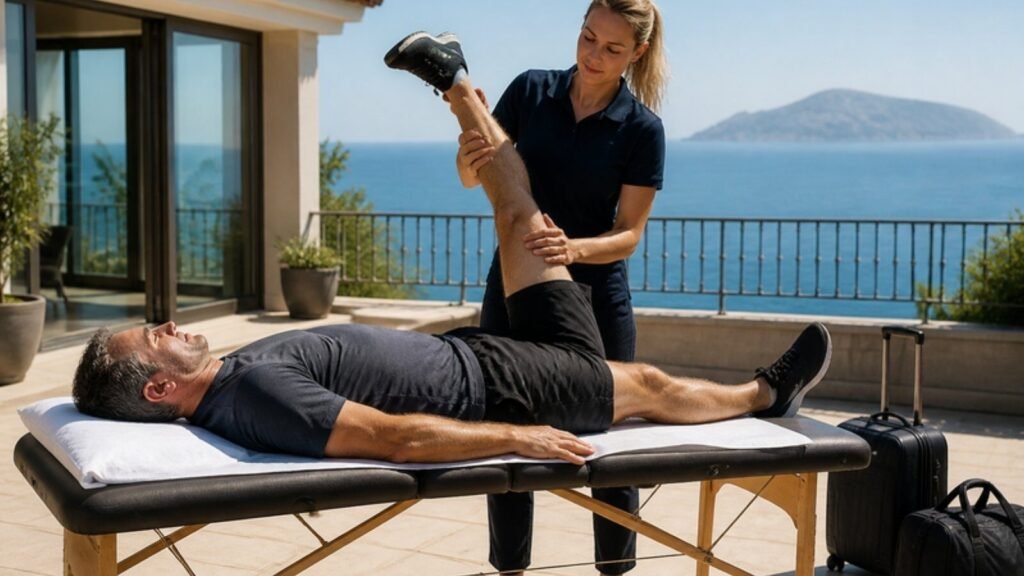
A short flight and a drive take the family to the coast. The villa has a terrace overlooking the sea, a small gym and a room that can be set up as a treatment space. The physiotherapist’s first job is practical: set up the treatment room, check the gym equipment, and find the safest flat surfaces for balance work with the principal’s mother.
They also meet the summer household team. Some travel with the family, some are local. A few minutes of introduction now makes the following weeks smoother. If you want a sense of how a physiotherapist sets up a working space inside a residence, our guide to how families structure a permanent private physiotherapist appointment is a good starting point.
Thursday: a full clinical day
With the family settled, the programme returns to full rhythm. A typical day at the villa might look like this:
| Time | Who | Focus |
|---|---|---|
| 07:30 | Son | Movement screen and corrective exercise before tennis training: hip control, ankle stiffness, landing mechanics |
| 09:30 | Principal’s mother | Balance and proprioception on the terrace, sit-to-stand strength, a short walk on uneven ground with supervision |
| 11:00 | Principal’s wife | Lower back: soft tissue release, lumbar and hip mobility, breathing and deep core control for riding |
| 13:00 to 16:00 | Free | Lunch, rest, a swim |
| 17:30 | Principal | Pre-padel preparation: shoulder mobilisation, assisted stretching, activation drills |
| 20:00 | Principal | Short recovery session after play if he wants it |
None of the sessions are long. What matters is consistency and timing: work done before play, recovery after it, and progress explained in plain language. The principal does not want a lecture on scapular kinematics. He wants to know that his shoulder will hold up through the summer, and that someone is watching for the early signs that it will not.
Friday: the unexpected
Travel always brings something unplanned. In this hypothetical week, the son rolls his ankle lightly during training. The physiotherapist assesses it on court, rules out anything that needs imaging or a doctor, and manages it conservatively: protection, early movement, a modified training plan and a conversation with his coach about load for the next few days. They document it and inform the household manager. If anything had been outside their scope, they would have coordinated with the family’s physician or a local clinic through the family’s office.
Clinical autonomy is a defining feature of these roles. You are often the only physiotherapist present, and the family expects sound decisions, clearly explained. Experience with elite athletes, professional teams or high-profile clients is a strong advantage precisely because it builds this kind of calm judgement. Our article on moving from elite sport to a private family explores which parts of that experience transfer directly.
Saturday: a lighter day
The family has a day on the water. The physiotherapist joins them, with a small kit, but most of the day is quiet. They run one short session for the principal’s mother on the boat’s deck, focusing on gentle mobility and breathing, and otherwise stay available without being in the way. Knowing when not to treat is part of the job.
In the evening they update their notes, review the plan for the next week and call home.
Day off
The physiotherapist’s day off is agreed in advance with the household manager. They leave the villa, take a long walk along the coast, train for themselves and have dinner in the village. They keep their phone on for genuine emergencies, but the household knows it is their day.
Protecting rest is the single most important habit in a travelling role. These are permanent appointments with time off and annual leave, but the family’s diary sets the pattern, and flexibility is part of the role. Clinicians who plan their rest deliberately are the ones who are still enjoying the work years later.
What this week tells you about the role
- The clinical work is familiar. Manual therapy, movement control, corrective exercise, injury prevention, breathing and balance work. What changes is the setting.
- Timing matters as much as technique. Sessions fit around play, travel and the family’s day, not around a clinic timetable.
- You need a portable mindset. A compact kit, notes you can access anywhere, and the ability to set up a treatment space in a new place within an hour.
- Discretion is constant. You travel with the family in private moments. You do not photograph, post or discuss.
- Rest is your responsibility. Plan it, protect it, use it.
What families require
- Start within about six weeks of an offer.
- Total flexibility on hours and destinations.
- Relocate alone and travel with the family: every role is live-in and single-status, so a partner or children do not relocate with you.
- A physiotherapy qualification obtained in Europe, with valid registration in the country where you trained, and fluent English for daily clinical work.
Remuneration and what is covered
As a market reference, physiotherapists in private family appointments earn from £60,000 a year gross, depending on experience. Private accommodation is provided free of charge, at home and when travelling. Flights and travel are always paid for by the family, and medical insurance is covered. Professional indemnity insurance is not included. The salary is agreed directly between the family and the clinician; each clinician should take advice from their own tax adviser on whether the income is taxable in their circumstances.
How the introduction works
Medical Staff Talent introduces and verifies clinicians. The engagement is contracted directly between the family and the clinician, and all local arrangements (visa, licensed entity, coordination with local clinics) remain with the family’s own office and advisers.
We read every CV personally, speak with you, verify your qualification, registration and references at source, and introduce you to a family only when a brief matches your experience, and only with your agreement. For the clinical scope families ask for, read our guide to sports physiotherapist jobs with private families in the Gulf, and see current openings such as our sports physiotherapist role with a private family in Riyadh.
Frequently asked questions
How often does a travelling physiotherapist travel with the family?
Often. From the first weeks, you travel continuously with the family across several countries, following their diary. Flights and travel are always paid for by the family.
Where do I stay when the family travels?
Usually where the family stays, or very close by, in a private room of your own arranged by the family’s office.
Do I need to bring my own treatment table?
It depends on the destination. Many physiotherapists keep a compact travel kit with a portable table, bands, a mobility ball, a foam roller and assessment tools, and agree with the household which destinations already have equipment.
Do I still get days off while travelling?
Yes. Time off continues while travelling, agreed in advance with the household manager and fitted around the family’s diary.
What happens if a family member needs care outside my scope?
You coordinate with the family’s physician or local services through the family’s office. Clinical decisions within your scope remain yours.
Is this a temporary travel contract?
No. Every role we introduce is permanent and live-in, with annual leave. Travelling with the family is part of the permanent role, not a separate contract.
Apply in confidence
If you are a European-trained physiotherapist with a sports and manual therapy background, can start within about six weeks, and are ready to relocate alone and travel with a family, we would like to hear from you. Send us your CV in confidence.
Send your CV in confidence