
By David Vilchez, Founder & CEO, Medical Staff Talent
Physiotherapists trained in Sweden, Denmark, Norway, Finland and Iceland rarely think of their education as an export. It is simply how physiotherapy is done at home: active, evidence-informed, built around movement and the patient’s own effort. Yet when private families in Saudi Arabia, the UAE and Qatar describe the physiotherapist they want, they often describe exactly that approach, combined with skilled hands.
This article is for Nordic-trained physiotherapists with a sports and manual therapy background who are curious about a permanent, live-in role with a private family in the Gulf. It explains what families are asking for, which parts of a Nordic training translate directly, what changes, and how an introduction works. Where we describe a situation, it is a hypothetical example, not an account of a real person or placement.
Medical Staff Talent in one line: Exclusively sourcing UK & European-trained Private & Concierge Physicians, Physiotherapists & Osteopaths, and Private & Maternity Nurses for Private Families across the GCC.
What private families are asking for now
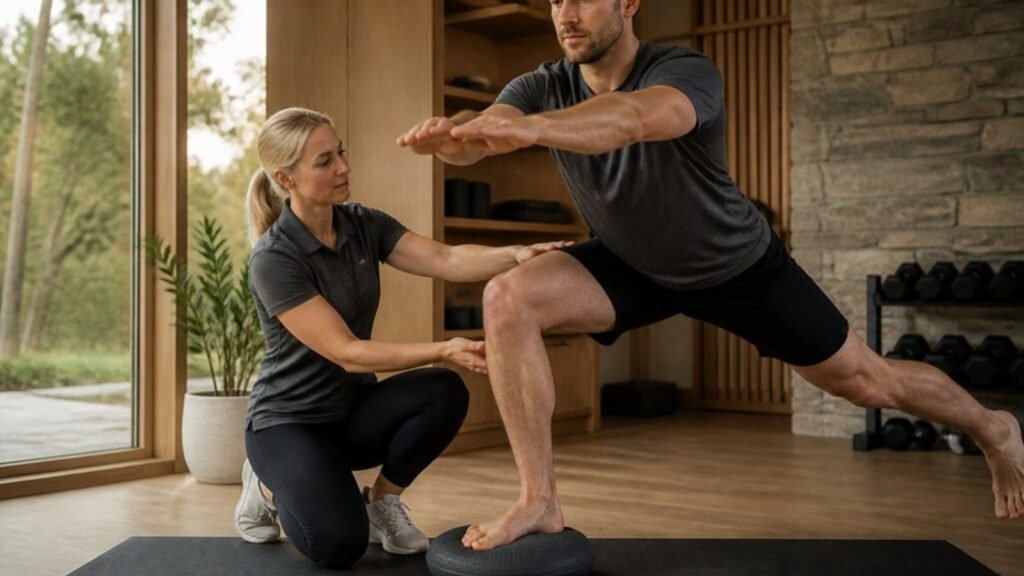
The brief we see most often today is remarkably consistent. Families want a physiotherapist with a sports and manual therapy profile who can keep an active household moving and free of injury. The core skills are:
- soft tissue release and assisted stretching;
- active mobility work and joint mobilisation;
- neuromuscular techniques for movement control and corrective exercise;
- movement analysis and biomechanics;
- injury prevention built around how each person trains and lives;
- breathing and core control;
- proprioception and balance training.
Experience with elite athletes, professional teams or high-profile clients is a strong advantage. Strength and conditioning plays a smaller part; the emphasis is on the manual and movement-control end of the spectrum. For a full picture of the clinical scope, read our guide to sports physiotherapist jobs with private families in the Gulf.
What a Nordic training brings
Physiotherapy education across the Nordic countries is delivered at university level, typically as a three to four year degree, with substantial clinical placements. Programmes differ from country to country, and every clinician’s path is individual, but several strengths come up again and again when we speak with Nordic-trained physiotherapists.
An active, exercise-led philosophy
Nordic physiotherapy tends to put the patient’s own movement at the centre. Exercise therapy, graded loading and patient education are part of everyday practice. In a private household, that matters: families want results that last between sessions, and a principal who understands and owns his programme is a principal who stays well.
Manual therapy as a recognised discipline
Many Nordic physiotherapists build on their degree with postgraduate manual therapy education. In Norway, for example, manual therapy is a recognised postgraduate specialisation. Whatever your route, a solid manual therapy foundation, combined with an active approach, is precisely the blend families describe: hands-on work to restore movement, followed by exercise to keep it.
A strong sports culture
Football, handball, cross-country and alpine skiing, ice hockey, orienteering, sailing and endurance sport are part of everyday life across the region. Many Nordic physiotherapists have worked with clubs, national federations or youth academies, or are athletes themselves. That experience translates directly into households where the principal plays padel or tennis most evenings, the children train seriously, and the family skis or sails on holiday.
Clinical autonomy and direct access
Nordic physiotherapists are used to taking clinical responsibility, assessing independently and explaining decisions clearly. In a private family role you are often the only physiotherapist in the house, so that independence is essential. You coordinate with the family’s physician when something sits outside your scope, but day-to-day clinical decisions within your scope are yours.
Plain, egalitarian communication
The Nordic habit of explaining things simply and treating the patient as a partner works well with principals who are busy, direct and used to expert advice. Families value a physiotherapist who says what they are doing, why, and what the person should do between sessions.
What changes when you join a private family
The clinical work is familiar. The setting is not. Picture a physiotherapist from Gothenburg with several years in a sports clinic and a season with a handball club. In the new role they work with five members of one family instead of a full caseload. Their treatment room is in a residence in Abu Dhabi. In summer, the room is a villa terrace in Europe. Their diary follows the family’s, not a clinic’s booking system.
The main adjustments are:
- From caseload to continuity. You see the same people for years, which allows prevention and long-term progress that a clinic rarely can.
- From fixed hours to flexibility. The family’s diary sets the pattern. Availability and flexibility are part of the role, balanced by time off and annual leave.
- From a team to a household. Your colleagues are household managers, drivers, chefs, trainers and nannies, sometimes a nurse or a physician.
- From one city to many. You travel continuously with the family across several countries.
- From open to discreet. Confidentiality is absolute. You do not post about your work or discuss the family.
Practical points for Nordic clinicians
Climate and daily rhythm
Summers in the Gulf are hot, and daily life moves indoors or to early mornings and evenings. Many families spend part of the hottest months in Europe, and you travel with them. Expect air-conditioned gyms and treatment rooms, evening sport and early-morning sessions.
Living alone in a household
Every role is live-in and single-status: you relocate alone and have private accommodation, free of charge, in or right next to the residence. Our article on your first 90 days in a live-in physiotherapist job covers privacy, the household team and protecting your rest.
Language
Fluent English for daily clinical work is expected. Nordic clinicians usually find this straightforward. Other languages are a bonus, not a requirement.
Your registration at home
Families ask for a physiotherapy qualification obtained in Europe with valid registration in the country where you trained. Keep that registration active and your continuing professional development up to date. All local arrangements in the Gulf (visa, licensed entity, coordination with local clinics) remain with the family’s own office and advisers.
Reading in your own language
We publish our physiotherapy pages in several Nordic languages: Swedish, Danish, Norwegian and Finnish. Our application form and CV are in English.
What families require
- Start within about six weeks of an offer.
- Total flexibility on hours and destinations.
- Relocate alone and travel with the family: every role is live-in and single-status, so a partner or children do not relocate with you.
- A physiotherapy qualification obtained in Europe, with valid registration in the country where you trained. What counts is where you trained, not your nationality.
Remuneration and what is covered
As a market reference, physiotherapists in private family appointments earn from £60,000 a year gross, depending on experience. Private accommodation is provided free of charge, flights and travel are always paid for by the family, and medical insurance is covered. Professional indemnity insurance is not included. The salary is agreed directly between the family and the clinician; each clinician should take advice from their own tax adviser on whether the income is taxable in their circumstances.
These are permanent appointments with annual leave, and you travel with the family from the first weeks.
How the introduction works
Medical Staff Talent introduces and verifies clinicians. The engagement is contracted directly between the family and the clinician, and all local arrangements (visa, licensed entity, coordination with local clinics) remain with the family’s own office and advisers.
You send your CV through our confidential form. We read it personally, speak with you, verify your qualification, registration and references at source, and introduce you only when a brief matches your experience, and only with your agreement. You can read more about the profile on our physiotherapists page, about the wider European picture in our guide to working for a private family in the Gulf as a European-trained clinician, and see a current opening such as our sports physiotherapist role with a private family in Abu Dhabi.
Frequently asked questions
Do private families in the Gulf accept physiotherapists trained in the Nordic countries?
Yes. Families ask for a physiotherapy qualification obtained in Europe, with valid registration in the country where you trained. Sweden, Denmark, Norway, Finland and Iceland are all within that scope.
Do I need elite sport experience?
It is a strong advantage, not a gate. Physiotherapists with a solid sports or musculoskeletal caseload and a strong manual therapy foundation are considered on the same basis.
Is the role hospital or clinic based?
No. You work for one private family, in a treatment space within their residence and wherever they travel.
Can I apply in Swedish, Danish, Norwegian or Finnish?
Our pages are available in those languages, but the CV form is in English and your CV should be in English, because daily clinical work is in English.
Is the role permanent?
Yes. Every role we introduce is permanent and live-in, with annual leave, and you travel with the family across several countries.
Is Medical Staff Talent my employer?
No. Medical Staff Talent introduces and verifies clinicians. The engagement is contracted directly between the family and the clinician, and all local arrangements remain with the family’s own office and advisers.
Apply in confidence
If you are a Nordic-trained physiotherapist with a sports and manual therapy background, can start within about six weeks, and are ready to relocate alone and travel with a family, we would like to hear from you. Send us your CV in confidence.
Send your CV in confidence