The clinical brief ran to two pages. The confidentiality schedule ran to nine.
That ratio tells you most of what you need to know about neonatal and paediatric private duty nursing at the top of the Gulf market. The nursing is exacting but recognisable — any senior NICU or PICU nurse would understand the case within a minute. What is not recognisable, and what no ward career prepares a clinician for, is everything around the nursing.
These are the least visible appointments we handle. They are also, by some distance, the ones candidates ask about most and understand least.
What the appointment actually is
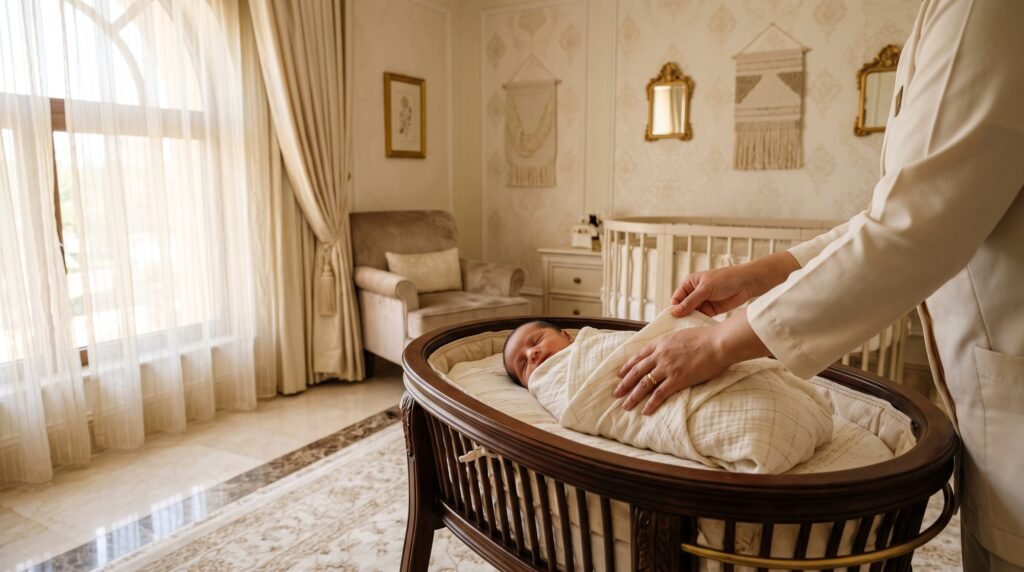
A private family retains a nurse — occasionally a small nursing team on rotation — for the care of an infant or child. The reasons vary. A premature infant discharged home on oxygen or with feeding support. A child with a complex congenital condition requiring continuous management. A neurologically impaired child with airway, seizure and nutritional needs. Occasionally, a well child in a household that simply expects continuous paediatric clinical presence in the way it expects continuous security.
The nurse works within a private residence, sometimes across several residences and a seasonal travel pattern. The reporting line runs through a household or family office structure rather than a nursing hierarchy. The clinical governance runs through a retained physician. And the appointment is measured in years — three, five, in some cases the entire childhood.
The distinction from agency private duty work in UK and European markets is worth drawing sharply. This is not shift-based domiciliary nursing. It is a senior professional appointment with continuity, autonomy, and an expectation of judgement that considerably exceeds what a band-equivalent ward role would demand.
The clinical specification
Families and their medical advisers are specific. The specifications we receive tend to cluster around a consistent core.
| Domain | What is typically required |
|---|---|
| Base registration | NMC, NMBI, or an equivalent European nursing registration, in good standing and maintained |
| Specialty background | Substantial recent NICU, PICU or complex paediatric community experience — commonly five years or more at senior level |
| Airway and respiratory | Tracheostomy care, home ventilation and non-invasive support, oxygen therapy, suction, recognition of respiratory deterioration |
| Feeding and nutrition | NG and gastrostomy management, feeding pumps, growth monitoring, liaison with dietetic input |
| Neurological | Seizure recognition and rescue medication, developmental observation, positioning and posture management |
| Vascular access | Central line care and management where indicated, and the infection-control discipline that surrounds it |
| Life support | Current paediatric and neonatal resuscitation certification, maintained throughout the appointment |
| Medicines | Paediatric calculation, controlled drug handling within a domestic setting, storage and reconciliation |
| Emergency capability | Ability to run a paediatric emergency alone until help arrives, in a house, at night |
That final row is the one candidates should sit with. In a hospital, deterioration triggers a team. In a residence at three in the morning, deterioration triggers you. Everything about the selection process is, ultimately, an attempt to establish whether a nurse can hold that.
Governance in a house
The most common misconception among strong candidates is that a household appointment means practising without structure. Households of this calibre do not want an unsupervised clinician, and a nurse should not accept one.
Well-constructed appointments carry the following, and where they are absent it is a legitimate — indeed expected — question at interview.
- A named supervising physician, usually a paediatrician or neonatologist retained by the family, with defined review intervals and clear responsibility for the clinical plan.
- A written escalation pathway: which private hospital, which consultant, what transport, and what the household does in the first four minutes of an emergency.
- Documentation standards — proper clinical records, kept properly, retained appropriately. The absence of an electronic patient record is not an absence of a record-keeping obligation, and your home regulator’s expectations follow you into the house.
- Medicines governance covering prescribing, storage, controlled drugs and reconciliation within a domestic environment.
- Defined rest. A nurse who has been awake for thirty hours is a clinical risk regardless of seniority. Rotation, relief cover and genuine off-duty are safety features, not perks.
- An identified confirmer or senior registrant for the purposes of maintaining your home registration.
“We decline mandates. A household that will not name a supervising physician, or will not fund relief cover, is not offering a clinical appointment — it is offering an exposure. Protecting the candidate from that is part of the retained brief, not an add-on to it.” — David Vilchez, Founder & CEO, Medical Staff Talent
Discretion as a clinical competency
Confidentiality in these appointments is absolute and contractually enforced, and it extends well beyond the ordinary professional duty. A nurse will know the identity of the family, the health status of a child, the internal rhythm of a household, and a great deal that has nothing to do with medicine. None of it is ever discussed — not with friends, not on any social platform, not in a professional anecdote at a conference, not after the appointment ends.
Candidates sometimes hear this as an imposition. In practice, nurses who do this work well describe it as a relief. The obligation is clean, it is understood by everyone in the household, and it produces a working environment of unusual calm.
Two practical notes. First, discretion and record-keeping are not in tension: your clinical documentation obligations remain, and a well-drafted confidentiality schedule accommodates them. Second, an NDA does not prevent you from maintaining your professional registration — anonymised reflective practice discloses nothing about a patient’s identity, and this should be agreed explicitly rather than assumed. Raise it during negotiation.
How selection actually works
The process bears little resemblance to hospital recruitment, and the sequence surprises people.
- The mandate is never published. No job board, no advertisement, no company careers page. The family’s requirement is confidential information in itself.
- A shortlist is drawn from a standing pipeline. Typically four candidates. They come from clinicians already known to us, already verified, already assessed. This is the single reason we ask serious nurses to register long before they intend to move.
- Verification precedes presentation. Registration status, references and history are checked at source before a name reaches the household.
- Clinical interview. Usually with the supervising physician. Genuinely searching, and appropriately so.
- Household interview. With the family office, the household manager, and frequently with family members directly. This stage assesses judgement, temperament, discretion and fit inside a home. It is not a formality, and it is where most candidates are decided.
- Trial period. Commonly a short structured period in the household before a long-term appointment is confirmed. Both parties are assessing.
What distinguishes successful candidates at stage five is rarely clinical. It is bearing. The ability to be present in a family’s home for years without becoming a member of the family or a stranger in it. Warmth without familiarity. Authority without assertion. It cannot be taught quickly and it is visible within ten minutes.
Remuneration
| Appointment | Indicative net, tax-free band | Principal drivers |
|---|---|---|
| Paediatric private duty nurse, single residence | £75,000 – £95,000 | Clinical complexity, hours pattern, seniority |
| Neonatal or complex paediatric specialist, private family | £88,000 – £110,000 | Specialty depth, sole clinical responsibility, exclusivity |
| Lead nurse coordinating a household clinical team | £95,000 – £110,000+ | Team leadership, governance accountability, travel obligation |
All net and tax-free, in the bands we see across our private duty mandates, and typically accompanied by accommodation — within or adjacent to the residence, or a separate villa allowance — annual repatriation travel, full family medical cover, and international schooling for dependants where the appointment permits a family.
Two structural points deserve attention. Where a role requires the nurse to travel with the family, establish what share of the year that represents and how leave is protected around it. And where a household proposes an exclusivity clause, understand what it restricts and for how long after the appointment ends.
Who this suits, and who it does not
It suits nurses who want depth rather than variety, who are comfortable with autonomy and rigorous about governance, who find continuity meaningful rather than confining, and who are genuinely private people. Many stay for the full duration of a childhood and describe it as the most significant clinical relationship of their career.
It does not suit nurses who need a team around them, who are energised by acuity and turnover, who find domestic proximity claustrophobic, or who need professional recognition from peers — because there is no ward, no register your name appears on, and no colleague who will ever know what you did.
Both are legitimate. The failure mode is a nurse who took the appointment for the package and discovered the shape of the work eight months in.
Protecting your career while you do it
Three disciplines separate nurses who emerge from a long household appointment stronger from those who emerge from it stranded.
Keep your home registration live and your evidence file current from day one; a long appointment with a lapsed licence is a career cul-de-sac. Keep your emergency and life support certifications renewed without exception. And maintain professional contact outside the household — supervision, congress attendance, a specialty network — so that the isolation does not quietly become deskilling. Each of these should be funded and diarised in the contract, not left to goodwill.
Where a household appointment sits alongside a physiotherapy or physician appointment for the same child — which in complex paediatric cases is common — the clinical team is best recruited together rather than piecemeal. Our physiotherapy practice and doctors practice routinely run in parallel with a nursing mandate for exactly this reason, and the licensing route for the whole team is mapped in advance through our Gulf healthcare licensing support function.
Rotation, relief and the two-nurse model
The most common structural failure in these appointments is not clinical. It is fatigue, and it is designed in at the contract stage by families who have never staffed a clinical rota before.
A household that requires continuous paediatric nursing presence requires more than one nurse. This is arithmetic, not preference. A single clinician cannot provide safe cover across a year that contains sleep, illness, annual leave, professional development and the ordinary business of having a life. Where a family attempts it, the outcome is predictable: the nurse absorbs the gap for six months out of loyalty to a child she has become attached to, and then resigns abruptly, which is the worst possible outcome for the family and for the patient.
Well-designed appointments therefore use one of a small number of structures.
| Model | How it works | Best suited to |
|---|---|---|
| Two-nurse rotation | Two nurses alternating extended blocks, with a formal handover between them | Continuous or near-continuous clinical need |
| Lead nurse plus relief | A permanent lead with a named relief nurse covering leave and rest days | High continuity requirement with a defined daily pattern |
| Small household team | Three or more nurses on a structured rota under a lead | Complex cases requiring genuine twenty-four-hour clinical presence |
| Single nurse, defined hours | One nurse, clearly bounded hours, with an agreed escalation route outside them | Stable children with predictable needs — and only with genuine boundaries |
Handover deserves particular attention in a rotation model, because the structures a hospital provides do not exist here. Agree a written handover format, a documented record both nurses maintain, and a period of overlap at each changeover. Continuity of information is the thing that makes a rotation safe; without it, two excellent nurses can deliver worse care than one.
Candidates should treat the staffing model as a clinical question at interview, not a lifestyle one. Ask directly how the role is covered when you are ill, when you take leave, and at three in the morning after a long day. A household that has thought about this will answer immediately and specifically. A household that has not will answer with reassurance, and reassurance is not a rota.
Live mandates on our desk
The appointments described in this briefing are open now rather than hypothetical. On the medical side, three Consultant Paediatrician mandates — with private families in Riyadh and Jeddah, and with a private family in Dubai — set the clinical framework the household nurses work within. On the nursing side, four Private Maternity Nurse appointments cover the newborn months in Riyadh, Dubai, Doha and the Eastern Province, and a Head Nurse and Household Nursing Lead in Riyadh carries the governance of a team that spans neonatal, paediatric and critical care nursing. Household nursing appointments on the Red Sea coast are listed on our private nursing jobs in Jeddah page.
Your next step
These mandates arrive with little warning and are filled from a pipeline that already exists. If you hold a senior neonatal or paediatric background and a current UK & European registration, the correct time to register is before a mandate opens, not after.
Register confidentially through the Medical Staff Talent candidate portal, or review the standard of appointment we handle on our nursing practice page.
Households specifying a newborn appointment for the first time — midwife, registered nurse or newborn care specialist, and what each may lawfully do in a residence — should start with Maternity Nurse and Newborn Care Specialist for a Private Family.
Companion Guide
Placement Inside a Private Family Runs on Different Rules
Protocol, confidentiality and NDA standards, and the pathways that lead into private family residences.
Download the Private Family Companion Guide →Commissioning on behalf of a household? Family offices and chiefs of staff can request The Household Medical Commissioning Brief. Advisers introducing a principal: Referral & Introduction Partners.