
By David Vilchez, Founder & CEO, Medical Staff Talent
→ Sports Physiotherapist (Manual & Movement Therapy) — Private Family, Dubai
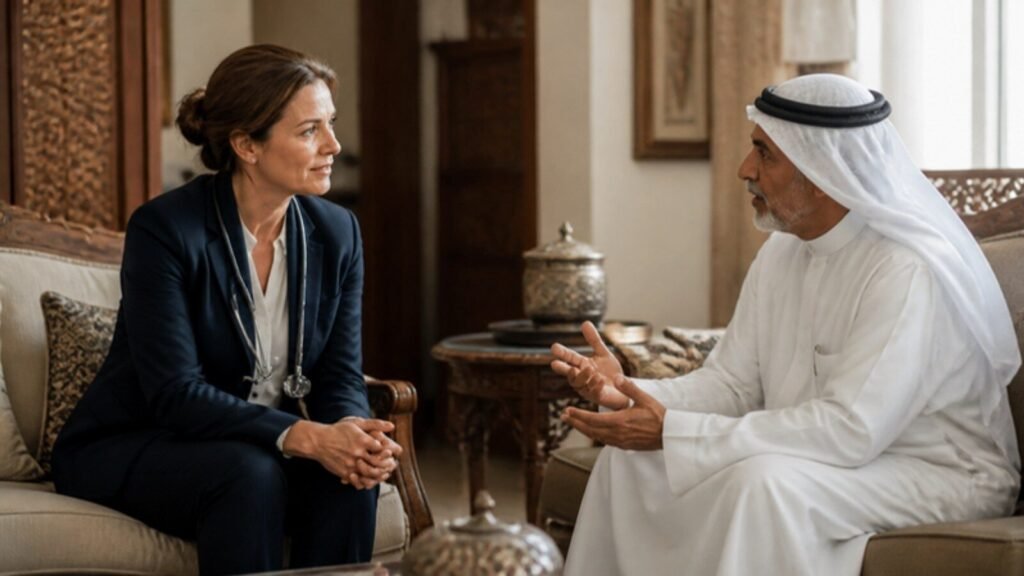
Most clinicians trained in Greece who write to us picture a Gulf hospital: a large department, a familiar rota, a new city. Our appointments are something else entirely. They are permanent, live-in roles with one private family in Saudi Arabia, the UAE or Qatar, where you care for a single household and travel with it wherever it goes.
This article is for nurses, physiotherapists, osteopaths and doctors trained in Greece and working in the ESY (Εθνικό Σύστημα Υγείας, the National Health System) or in private practice, who want a clear, unvarnished picture before they decide. It covers how the work changes, what families require from day one, and what to settle in Greece before you leave.
Medical Staff Talent in one line: Exclusively sourcing UK & European-trained Private & Concierge Physicians, Physiotherapists & Osteopaths, and Private & Maternity Nurses for Private Families across the GCC.
Why a private family is a different decision from a Gulf hospital
A hospital post abroad is still institutional medicine: a department, a line manager, a team you can hand over to at the end of a shift. A private family appointment has none of that structure. There is one household, one set of patients, and a principal or a family office to whom you answer. You are not one clinician among hundreds; you are often the only clinician in the residence.
That changes everything that follows: how you plan care, how you document it, how you rest and how you are judged. Families choose a clinician as much for judgement, discretion and temperament as for clinical skill, and they expect continuity of care over years, not months.
From an ESY ward or clinic to one household
In the ESY, your working day is shaped by volume. The EU’s State of Health in the EU country profile for Greece (2023) describes “a significant shortage of doctors in the public system” and records nurse numbers as “very low, at 3.8 per 1 000 population in 2021” (a figure that counts hospital nurses only). Many clinicians who contact us describe exactly that pressure.
In a private household the arithmetic reverses. Your caseload may be one principal, a child, an elderly parent, or a small number of family members. With that comes a different kind of responsibility:
- Caseload: very small, but continuous. You know every detail of your patients’ history and preferences.
- Clinical autonomy: high. There is no consultant down the corridor; you make and own decisions, and you know when to escalate to the family’s external specialists.
- Documentation: precise, private and kept to the standard you were trained to, but for one household rather than a hospital information system.
ESY vs private family practice in the Gulf
| Aspect | ESY (public hospital or health centre) | Private family in the Gulf |
|---|---|---|
| Caseload | High volume, many patients per shift | One household, a handful of patients |
| Team | Department, colleagues, handover | Often the only clinician; nurses work in pairs |
| Autonomy | Within protocols and a hierarchy | High, with clear escalation to external specialists |
| Documentation | Institutional systems | Private, precise records for one family |
| Hours | Rota and on-call duties | Around the family; availability is part of the role |
| Where you live | Your own home | In the family’s residence, fully free |
| Travel | Rare, personal | Frequent, with the family, as part of the work |
| Confidentiality | Professional duty of confidentiality | Professional duty plus a strict NDA |
Travel with the family
From the day you start, you travel with the family. That typically means summers in Europe, stays at other residences, flights on a private jet and time on a yacht. The family arranges and pays the visas for its international travel. It is worth being clear about one point: travel is work. You are on duty in a new country exactly as you are at home, often with less infrastructure around you, which is why calm judgement matters as much as clinical skill.
Discretion and NDAs
Every appointment comes with a strict non-disclosure agreement. You do not discuss the family, its homes, its travel or its health with anyone, and you do not post about your work. In practice, discretion is what families value most. Clinicians who thrive in these roles are those who find privacy natural rather than restrictive.
What private families require from day one
Three conditions apply to every appointment:
- Start within about six weeks. Families usually need someone soon. Check your notice period now, and if you are in a public post, check the leave rules that apply to you in Greece (see below).
- Total flexibility. Schedules follow the family’s life, not a fixed rota.
- Relocate alone and travel with the family at any time. Every role is live-in and single-status. You can read more in our article on live-in, single-status private clinical appointments.
Leaving the ESY well: what to settle before you go
The points below are factual summaries of official Greek and EU sources. They are not legal, tax or pension advice; rules change and individual circumstances differ, so confirm each point with the body named and with your own adviser.
Unpaid leave and keeping a right to return
Greek civil servants can request unpaid leave (άδεια χωρίς αποδοχές) under article 51 of the Civil Servants’ Code (ν. 3528/2007). For serious private reasons it can total up to five years across your whole career, on application and subject to the opinion of the service council (υπηρεσιακό συμβούλιο), as the Ministry of Interior circular sets out. Leave beyond one month does not count as actual service. Doctors in the ESY have their own statute, so check with your hospital’s HR department whether different rules apply to you. Confirm with your employer’s HR department and your own adviser.
Your registration
Doctors may not practise in Greece before registering with their local medical association, which sits under the Panhellenic Medical Association (ΠΙΣ). Nurses must be registered with the Ένωση Νοσηλευτών Ελλάδος (ΕΝΕ), which describes registration as a legal requirement for practice and asks registered nurses to submit an annual declaration by the end of February. Physiotherapists are represented by the Πανελλήνιος Σύλλογος Φυσικοθεραπευτών (ΠΣΦ). If you want to return to practice in Greece, ask your body before you leave what keeping your registration while abroad involves (fees, declarations, continuing education). Confirm with your medical association, ENE or ΠΣΦ.
Your tax residence in Greece
According to AADE, you are a Greek tax resident if your permanent or main home, habitual abode or centre of vital interests (your personal and economic ties) is in Greece, or if you spend more than 183 days in Greece in any twelve-month period. Ask AADE how these tests, and any double tax treaty, apply to you once you live in the Gulf.
Moving your tax residence is a formal procedure. Under AADE’s transfer procedure, you apply through myAADE by the last working day of the first ten days of March of the year after you leave, and file supporting documents (for example proof of residence abroad and a foreign tax-residence certificate) by the corresponding date in September. Confirm with AADE and your own tax adviser.
Your state pension
There is no bilateral social security agreement between Greece and the UAE, Saudi Arabia or Qatar, and the EU social security coordination rules apply only in the EU, Iceland, Liechtenstein, Norway and Switzerland, with specific rules for the UK. As the European Commission puts it, outside these countries benefits are only exported “when national legislation or a bilateral agreement provides so”. Your Gulf years will not count towards a Greek pension unless you contribute voluntarily.
e-EFKA offers two routes. Greek nationals settled abroad can join the special account for Greeks abroad (ν. 1469/1984), paying both the employee and employer pension shares in one of five contribution classes; e-EFKA confirmed in 2019 that this scheme remains in force. Alternatively, voluntary continuation of insurance under ν. 4387/2016 is open to those with enough prior insurance (broadly five years with recent contributions, applying within a year of leaving compulsory insurance, or ten years at any time). Confirm with e-EFKA and your own adviser which route fits your record.
For the wider financial picture, see our articles on the Gulf cost of living and your net position and wealth preservation for clinicians in the GCC.
Your registration while you are away. You can keep your home registration active through years with one family if you plan it from the start. Read how many years, what counts as practice, and the pros and cons, and check your own situation with the Home Registration Checker.
Practising while you travel. What you may do clinically depends on the country you are in with the family. See what you can and can’t do, country by country, or check a destination with the Where Can I Practise? checker.
The three service lines
Private & Maternity Nurses
Nurses are always placed in pairs: two nurses alternating shifts of 8 or 12 hours, so the family has continuous cover and each nurse has protected rest. Every appointment carries a strict NDA. Experience from ESY paediatric, neonatal, intensive care, maternity and community settings translates well. See private and maternity nurses and our article on private nursing in pairs.
Physiotherapists & Osteopaths
Families look for musculoskeletal, sports, neurological and post-operative rehabilitation experience, delivered daily and adapted to the family’s routine and travel. See physiotherapists and osteopaths.
Private & Concierge Physicians
Families value doctors with broad clinical range: general and internal medicine, emergency medicine, anaesthesia and family medicine, combined with the judgement to coordinate external specialists. See private and concierge physicians.
Realistic salary bands
As market references, gross:
- Private & Concierge Physicians: £218,000 a year gross, with free accommodation and medical insurance covered (professional indemnity insurance is not included).
- Physiotherapists & Osteopaths: from £60,000 a year gross, depending on experience.
- Private & Maternity Nurses: from €5,000 a month.
The salary is agreed directly between the family and the clinician; each clinician should take advice from their own tax adviser on whether the income is taxable in their circumstances.
All roles are permanent, with annual leave. Accommodation in the residence is fully free. Medical insurance is covered; professional indemnity insurance is not included. Flights and travel are always paid for by the family. To compare a package with your current position in euros, use our UK & European vs GCC gross package calculator, which includes Greece in its country selector.
The honest trade-offs
- Availability: being available around the clock and working a six-day week are normal.
- Living where you work: the residence is your home and your workplace.
- Time off: it follows the family’s timetable, not yours.
- Professional isolation: there is no department, no journal club, no colleague to ask in the corridor. You must keep your own skills current.
- Distance from home: you will miss family events in Greece, and you cannot bring a partner or children.
Who it suits and who it does not
It suits clinicians who are experienced, calm, self-directed and comfortable with discretion, with no dependants who need them at home, and who see travel as part of the job rather than a perk. It does not suit someone who wants a fixed rota, a large team, a life of their own in one city, or a clear separation between work and home.
Picture a paediatric nurse in her mid-thirties, ten years in an ESY hospital in Thessaloniki, single, fluent in English, tired of chronic understaffing but still deeply committed to her patients. She wants to care for one child properly, and she is happy to spend summers wherever the family goes. This is a hypothetical profile, but it captures the kind of clinician for whom this work makes sense.
How the introduction works
Medical Staff Talent introduces and verifies clinicians. The engagement is contracted directly between the family and the clinician, and all local arrangements (visa, licensed entity, coordination with local clinics) remain with the family’s own office and advisers.
The process is simple. A family sends us a brief. We match it against clinicians we know, and we speak with you in confidence. We verify your registration, references and clinical history. We introduce a small number of clinicians to the family, who hold video interviews and then make the offer. We are not the employer and we are not a party to the contract. Your CV is never sent to a family without your agreement.
How to apply
Send your CV through our website form. Fluent English is required for every appointment. For a broader overview, see our guide for European-trained clinicians.
Prefer to read in Greek? See our page in Greek.
Frequently asked questions
Can I keep my place in the ESY while I work for a family?
Greek civil servants can request unpaid leave under article 51 of ν. 3528/2007, up to five years in total across a career for serious private reasons, subject to the service council’s opinion. ESY doctors should check with their hospital’s HR department whether their statute differs.
Do I keep my registration in Greece?
Ask your medical association, ENE or ΠΣΦ before you leave what keeping your registration while abroad involves. Nurses registered with ENE submit an annual declaration by the end of February.
Can my partner or children come with me?
No. Every role is live-in and single-status, and you travel with the family at any time.
How much will I be paid?
As market references, gross: Private & Concierge Physicians £218,000 a year gross with free accommodation and medical insurance covered (professional indemnity insurance is not included); Physiotherapists & Osteopaths from £60,000 a year gross, depending on experience; Private & Maternity Nurses from €5,000 a month. The salary is agreed directly between the family and the clinician; each clinician should take advice from their own tax adviser on whether the income is taxable in their circumstances.
How much will I travel?
A lot. You travel with the family from the day you start, often to Europe in summer, by private jet or on a yacht. The family arranges and pays the visas for its international travel, and travel is work.
Is Medical Staff Talent my employer?
No. Medical Staff Talent introduces and verifies clinicians. The engagement is contracted directly between the family and the clinician, and all local arrangements (visa, licensed entity, coordination with local clinics) remain with the family’s own office and advisers.
Apply in confidence
If you are trained in Greece and this way of working appeals to you, send your CV through our website form. We read every application personally and will only speak with you in confidence. If you would like the clinician guide “Private Household Appointments: A Guide for UK & European-Trained Clinicians”, mention it when you apply and I will send it to you personally.
Sources: AADE: tax residence; AADE: transferring tax residency abroad; Ministry of Interior; ΠΙΣ; ΕΝΕ; ΠΣΦ; European Commission; European Commission: State of Health in the EU, Greece 2023.