By David Vilchez, Founder & CEO, Medical Staff Talent
When a private family in Riyadh, Dubai or Doha asks for a physiotherapist or an osteopath, the request rarely begins with a job title. It begins with a person and a goal: a principal who wants to walk without a stick again after a stroke, an elder of the family whose balance has become a worry, a mother recovering after birth, or someone in good health who simply wants to stay strong, mobile and pain-free for as long as possible.
Those goals sit along a spectrum that runs from motor recovery to longevity. This article explains what physiotherapy and osteopathy look like at each point on that spectrum inside a private household, how the work differs from a clinic or ward caseload, and what families look for. It is written for UK & European-trained physiotherapists and osteopaths with solid post-qualification experience who are considering a live-in appointment with a private family in Saudi Arabia, the United Arab Emirates or Qatar.
One patient, one programme, no discharge date
The single biggest difference from clinic or ward work is the caseload. In a household you usually work with one principal, sometimes with two or three members of the same family. There is no waiting list, no fixed number of sessions and, often, no discharge date. The programme continues for as long as it is useful, and in longevity work that can mean indefinitely.
That changes the clinical relationship. You see the full picture: how the principal sleeps, how they move around their home, how travel affects their back, what they actually do between sessions. You can adjust daily rather than weekly. And because you live where the patient lives, small changes are noticed early.
The families we work with require clinicians who relocate alone: every role is live-in and single-status. You live in the residence or on the same estate and travel with the family when they move between homes or abroad. Our article on how families structure a private physiotherapist appointment explains the permanent, live-in appointment in detail.
The spectrum: from motor recovery to longevity
Most household appointments sit somewhere on the spectrum below. Many move along it over time, which is part of what makes the work interesting.
| Focus | Typical situation | What the work involves | Background that helps |
|---|---|---|---|
| Neurological motor recovery | After a stroke or other neurological event | Gait, balance, upper-limb function, daily-living goals, family education | Neurological rehabilitation |
| Post-surgical recovery | After joint replacement or spinal surgery | Graded programme, pain management, return to function and travel | Musculoskeletal and orthopaedic rehabilitation |
| Chronic pain and structural problems | Long-standing back, neck or joint pain | Assessment, manual therapy, movement retraining, self-management | Musculoskeletal physiotherapy or osteopathy |
| Women’s health and post-natal | Recovery after birth | Pelvic health, core rehabilitation, safe return to exercise | Women’s health physiotherapy |
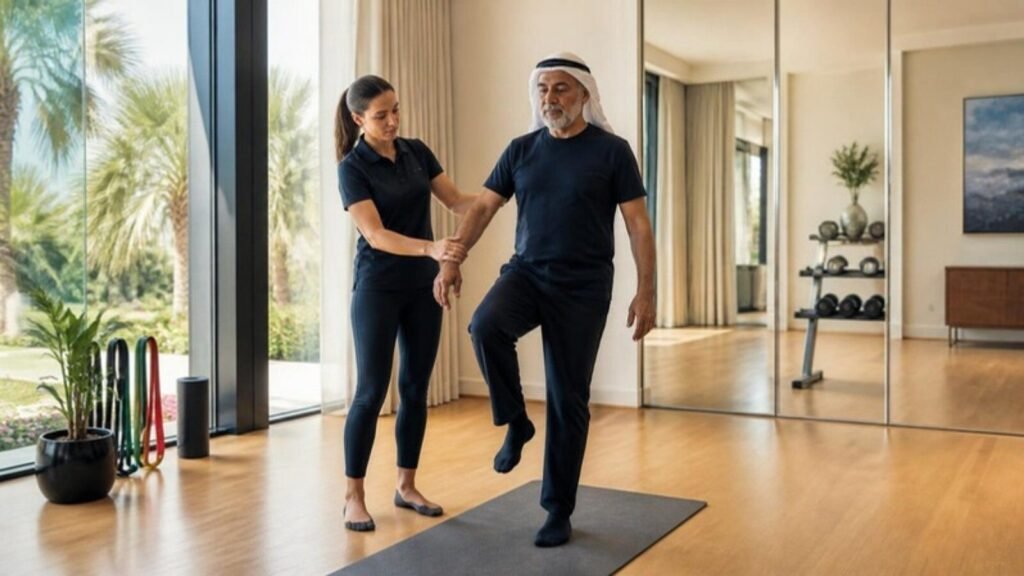
| Falls prevention and healthy ageing | Elder of the family with declining balance | Strength and balance work, home review, confidence | Older people’s rehabilitation |
| Longevity and performance | Principal in good health wanting to stay that way | Strength, mobility, conditioning, recovery, travel management | Sports, performance or exercise rehabilitation |
Motor recovery
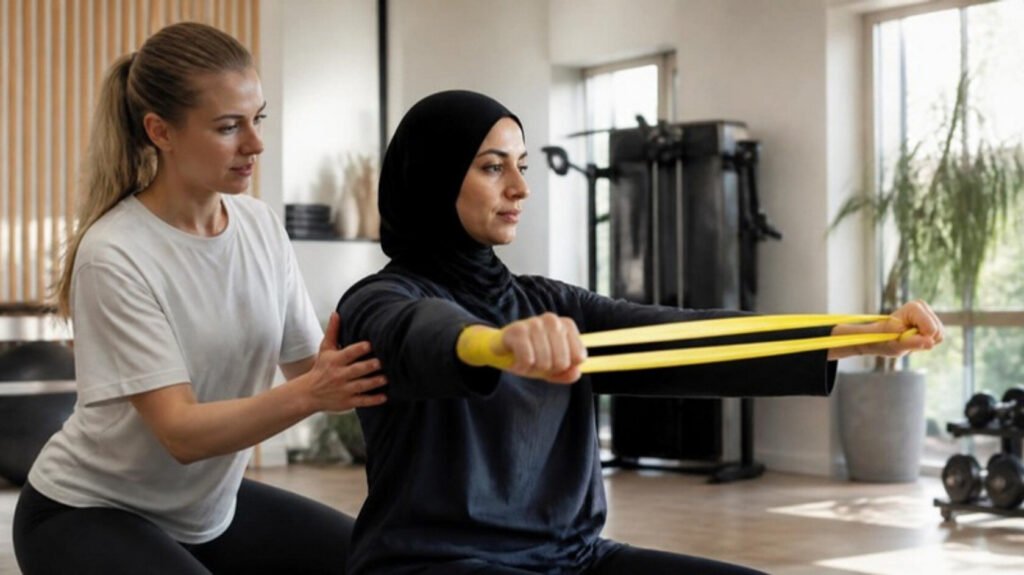
At the recovery end of the spectrum, the work is goal-driven and often intensive. A principal recovering from a stroke may have clear, personal goals: walking unaided in the garden, managing stairs, using a hand well enough to write. The household setting helps. You can practise real tasks in the real environment, involve family members and household staff in safe handling, and adjust the programme daily.
Chronic pain and structural work
Further along, the work is often about long-standing pain, posture and movement, particularly in principals who travel a great deal or spend long hours seated. This is where osteopathy and physiotherapy most often overlap. Families brief the outcome they want, less pain and better movement, and are open to the discipline that delivers it. That is why we place physiotherapists and osteopaths within one practice; our article on why osteopathy sits beside physiotherapy explains how families brief this work.
Longevity
At the other end, the principal is well and wants to stay well. The work becomes a standing programme of strength, mobility, conditioning and recovery, adapted to age, travel and the rest of the family’s medical picture. It requires a different mindset from rehabilitation: there is no endpoint, motivation must be sustained over years, and progress is measured in function maintained rather than function restored. Our article on longevity and elite performance physiotherapy describes how families brief it.
“Families do not hire a modality. They hire the person who will get the principal walking in the garden again, or keep them strong at seventy. The clinicians who do best are those who can move comfortably along that whole spectrum.”
David Vilchez, Founder & CEO, Medical Staff Talent
What a week looks like
No two households are alike, but a typical week includes:
- Scheduled sessions fitted around the principal’s diary, often in a private gym, treatment room or garden within the residence.
- Short daily check-ins on pain, sleep and how the previous session was tolerated.
- Programme planning and notes, including progress against the goals agreed with the principal.
- Coordination with the family’s physician, private nurses and any specialists, so that everyone works to one plan.
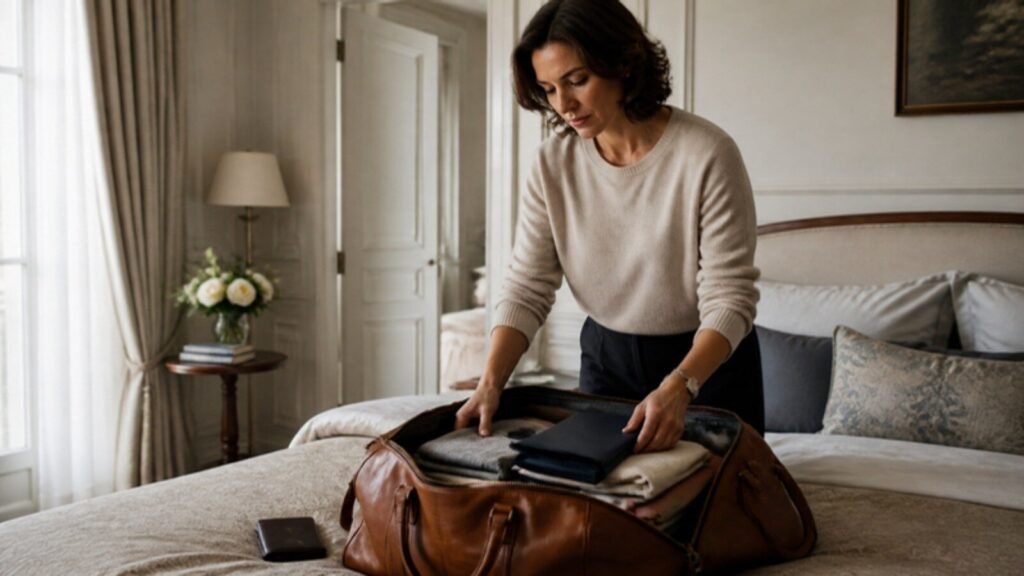
- Travel, during which the programme continues: hotel gyms, yacht decks and holiday homes become treatment spaces.
Working inside a household also means working alongside a household manager, security, drivers and other staff. Clear communication, discretion and respect for the household’s ways of doing things matter as much as clinical skill.
Starting well: the first month
The first weeks of a household appointment set the tone for everything that follows. Clinicians who settle quickly tend to do four things well.
- Build a thorough baseline. A full assessment in the first days, written up clearly, gives you, the principal and the family’s physician a shared reference point. In longevity work in particular, a clear baseline is what later makes progress visible.
- Agree goals in the principal’s own words. “Walk to the end of the garden without stopping” or “play a full round of golf without back pain the next day” are far more motivating than clinical measures alone. Record both.
- Learn the household’s rhythm. Find out when the principal is at their best, which days are taken up by family or business commitments, and when travel is planned. A programme that fits the diary is a programme that happens.
- Establish communication lines early. Agree with the family’s physician how and when you report progress, and with the household manager how sessions are scheduled and changed.
Done well, this first month earns the trust that allows you to adapt the programme freely later, which is exactly the autonomy most clinicians come to these appointments for.
Clinical autonomy and professional standards
In a household there is usually no senior physiotherapist or clinical lead in the same discipline to consult. You plan, deliver and review the programme yourself, and you decide when to involve the family’s physician or recommend a specialist opinion. That autonomy is a strength of the role, and it places professional standards at the centre of your practice.
Your professional standards travel with you. UK physiotherapists work to the HCPC’s standards of conduct, performance and ethics, which include working within the limits of your knowledge and skills, respecting confidentiality and keeping records of your work. The HCPC’s guidance on record keeping stresses that full, clear and accurate records support continuity of care, which matters greatly when you may be the only person documenting a principal’s progress. UK osteopaths work to the General Osteopathic Council’s Osteopathic Practice Standards, built around communication and patient partnership, knowledge and performance, safety and quality, and professionalism. European-trained colleagues work to the equivalent standards of their own professional bodies.
Discretion
You will be close to the principal physically and personally, often several times a day. Discretion is expected without exception: no social media mention of the family or your whereabouts, no photographs, careful handling of devices and notes, and quiet professional conduct in public places and while travelling. Every appointment comes with a strict confidentiality agreement.
What families look for
- Solid post-qualification experience in at least one area on the spectrum, ideally with exposure to others.
- Adaptability. The ability to move from recovery to longevity work as the principal’s needs change.
- Motivational skill. Long programmes depend on sustaining engagement over months or years.
- Clear communication with the principal, the family’s physician and household staff.
- The three conditions. Every candidate we introduce must be able to start within six weeks at most, offer total flexibility, and relocate alone and travel with the family worldwide.
As a market reference, packages for UK & European-trained physiotherapists and osteopaths in these appointments start from £60,000 a year gross, depending on experience, scope and the appointment.
Scope of engagement
Medical Staff Talent introduces and verifies clinicians. The engagement is contracted directly between the family and the clinician, and all local arrangements (visa, licensed entity, coordination with local clinics) remain with the family’s own office and advisers.
We verify registration, references and clinical history and introduce candidates to families in confidence. We are not the employer and not a party to the contract. You can read more on our Physiotherapists and Osteopaths pages.
Frequently asked questions
Do families prefer physiotherapists or osteopaths?
Families usually brief the outcome they want rather than the discipline. Depending on the principal’s needs, either a physiotherapist or an osteopath may be the right appointment, which is why we place both within one practice.
What equipment will I have?
It varies by household. Many residences have a private gym or treatment room, and families are generally willing to provide reasonable equipment that the programme needs. Discuss it during the interview process.
Does the programme continue when the family travels?
Yes. You travel with the family and adapt the programme to wherever they are, whether a holiday home, a hotel or a yacht.
Is longevity work suitable if my background is mainly rehabilitation?
Often yes, provided you have strong exercise prescription skills and can sustain motivation over a long programme. Sports, performance or exercise rehabilitation experience is an advantage.
What is the salary range?
As a market reference, packages for physiotherapists and osteopaths in these appointments start from £60,000 a year gross, depending on experience, scope and the appointment.
Apply in confidence
If you are a UK & European-trained physiotherapist or osteopath who can start within six weeks, offers full flexibility, and is ready to relocate alone and travel with a family worldwide, we would like to hear from you. Applications are handled in strict confidence. Send us your CV.
Most requested by families now: UK & European-trained sports and manual-therapy physiotherapists, with elite-athlete experience a strong advantage. Read the sports physiotherapist role brief, how elite-sport experience is weighed and what the first 90 days look like.
Send your CV in confidence