By David Vilchez, Founder & CEO, Medical Staff Talent
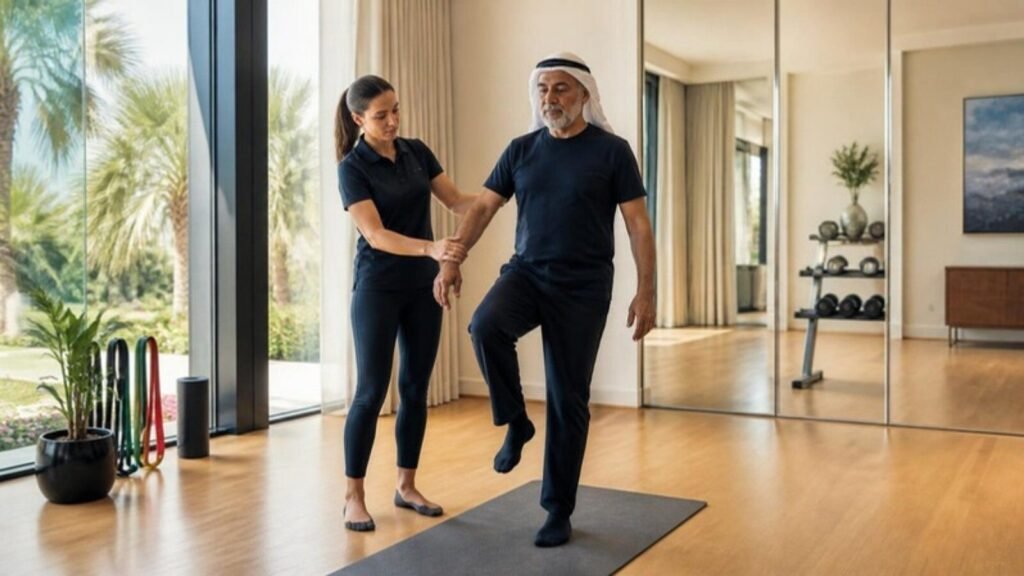
→ Sports Physiotherapist (Manual & Movement Therapy) — Private Family, Dubai
Most clinicians in Portugal who write to us picture a Gulf hospital. Our appointments are something else. Each one is a permanent, live-in role with one private family in Saudi Arabia, the UAE or Qatar. This article is for nurses, physiotherapists, osteopaths and doctors trained in Portugal and working in the Serviço Nacional de Saúde (SNS) or in private practice, who want a clear picture before they decide.
Medical Staff Talent in one line: Exclusively sourcing UK & European-trained Private & Concierge Physicians, Physiotherapists & Osteopaths, and Private & Maternity Nurses for Private Families across the GCC.
Why a private family is a different decision from a Gulf hospital
A hospital move changes your employer and your city. A private family appointment changes the shape of your working life. There is no department, no ward manager and no scheduling office. There is one household, and usually one principal patient or a small number of family members whose health you look after over months and years. Continuity of care is the whole point of the role.
For a fuller overview, see our guide for European-trained clinicians.
From an SNS ward or clinic to one household
In the SNS, your day is defined by volume: patient lists, emergency cover, handovers and the system’s documentation. In a private household the caseload is small and stable, and the depth of the work replaces the breadth. You know your patient’s history in detail and are expected to anticipate rather than react.
Clinical autonomy is greater, and so is responsibility. Decisions that would go through a team in Portugal are often yours to make and explain. Documentation remains essential, but it is precise and private: concise clinical notes kept to a high standard, shared only with those the family authorises.
SNS vs private family practice in the Gulf
| Aspect | SNS (Portugal) | Private family practice in the Gulf |
|---|---|---|
| Caseload | High volume, changing patients | One principal patient or a few family members |
| Team | Multidisciplinary department | You, sometimes a second clinician, and the family’s office |
| Clinical autonomy | Within protocols and hierarchy | High, with direct accountability to the family |
| Documentation | Institutional systems | Concise, confidential clinical records |
| Hours | Shifts, on-call and overtime | Built around the family’s day; availability is the norm |
| Where you live | Your own home | In the family’s residence, accommodation provided |
| Travel | None as part of the job | Frequent, with the family, at short notice |
| Confidentiality | Professional secrecy | Professional secrecy plus a strict NDA |
Travel with the family
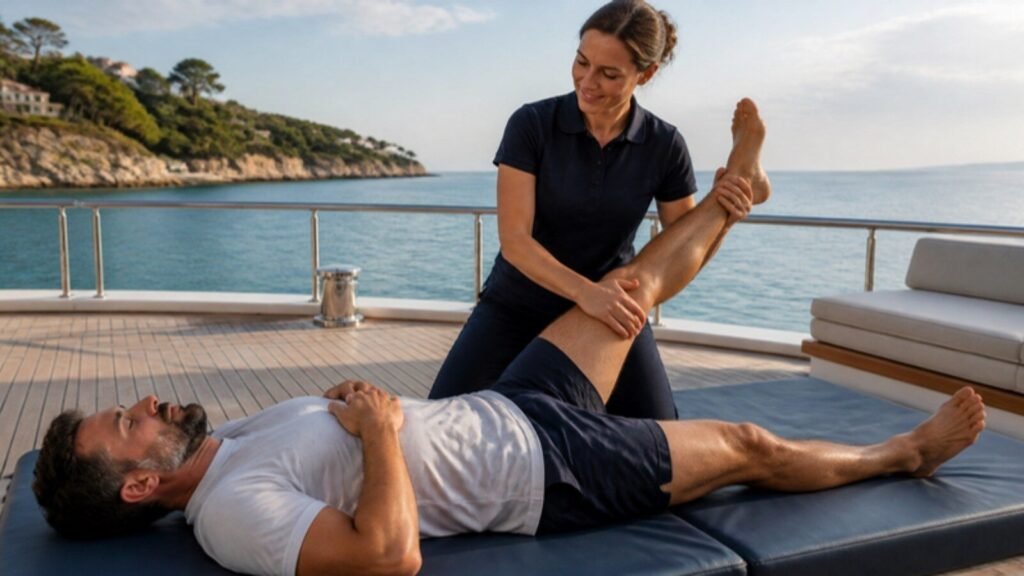
Summers in Europe are common, as are journeys by private jet and time aboard a yacht. The family arranges and pays the visas for international travel. Travel is not a perk on the side: it is work, and you remain on duty throughout.
Discretion and NDAs
Every appointment involves a non-disclosure agreement, and discretion is assessed long before any offer: no social media references to the family, their homes or their travel, and no conversations about them with friends or former colleagues. It is an extension of the professional secrecy you already practise.
What private families require from day one
Three conditions apply to every role, and we raise them in the first conversation:
- Start within about six weeks. Families usually need someone soon. Check your notice period and, if you work in the SNS, the leave rules that apply to your contract (see below) before you apply.
- Total flexibility. The family’s schedule sets yours.
- Relocate alone and travel with the family at any time. Every role is live-in and single-status. Partners and children do not relocate with you. For more on what this means in practice, read what a live-in, single-status appointment involves.
Leaving the SNS well: what to settle before you go
The points below summarise official sources. Rules change, so treat each one as a starting point, not as advice.
Unpaid leave and keeping a right to return
How you are employed in the SNS matters. Under the SNS Statute (Decreto-Lei 52/2022), staff of E.P.E. hospitals work under the Código do Trabalho, while staff of other public services usually hold a contrato de trabalho em funções públicas under the LTFP (Lei 35/2014).
Under both regimes, unpaid leave to work abroad is at the employer’s discretion: the employer may grant it at your request, but it is not an automatic right. Under the LTFP (article 280), leave suspends your employment relationship. According to article 281, after leave of less than one year you are entitled to a post in your service; after a longer leave, you must wait for a vacant post or apply elsewhere. Under the Código do Trabalho (article 317), leave suspends the contract; the period counts for seniority and your rights are restored when it ends. Confirm your position with your employer’s human resources department and your own adviser.
Keeping your professional registration
Doctors. Under the Estatuto da Ordem dos Médicos (article 119), you may ask your regional council to suspend your registration when you intend to stop practising in Portugal for a period. The request must be reasoned and submitted with your cédula profissional and proof that your quotas are paid. While suspended you cannot practise and you pay no quotas; the minimum period is six months unless the council accepts a special justification, and the suspension is lifted at your request.
Nurses. The Estatuto da Ordem dos Enfermeiros (article 11) provides for suspension of registration at the member’s request, with the cédula profissional returned to the Ordem. Registration is also suspended automatically after 12 months or more of unpaid quotas, so do not simply let it lapse.
Physiotherapists. The Ordem dos Fisioterapeutas registration regulation (article 9) allows suspension on request when you intend to stop practising for a period, provided no quotas are owed. Under the Regulamento de Quotas e Taxas, no quotas are due while suspended; a fee applies when the suspension is lifted.
Osteopaths. Osteopathy has no Ordem. Under Lei 71/2013, practice in Portugal requires a cédula profissional issued by the ACSS, which keeps a public register.
Your Portuguese registration does not by itself authorise practice in the Gulf; any local arrangements sit with the family’s own office and advisers. Confirm the current rules with your Ordem or the ACSS before you leave.
Your tax residence in Portugal
Under article 16 of the Código do IRS, you are resident in Portugal if you spend more than 183 days there in any 12-month period, or if you keep a home there in circumstances suggesting you intend to keep it as your habitual residence. When you leave, residence generally ends from your last day of presence, with exceptions for those who spent more than 183 days in Portugal that year.
One rule needs particular care. If you are a Portuguese national and move your tax residence to a jurisdiction on the list of privileged tax regimes in Portaria 150/2004, article 16(6) and (7) of the Código do IRS treats you as still resident in Portugal for the year of the move and the four following years, unless you show that the move is for reasonable grounds. The United Arab Emirates and Qatar are on that list. Saudi Arabia is not. The most recent amendment, Portaria 292/2025/1, removed Hong Kong, Liechtenstein and Uruguay with effect from 1 January 2026, and did not change the position of the UAE or Qatar.
On formalities, article 19 of the Lei Geral Tributária says a change of address has no effect until you report it, and a change of residence status must be reported within 60 days. If you live outside the EU or EEA, you must appoint a fiscal representative resident in Portugal, unless you sign up to the Portal das Finanças electronic notifications or the caixa postal eletrónica. Take advice from your own tax adviser before you move, and confirm your position with the Autoridade Tributária.
Your state pension
The EU social security coordination rules apply only within the EU, the EEA and Switzerland. Outside that area, the European Commission notes that benefits are exported only where national law or a bilateral agreement provides for it. The Segurança Social guide to bilateral instruments lists no agreement with the UAE, Saudi Arabia or Qatar.
To protect your record, Portuguese nationals working abroad who are not covered by an international instrument may join the Seguro Social Voluntário. For this group it covers invalidity, old age and death, at a rate of 26.9% on a contribution base you choose from bands linked to the IAS. You apply in writing to the Instituto da Segurança Social. Confirm current amounts and conditions with the Segurança Social and your own adviser. For the wider financial picture, see wealth preservation for GCC clinicians.
The three service lines
Private & Maternity Nurses. Nurses are always placed in pairs: two nurses alternating shifts of 8 or 12 hours, so care is continuous and each nurse has protected rest, under a strict NDA. Experience in SNS maternity, neonatal, intensive care, palliative care or home care (cuidados continuados) translates well. Read more about how nursing in pairs works.
Physiotherapists & Osteopaths. Musculoskeletal, sports, neurological and post-surgical rehabilitation experience translates well.
Private & Concierge Physicians. Internal medicine, family medicine (Medicina Geral e Familiar), emergency medicine and anaesthesia are especially relevant, with the judgement to coordinate specialists and manage care across countries.
Realistic salary bands
As market references, gross:
- Private & Concierge Physicians: £218,000 a year gross, with free accommodation and medical insurance covered (professional indemnity insurance is not included).
- Physiotherapists & Osteopaths: from £60,000 a year gross, depending on experience.
- Private & Maternity Nurses: from €5,000 a month.
The salary is agreed directly between the family and the clinician; each clinician should take advice from their own tax adviser on whether the income is taxable in their circumstances.
All roles are permanent, with annual leave. Accommodation in the residence is fully free. Medical insurance is covered; professional indemnity insurance is not included. Flights and travel are always paid for by the family. To compare packages in euros, use our UK & European vs GCC gross package calculator, which includes Portugal in its selector, and read our note on cost of living and your net position.
The honest trade-offs
Availability around the clock and a six-day week are normal. You live where you work, so the boundary between duty and rest is set by the household. Time off follows the family’s timetable rather than yours. You will be professionally isolated compared with an SNS team, and far from home for long stretches.
These roles also come at a time when many SNS clinicians feel stretched. The European Observatory’s Portugal: Country Health Profile 2025 reports that overtime in the SNS reached 19.8 million hours in 2022, 51% more than in 2018. A private family role removes that volume but brings a different kind of demand.
Who it suits and who it does not
It suits clinicians who are settled in their practice, comfortable working alone, discreet by temperament and genuinely free to relocate without a partner or children. It does not suit anyone who needs a fixed schedule, a team around them, or the option of bringing their family.
Picture a nurse trained in Portugal with eight years in a neonatal intensive care unit in Lisbon, fluent in English, with no dependants and a wish to step away from SNS overtime. She suspends her registration with the Ordem dos Enfermeiros, takes advice on her tax position, and joins a colleague as one of a pair caring for a newborn, travelling with the family between the Gulf and Europe. This is a hypothetical profile.
How the introduction works
Medical Staff Talent introduces and verifies clinicians. The engagement is contracted directly between the family and the clinician, and all local arrangements (visa, licensed entity, coordination with local clinics) remain with the family’s own office and advisers.
A family sends us a brief. We match it against clinicians who have applied, speak with suitable candidates in confidence, and verify registration, references and clinical history. We introduce a small number of clinicians to the family, who hold video interviews and make the offer directly. We are not the employer and we are not a party to the contract. Your CV is never sent to a family without your agreement.
How to apply
Send your CV through the form on our website. Fluent English is required for every role. Prefer to read in Portuguese? See our page in Portuguese.
Frequently asked questions
Can I keep my place in the SNS while I work for a family?
Only if your employer grants unpaid leave, which is discretionary under both the LTFP and the Código do Trabalho. Under the LTFP, a post is guaranteed only after leave of less than one year. Confirm with your employer’s human resources department.
Do I keep my Ordem registration while I am abroad?
The Ordem dos Médicos, the Ordem dos Enfermeiros and the Ordem dos Fisioterapeutas all allow suspension of registration at your request, and quotas are not due while it is suspended at the Ordem dos Médicos and the Ordem dos Fisioterapeutas. Osteopaths hold a cédula issued by the ACSS. Confirm the current rules with your body before you leave.
Can my partner or children come with me?
No. Every role is live-in and single-status, and you travel with the family at any time.
How much will I be paid?
As market references, gross: Private and Concierge Physicians £218,000 a year gross with free accommodation and medical insurance covered (professional indemnity insurance is not included); Physiotherapists and Osteopaths from £60,000 a year gross, depending on experience; Private and Maternity Nurses from €5,000 a month. The salary is agreed directly between the family and the clinician.
Who arranges travel and visas?
The family arranges and pays the visas for international travel. Travel is part of the work, and you remain on duty throughout.
Is Medical Staff Talent my employer?
No. Medical Staff Talent introduces and verifies clinicians. The engagement is contracted directly between the family and the clinician, and all local arrangements remain with the family’s own office and advisers.
Apply in confidence
If you are trained in Portugal and this way of working fits your life, send your CV through the form on our website. We will speak with you in confidence before anything goes further. On request, I can also send you our guide, Private Household Appointments: A Guide for UK & European-Trained Clinicians.