By David Vilchez, Founder & CEO, Medical Staff Talent
→ Sports Physiotherapist (Manual & Movement Therapy) — Private Family, Dubai
Most UK physiotherapists who search for sports physiotherapy jobs abroad picture a club, a clinic or a performance centre in a new city: the same caseload, a different climate. The roles we introduce are different. A private family in Saudi Arabia, the United Arab Emirates or Qatar asks for one sports and manual-therapy physiotherapist to look after the household, live with them and travel with them. This guide is written specifically for HCPC-registered physiotherapists with a sports or musculoskeletal background, and explains what families value in UK training, what the role involves, the package, and what to think about before you leave.
If you are weighing up a move from the NHS in any clinical profession, our broader article on leaving the NHS for the Gulf covers the wider change. For the role itself, start with our guide to sports physiotherapist jobs with private families in the Gulf.
Why private families ask for UK-trained sports physiotherapists
Families and their offices do not choose a passport; they choose a training and a register they can check. UK physiotherapy is a degree-level profession, “physiotherapist” and “physical therapist” are protected titles, and every practising physiotherapist must be registered with the Health and Care Professions Council (HCPC), whose register anyone can search. Many are also members of the Chartered Society of Physiotherapy (CSP), the profession’s professional body. That combination gives a family’s adviser something concrete to verify.
The typical UK sports physiotherapy career also translates well. Many clinicians combine NHS musculoskeletal outpatients, where they learn to assess quickly and reason clearly across a wide caseload, with weekends at a football, rugby or cricket club, a private sports clinic or a postgraduate qualification in sports and exercise medicine. Families notice three things in that background: confident hands-on skills, exercise-based rehabilitation that patients actually follow, and the habit of working within a multidisciplinary team. None of this is unique to the UK, which is why we recruit UK & European-trained physiotherapists alike, but it is a recognisable profile.
What the role actually is
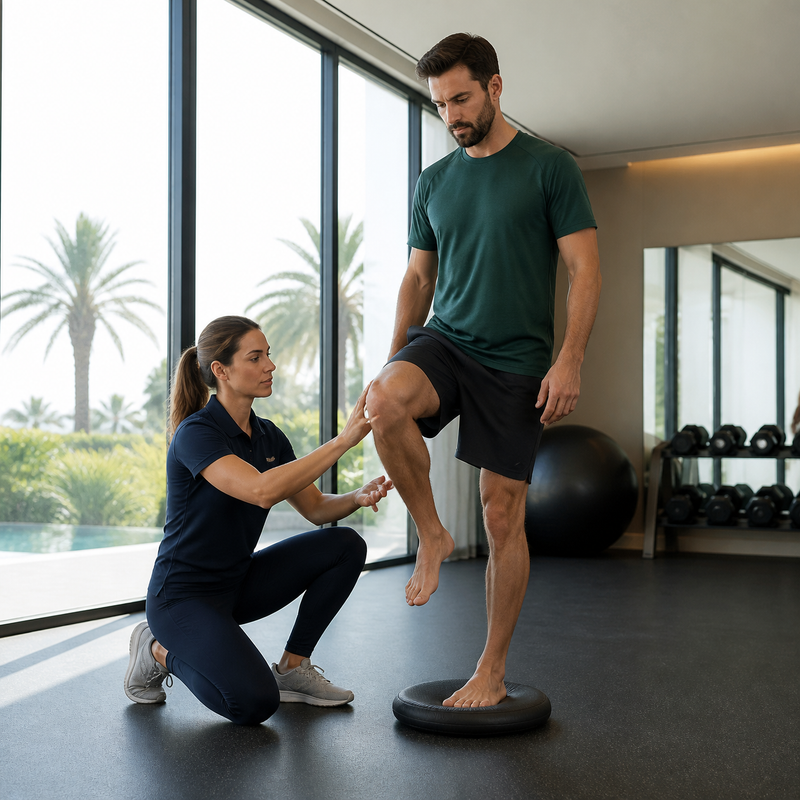
You work for one household rather than a clinic list. Your patients are the family: perhaps a principal in their fifties who plays padel several evenings a week, a teenager in a tennis or riding programme, a parent recovering from shoulder surgery, a grandparent whose balance has started to worry everyone. Sessions take place in a home gym, a treatment room in the residence, a hotel suite or on a yacht, and you work alongside the family’s physician and personal trainer.
Every role is permanent, live-in and single-status, with annual leave. You relocate alone, live in your own private accommodation provided by the family and, from the start, travel with them continuously across several countries: the Gulf, Europe in summer, perhaps the Alps in winter. It suits physiotherapists who want depth with a small group of people rather than volume, and who are genuinely comfortable with a life on the move.
The skills families ask for
The briefs we receive describe a hands-on sports and manual-therapy profile:
- Soft tissue release, assisted stretching and joint mobilisation
- Active mobility work and corrective exercise
- Neuromuscular and movement control, proprioception and balance
- Movement analysis and biomechanics
- Injury prevention, load management and return to sport
- Breathing and core work
Experience with elite athletes, professional teams or high-profile clients is a strong advantage. If you have worked in a Premier League or EFL academy, Premiership rugby, county cricket or a national governing body programme, make it clear in your CV. If you come from NHS MSK or first contact practitioner work with a strong private sports caseload alongside it, that counts too. Our article on moving from club or national-team physiotherapist to private family explains which skills transfer most directly.
A typical case (hypothetical)
Imagine a physiotherapist who trained in the UK, spent four years in NHS musculoskeletal outpatients and three seasons with a semi-professional rugby club, and completed a postgraduate module in sports rehabilitation. A family’s brief asks for someone to keep a principal golfing without back pain, guide a teenager’s return to tennis after an ankle sprain and run a short daily balance programme for an older relative. In the first weeks, the physiotherapist screens each family member and agrees a weekly rhythm with the household manager. By the third month the work travels: mobility before a long flight, recovery work in a resort, a short note to the family’s physician when something changes. The clinical skills are familiar; the continuity is new.
The package
| Element | What families offer |
|---|---|
| Salary | From £60,000 a year gross, depending on experience |
| Accommodation | Private accommodation provided free of charge |
| Flights and travel | Paid by the family |
| Medical insurance | Covered |
| Professional indemnity insurance | Not covered: arranged by the clinician |
| Contract | Permanent, live-in, single-status, with annual leave |
The salary is agreed directly between the family and the clinician; each clinician should take advice from their own tax adviser on whether the income is taxable in their circumstances. For context on how this compares with other settings, see our physiotherapy salary benchmarks in the Gulf.
Practical points for UK physiotherapists
Keep your HCPC registration and CPD live
Your current HCPC registration is the first thing we verify, and families’ advisers will want to see it. It also keeps the door open for a return to UK practice later. Keep your contact details current with the HCPC, renew on time, and keep a CPD record you could submit if selected for audit, in line with the HCPC’s CPD standards and its standards of conduct, performance and ethics. Many physiotherapists also keep their CSP membership for professional networks and learning resources. Our guide to keeping your clinical skills current while travelling has practical ideas.
Think about coming back
Most physiotherapists treat a private family role as a chapter, not an exit. Keeping registration, CPD and professional contacts alive makes a later return to the NHS, a club or private practice much easier. A well-documented period of autonomous, one-to-one sports work with a varied household is a distinctive line on a CV.
Relocating alone
You will have your own private accommodation within the residence or close by, and your privacy and rest hours matter as much as the family’s programme. Our article on relocating alone to the Gulf as a physiotherapist covers safety, privacy, accommodation and rest in detail.
How it works with Medical Staff Talent
You send your CV through our form. I read every CV personally, and if your background fits a current brief we arrange a confidential conversation. Before any introduction we verify your qualification, your HCPC registration and your references at source. Only then, and only with your agreement, are you introduced to the family.
Medical Staff Talent introduces and verifies clinicians. The engagement is contracted directly between the family and the clinician, and all local arrangements (visa, licensed entity, coordination with local clinics) remain with the family’s own office and advisers. Our physiotherapists page explains how we work, and the current opening is our sports physiotherapist job with a private family.
Frequently asked questions
Do I need to be British to apply?
No. What counts is that you trained in the UK or elsewhere in Europe and hold current registration in that country, such as the HCPC in the UK. Nationality is never a requirement.
Should I keep my HCPC registration while I am abroad?
Yes, in most cases. We verify it before any introduction, families’ advisers expect it to be current, and it keeps a return to UK practice straightforward. Keep your details and CPD record up to date and renew on time.
Do I need experience in professional sport?
It is a strong advantage but not the only route. Solid manual therapy, exercise prescription and clear clinical judgement, from NHS MSK work or private sports practice, are essential.
What is the salary?
From £60,000 a year gross, depending on experience, with free private accommodation, flights and travel paid and medical insurance covered. Professional indemnity insurance is not covered.
Is the role permanent?
Yes. It is permanent and live-in, with annual leave, and from the start you travel continuously with the family across several countries.
Send your CV in confidence
If you are a UK-trained sports or manual-therapy physiotherapist and this way of working appeals to you, send your CV in confidence. Every CV is read personally and handled with discretion.
Send your CV in confidence