
By David Vilchez, Founder & CEO, Medical Staff Talent
→ Sports Physiotherapist (Manual & Movement Therapy) — Private Family, Dubai
In Belgium the profession has its own name: kinesitherapy, kinesitherapie in Dutch and kinésithérapie in French. Belgian kinesitherapists train for several years to master’s level, many work in busy private practices from early in their careers, and a large number have treated cyclists, footballers, hockey players and, increasingly, padel players. They are used to independent practice, direct contact with patients and a strong emphasis on manual therapy. That profile matches what private families in Saudi Arabia, the United Arab Emirates and Qatar describe when they ask for a sports physiotherapist.
This guide explains the role, how Belgian training translates, what changes in daily practice and what the package looks like. For the wider context, read our pillar guide to sports physiotherapist jobs with private families in the Gulf. Our pages are also available in Dutch and French.
What the work involves
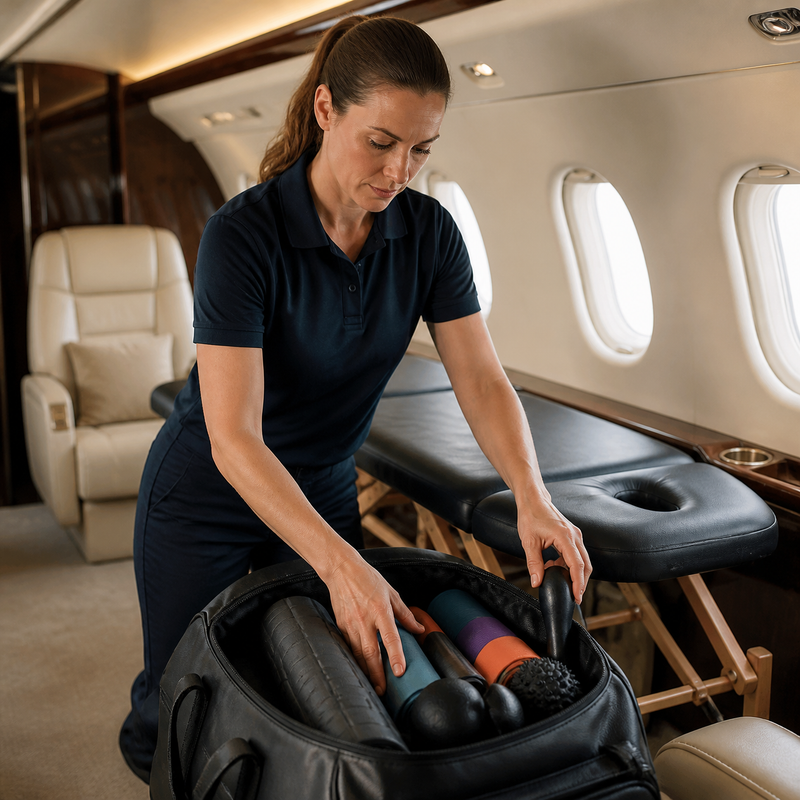
You are the household’s physiotherapist. Your patients are the members of one family: a principal who rides a road bike or plays padel most evenings, children with academy or competition ambitions, a parent after shoulder surgery, an older relative who needs regular mobility work. The work is hands-on and programme-based, from soft tissue release and joint mobilisation to corrective exercise, movement analysis and injury prevention. It is permanent, live-in and single-status. You relocate alone, live in private accommodation provided by the family and travel with them continuously across several countries, with annual leave.
How Belgian training translates
To practise in Belgium a kinesitherapist needs a recognised degree and authorisation from the federal health authorities, and those working within the national health insurance system also hold an INAMI/RIZIV number. For a family office, that layered recognition is reassuring. What counts is where you trained and that your registration there is current, not your nationality.
- Cycling. Belgium’s cycling culture produces physiotherapists who understand bike fit, lower back and knee overload, and recovery after long efforts. Many Gulf principals ride seriously.
- Hockey, football and padel. Hamstring, ankle and shoulder problems, rotational sports and rapid return-to-play decisions are part of everyday Belgian practice.
- Independent practice. Kinesitherapists often run their own diary and see patients without a team around them, which is exactly the self-reliance a household needs.
- Languages. Dutch, French and often German alongside English are an asset with European staff and when the family travels.
A typical case (hypothetical)
Picture a kinesitherapist who trained in Ghent, worked eight years in a group practice with many cyclists and spent two seasons with a hockey club. The family’s brief asks for someone to keep a principal riding long distances without back pain, support a teenage son through a growth-related knee problem and help a parent regain shoulder movement after surgery. The physiotherapist assesses each person in the first week, agrees a timetable with the household manager and adapts the bike set-up in the residence gym. When the family travels to Europe for the summer, the programmes go with them: hotel-room mobility sessions, a padel warm-up routine, a call with the surgeon’s team to review progress. The clinical work is familiar; the continuity is new.
What changes day to day
In a private practice you see many patients briefly. In a household you see a few patients often, and you see the results. Sessions are scheduled around the family’s day, so early starts before a flight and evenings after a match are normal, balanced by quiet stretches and protected rest. You travel light, keep clear notes for the family’s doctor and work alongside a personal trainer or coach where there is one. The skill families value most is judgement: knowing when to progress, when to rest and when to refer.
The package
| Element | What families offer |
|---|---|
| Salary | From £60,000 a year gross, depending on experience |
| Accommodation | Private accommodation provided free of charge |
| Flights and travel | Paid by the family |
| Medical insurance | Covered |
| Professional indemnity insurance | Not included: arranged by the clinician |
| Contract | Permanent, live-in, single-status, with annual leave |
The salary is agreed directly between the family and the clinician; each clinician should take advice from their own tax adviser on whether the income is taxable in their circumstances.
Requirements
- A physiotherapy or kinesitherapy qualification obtained in the UK or in Europe, with current registration in the country where you trained. What counts is where you trained, not your nationality.
- Strong manual therapy and exercise skills; experience with elite athletes, professional teams or high-profile clients is a major advantage.
- Availability to start within about six weeks and total flexibility.
- Willingness to live with the family and travel with them continuously across several countries, relocating alone.
- Fluent English and complete discretion.
Our role
Medical Staff Talent introduces and verifies clinicians. The engagement is contracted directly between the family and the clinician, and all local arrangements (visa, licensed entity, coordination with local clinics) remain with the family’s own office and advisers.
Further reading
Read padel, tennis, golf and riding: sport-specific physiotherapy for active private families, manual therapy jobs abroad and your first 90 days in a live-in role. The current opening is our sports physiotherapist job with a private family, and our physiotherapists page explains how we work.
Frequently asked questions
I am a kinesitherapist. Is that the same as a physiotherapist?
Yes. Kinesitherapy is the Belgian name for physiotherapy, and families’ offices understand the equivalence. Use both terms in your CV.
Do I need Belgian nationality?
No. What counts is that you trained in Belgium, the UK or elsewhere in Europe and hold current registration in that country.
Is cycling experience useful?
Very. Many principals ride seriously, and bike fit, back and knee overload management and recovery after long rides are frequent requests.
What is the salary?
From £60,000 a year gross, depending on experience, with free private accommodation, flights and travel paid and medical insurance covered. Professional indemnity insurance is not included.
Can my family relocate with me?
No. Every role is single-status: the clinician relocates alone and lives in private accommodation provided by the family.
Send your CV in confidence
If you trained in Belgium and would like to be considered, send your CV in confidence. A CV in English is ideal; every CV is read personally.
Send your CV in confidence