By David Vilchez, Founder & CEO, Medical Staff Talent
→ Sports Physiotherapist (Manual & Movement Therapy) — Private Family, Dubai
Many principals in private families across Saudi Arabia, the United Arab Emirates and Qatar live at a pace that leaves little room for their own bodies. Long meetings, long flights, short nights and a full social calendar add up to stiff hips, a tight upper back and a neck that never quite relaxes. When a family brings a sports physiotherapist into the household, one of the most valued things that clinician can offer is not dramatic: a short, well-designed assisted stretching and mobility programme that fits into the gaps of a demanding day and keeps the principal moving freely, year after year.
This article explains what assisted stretching and mobility work looks like in a private family setting, how a physiotherapist designs a programme for someone with very little time, and what families look for in the clinician who leads it. For the wider picture of the role, see our guide to sports physiotherapist jobs with private families in the Gulf.
Why assisted stretching matters in a private household
In a clinic, mobility work is often the last ten minutes of a session, or a printed sheet of exercises the patient may or may not do at home. In a household, the physiotherapist is there every day. That changes everything. Stretching and mobility stop being homework and become a routine the clinician delivers, adjusts and protects.
For a busy principal, the appeal is simple. Assisted work asks very little of them: they lie down or sit, and the physiotherapist does the thinking, positioning and pacing. It feels restorative rather than like another task on the list. Done well, it also supports the things the principal cares about most: comfortable travel, a good round of golf or game of padel, playing with children or grandchildren without discomfort, and sleeping better after a long day.
For the physiotherapist, it is also one of the clearest ways to build trust. A principal who feels looser and calmer after fifteen minutes on the mat on the first morning is far more likely to accept the strength and movement work that genuinely changes things over months.
What an assisted stretching and mobility programme includes
There is no single recipe, and families notice quickly when a clinician is running the same routine on everyone. A good programme draws on several tools, chosen for the person in front of you:
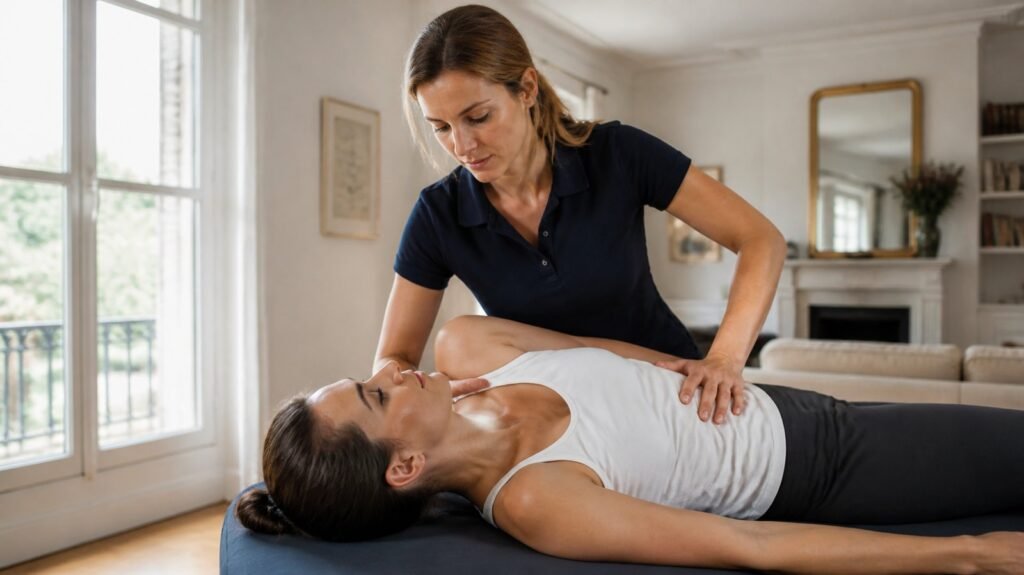
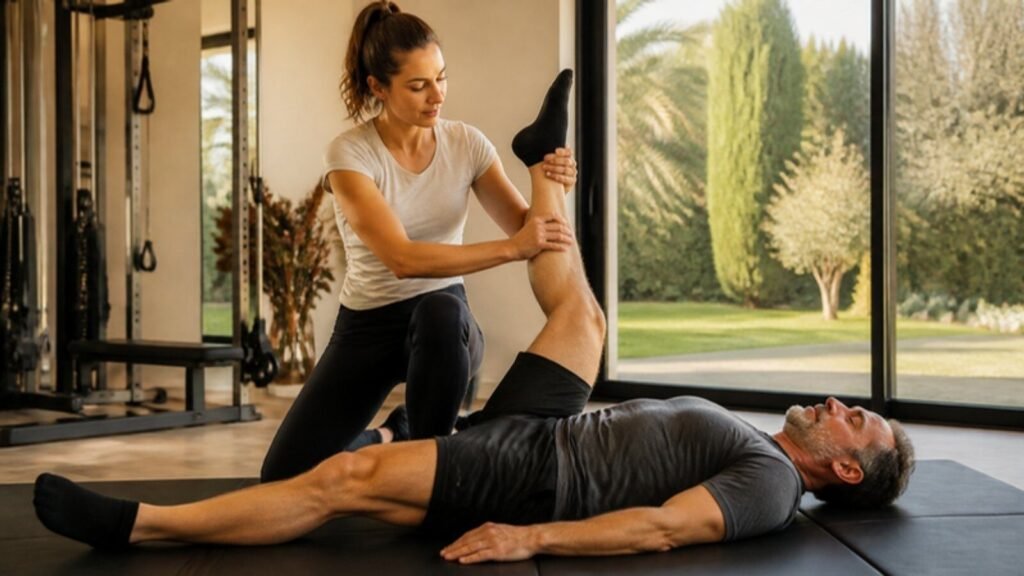
- Passive and active-assisted stretching for the hips, hamstrings, calves, chest and thoracic spine, the areas that tighten most with sitting and flying.
- Proprioceptive neuromuscular facilitation (PNF) techniques, such as contract-relax, to gain range comfortably and with the principal’s active involvement.
- Joint mobilisation and soft tissue work where assessment shows a stiff segment or a sensitive area that limits movement, drawing on your manual therapy skills.
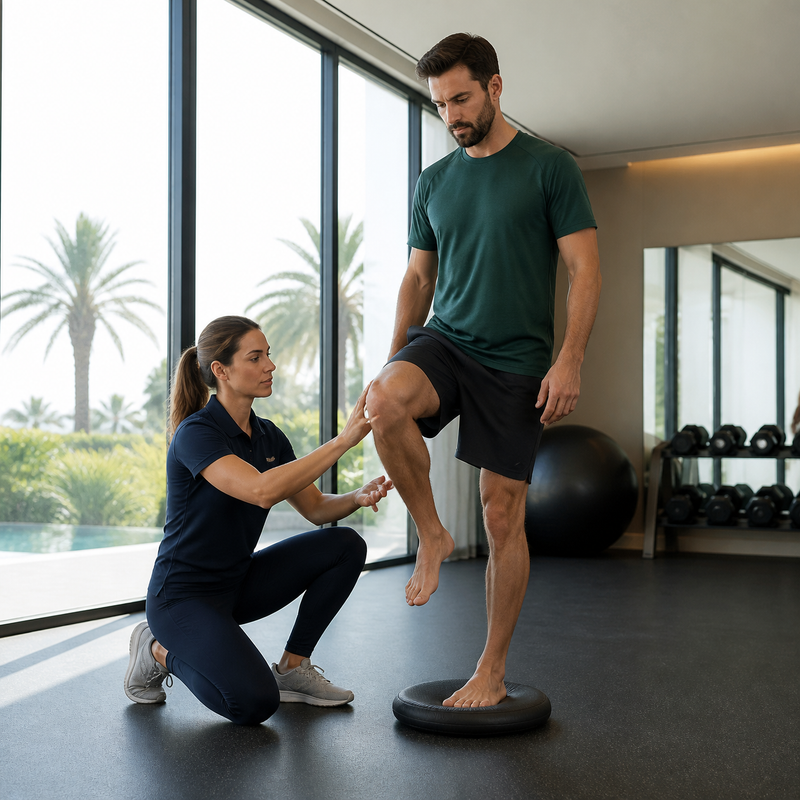
- Active mobility drills that the principal can do alone in a hotel room or on a plane: controlled joint circles, thoracic openers, hip flow sequences.
- Breathing and down-regulation at the end of a session, so that mobility work also becomes a moment of calm in a crowded day.
- Strength at end range, because flexibility without control rarely lasts. Gaining range is the start; owning it is the goal.
If you want to see how these hands-on skills fit into the wider brief, our article on manual therapy jobs abroad and the hands-on skills private families ask for covers soft tissue release, joint mobilisation and movement control in more depth.
Designing a programme for someone with no time
The defining constraint is time. A principal’s diary is set by business, family and travel, and the physiotherapist works around it rather than the other way round. That calls for a different way of planning.
Start with a thorough assessment, once
A careful initial assessment is worth the time it takes: posture, movement patterns, joint ranges, past injuries, sports, sleep, travel pattern and what the principal actually wants. Everything else follows from it. Because you will see the same person for months, you can repeat key measures at regular intervals and show progress in a simple, discreet way.
Think in short blocks, not long sessions
Ten focused minutes before the first meeting often achieve more than an hour that keeps being postponed. Many physiotherapists in this setting build a menu of short sessions they can offer depending on the day, and keep a longer assisted session for evenings or quieter days.
Prioritise ruthlessly
With limited time, choose the two or three areas that matter most for this person, usually the hips, thoracic spine and neck for someone who sits and flies a great deal, and leave the rest for later. A principal who feels a clear change in one area stays engaged.
Make it portable
The family travels continuously, so the programme must work in a residence, a hotel suite, on a yacht deck or in a private cabin. A mat, a strap and a few minutes are often all you need. For more on keeping work going on the move, see balance and proprioception training, from elite athletes to older family members, which uses the same portable approach.
A typical week of mobility sessions
The table below is illustrative, not a prescription. It shows the kind of session menu a physiotherapist might build for a busy principal; the content and timing always depend on the assessment and on the family’s calendar.
| Session | When it fits | Focus | Typical format |
|---|---|---|---|
| Morning mobility | Before the first meeting | Spine, hips, breathing | Short guided routine, partly assisted |
| Assisted stretching | Evening or quieter days | Hips, hamstrings, chest, thoracic spine | Longer hands-on session on a mat or treatment table |
| Post-flight reset | After arrival | Calves, hips, neck, circulation | Gentle assisted stretching and active drills |
| Pre-sport preparation | Before golf, padel, tennis or riding | Sport-specific ranges and activation | Dynamic mobility and warm-up |
| Self-led routine | Days the physiotherapist cannot be present | Maintaining gains | Simple sequence the principal knows by heart |
A typical case: the principal who travels every week
Picture a principal in his fifties who flies most weeks, plays golf when the diary allows and complains of a stiff lower back and tight hips after every long journey. The physiotherapist begins with a full assessment, then agrees two things with him: a ten-minute morning routine, part assisted and part self-led, and a longer assisted stretching session on the evening of each arrival.
Over the first weeks, the clinician adds hip and trunk strength at end range, adjusts the post-flight session to his travel pattern and builds a short pre-golf preparation. The principal is never asked for more than he can give on a given day. By the time the family moves on to its next destination, the routine travels with them, and the physiotherapist reviews and progresses it as the season changes. This is a hypothetical example, but it reflects the kind of steady, practical work families value.
Working with the household
Programmes for principals succeed or fail on small practical details, and most of them involve other people.
- The diary. Build a good relationship with whoever manages the principal’s schedule. Knowing that a meeting has moved or that a flight leaves early lets you adapt instead of losing the session.
- The space. Agree on a quiet room or a shaded terrace where you can work, with a treatment table or mat ready. Consistency helps the principal switch off.
- Other professionals. If the family already works with a personal trainer or coach, coordinate so that mobility, strength and conditioning support each other rather than compete.
- Discretion. Sessions are private. What you observe and what the principal shares stays between you, in line with the strict confidentiality expected in every private household.
What families look for in the physiotherapist
Families rarely ask for “a stretching specialist”. They ask for a sports physiotherapist who can assess carefully, treat with skilled hands, build a programme the principal will actually follow, and adapt it to an unpredictable life. In practice, that means:
- Solid manual therapy skills and confident, comfortable handling during assisted work.
- Good exercise prescription, so that new range is backed by strength and control.
- Clear, calm communication: explaining briefly why each part matters, without jargon.
- Flexibility to work early mornings, late evenings or around travel when the day demands it.
- Experience with elite athletes, professional teams or high-profile clients, which is a major advantage because it shows you can deliver results under pressure and with discretion.
If you have worked in elite sport, our article on sports physiotherapists with elite athlete experience explains how that background translates to a private family. For a sense of how prevention fits alongside mobility work, see injury prevention for active private families.
Requirements and conditions of the role
The roles we are currently sourcing for sports and manual physiotherapists share the same core requirements and conditions:
- A physiotherapy degree from the UK, Europe, Australia, New Zealand, the United States or Canada, with current registration in the country of training. What counts is where you trained, not your nationality.
- Strong manual therapy, exercise prescription and mobility skills; experience with elite athletes, professional teams or high-profile clients is a major advantage.
- Availability to start within about six weeks and total flexibility.
- Willingness to live with the family and travel with them continuously across several countries. The role is live-in and single-status: you relocate alone, and partners or children do not relocate with you.
- Fluent English and complete discretion.
The package:
- Salary from £60,000 a year gross, depending on experience.
- Free private accommodation.
- Flights and travel paid by the family.
- Medical insurance covered. Professional indemnity insurance is not included.
- A permanent position with annual leave.
The salary is agreed directly between the family and the clinician; each clinician should take advice from their own tax adviser on whether the income is taxable in their circumstances.
Medical Staff Talent introduces and verifies clinicians. The engagement is contracted directly between the family and the clinician, and all local arrangements (visa, licensed entity, coordination with local clinics) remain with the family’s own office and advisers.
The current opening is our sports physiotherapist job with a private family. You can read about the first months in the role in your first 90 days in a live-in physiotherapist role, and see all our physiotherapy roles on the physiotherapists page.
Frequently asked questions
Is assisted stretching a large part of the role?
It is often a regular part of the week, especially for principals who travel a great deal, but it sits within a wider sports physiotherapy role that includes assessment, manual therapy, exercise prescription and injury prevention.
Do I need a specific stretching qualification?
No separate qualification is required. Families look for a qualified physiotherapist with strong manual therapy and exercise prescription skills. Courses in techniques such as PNF can strengthen your CV.
How long are the sessions?
It depends on the principal’s day. Many physiotherapists combine short morning routines with longer assisted sessions in the evening or on quieter days, and adapt around travel.
Who can apply?
Physiotherapists with a degree from the UK, Europe, Australia, New Zealand, the United States or Canada and current registration in the country of training. What counts is where you trained, not your nationality.
What is the salary?
From £60,000 a year gross, depending on experience, with free private accommodation, flights and travel paid and medical insurance covered. Professional indemnity insurance is not included.
Is the role permanent?
Yes. It is a permanent, live-in position with annual leave, and you travel continuously with the family across several countries.
Send your CV in confidence
If designing mobility and assisted stretching programmes for one family, and travelling with them, appeals to you, send your CV in confidence. Every CV is read personally.
Send your CV in confidence